 MineArchive
Powered Roof Supports
| Also known as | Self-advancing supports, Hydraulic chock, Shield support, Walking chock |
|---|---|
| Category | Structures & Machinery |
Hydraulic jacks, set side by side in a line along a longwall face, that hold the roof up over the men and machinery and then walk themselves forward as the face advances. They are called chocks or shields, and they replaced the wooden props and bars a timberman set and drew by hand.
Historical usage
A chock was originally a piece of timber used to support the face; the word carried over to the hydraulic machine that replaced it. The British introduced powered, self-advancing supports in the late 1950s. The Dowty Group had gone into mining in the mid-1940s, when Sir George Dowty began looking for industrial uses for the hydraulic technology he had mastered in aircraft undercarriages; Dowty Mining Equipment was formed in 1954, opened a factory at Ashchurch near Tewkesbury in 1956, and grew from hydraulic pit props into complete longwall support systems and the control gear to run them, sharing a Queen's Award for Technical Innovation in 1967.
How it worked
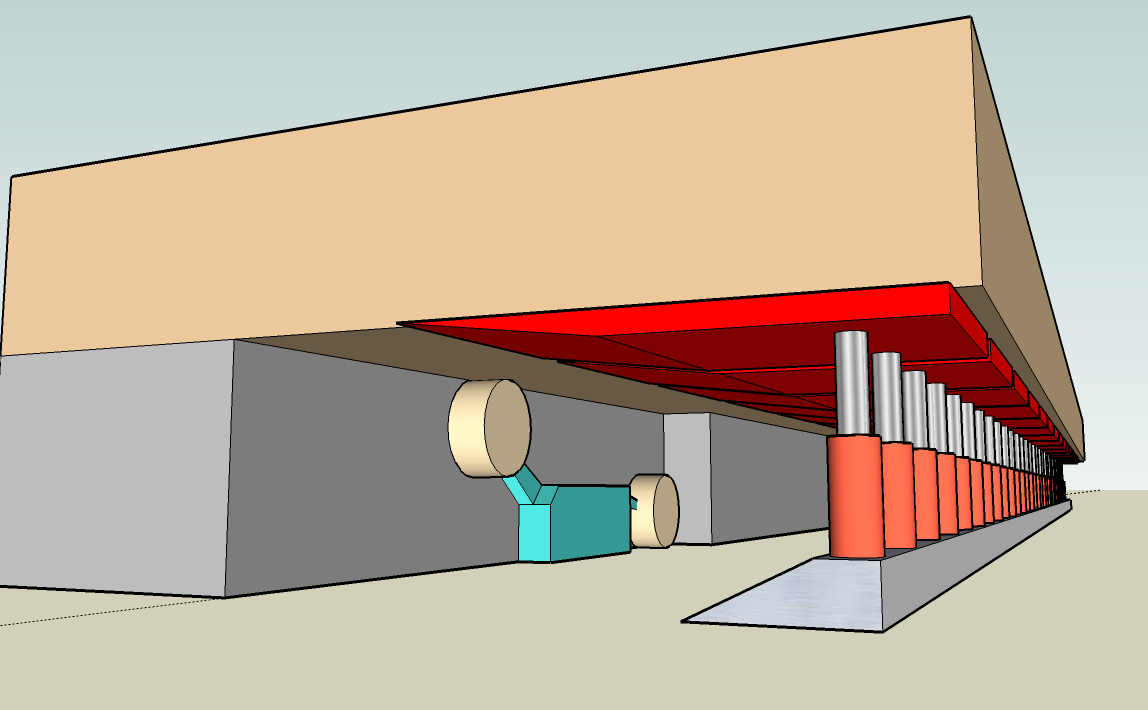
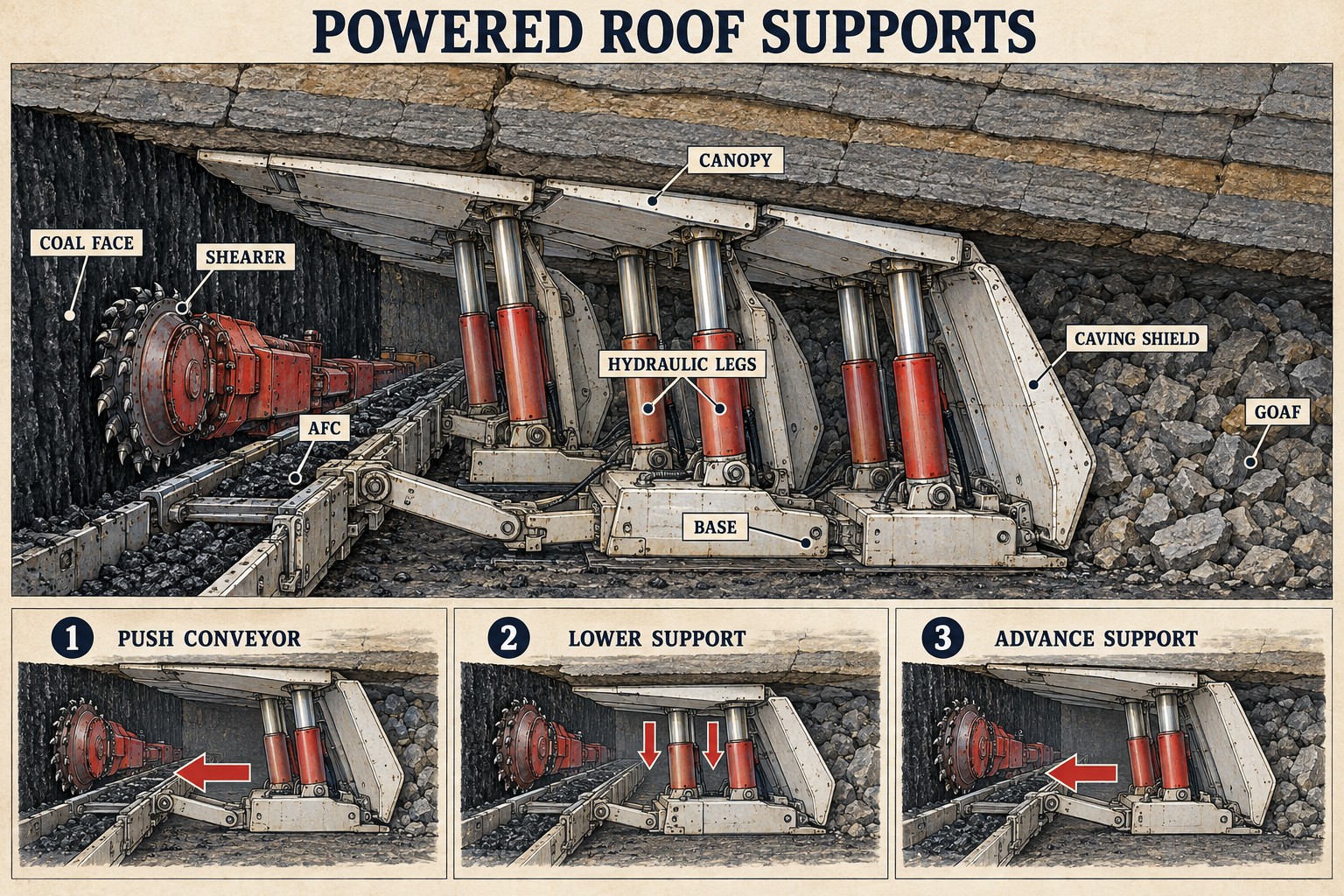
Each support is a set of hydraulic rams under a canopy, typically about 1.75 m wide, and a line of them can run four hundred metres along a face. Hydraulic fluid is admitted through hoses and valves so that the support can be set hard against the roof, yield as roof and floor converge, push the face conveyor over, lower itself, and drag itself forward a metre at a time into the space the shearer has just made. An individual chock can weigh thirty to forty tonnes, extend to a cutting height of six metres and yield at a thousand tonnes or more. Behind the advancing line the roof is let go, and the goaf collapses.
Why it was used
Speed and safety together. A shearer running back and forth all shift outruns any crew setting timber behind it, so mechanised cutting only works if the support mechanises too. And the men are always under steel: the great advantage claimed for longwall over room and pillar is that the face workers stand beneath the hydraulic supports the whole time they are winning coal.
Risks & limitations
The equipment is heavy, expensive and slow to move, so a powered face has to be planned into a long, regular panel of ground to pay for itself. The controlled collapse behind the supports is deliberate, and the strata above settle onto the goaf for roughly two and a half times the thickness of the seam taken, which is why longwall faces lower the ground surface above them and damage what stands on it.
Related terminology
Goaf, Longwall, Roof Fall, Shearer, Subsidence, Timberman
Mines associated with this term
5 examples chosen from 8 linked records — the term page is not an index.
- Bevercotes Colliery — Nottinghamshire (well documented example)
Named in this record’s workings: “…Face automated the shearing machine, the hydraulic roof supports (chocks) and the armoured face conveyor, leaving only the ripping and…” - Blaenant Colliery — Neath Port Talbot (well documented example)
Named in this record’s workings: “…the faces were worked by retreat, with ranging-drum shearers and self-advancing supports by 1981.” - Desford Colliery — Leicestershire (well documented example)
Named twice in this record, first in the summary: “…that put safety lamps into every Leicestershire pit, and the Desford Chock — claimed as the first hydraulic powered roof support, invented by…” - Measham Colliery — Leicestershire (well documented example)
Named in this record’s workings: “…and hand-loaded. Face supports were Wild-Desford hydraulic goal post chocks; the stables were held by Dowty props and link bars. The seam was…” - New Boston Colliery — Merseyside (well documented example)
Named twice in this record, first in the history: “…killed by a rope slipping on the drum in 1872, men drawing chocks under falling roof, a bricksetter subject to fits who fell from the…”
Disasters associated with this term
Included only where MineArchive's own research gives a reasonable evidential basis, with the nature of the relationship stated — not every disaster where this term might plausibly apply.
- Clifton Hall Colliery explosion (contextual relationship)
Named in this record’s investigation: “…number 2 level had been ignited at a lighted candle placed against a chock in John Dyke's working place. Morley recorded his doubts about…” - Glyncorrwg Colliery Explosion (contextual relationship)
Named in this record’s narrative: “…singed. Overman G. Thomas, examining No. 6 pack between two steel chocks, heard a thud and shouting and saw flame travel past him towards the…” - Usworth Colliery fall of ground, 1897 (contextual relationship)
Named twice in this record, first in the summary: “On 6 July 1897 a chock drawer and a deputy were buried and killed by a sudden fall of…” - Walsall Wood Colliery Collapse (1956) (contextual relationship)
Named in this record’s cause: “…collapsed and was only temporarily supported by a hollow wooden chock; at 3:50pm on 9 October 1956 it gave way without warning, burying…”
Sources
- (secondary) Dowty Mining Equipment — Dowty Heritage
- (secondary) Glossary of coal mining terminology — Wikipedia
- (secondary) Longwall mining — Wikipedia
Record created: 11 September 2026 · Last researched: 11 September 2026