 MineArchive
Clifton Hall Colliery explosion
Firedamp that had gathered in the void above a collapsing goaf reached the working places at the far end of number 2 East and was lit by a candle. The blast ran through almost the whole Trencherbone seam, and 177 or 178 men and boys died — by burns, by injury, or by the afterdamp that followed.
| Date | 18 June 1885 |
|---|---|
| Mine | Clifton Hall Colliery |
| Region | Greater Manchester |
| Primary type | Explosion |
| Associated types | Gas / Asphyxiation |
| Fatalities | 178 (The figure is genuinely unsettled. Morley's official report tabulates 177 deaths and lists 177 names, but the title of its minutes of proceedings says 178 men and boys were killed; the memorial at St Augustine's records 178, and modern accounts follow it. The plan of the mine showing where bodies were found marks only 157.) |
| Context | During active mining |
Cause
Ignition of firedamp by a naked candle, propagated by coal dust
Contributing factors
A goaf up to 1,200 yards across, left to subside, in which the weak white-metal roof bridged over an unsupported span of six hundred yards by four hundred and then broke away from the Trencherbone rock, leaving a void where firedamp collected out of reach of the firemen's inspections. Naked candles permitted in a seam an expert witness told the inquiry should not have been worked with them. Furnace ventilation, all the return air from the Trencherbone passing over an open fire. Roadways dusty enough to need watering, and props afterwards found thickly coated with coked coal dust.
What happened
The explosion came at twenty past nine on the morning of Thursday 18 June 1885. Higson's report, read into the record by the coroner, placed its origin at the far end of the number 2 East level, where a crack opened in the ground above and the gas that had gathered in the void over the goaf came down on men working by candlelight. The first blast alone could not account for the damage: it drew more gas out of the goaf behind it and carried the explosion through the seam, and the coal dust on the roadways carried it further. Sir William Galloway, then an Inspector of Mines and later Professor of Mining at Cardiff, held that explosions of this kind were 'chiefly or very largely promoted by coal dust'.
The blast travelled through the whole Trencherbone except number 3 East, where ten men were cut off by afterdamp and got out after thirteen hours. Everyone else in that seam died. In the Dow and Five-Quarters seams 122 men escaped along the old tunnel that ran from Clifton Hall's Dow mine through to Agecroft Colliery's Trencherbone — a road not in regular use, driven five feet high but squeezed to three in places, with two hundred yards of standing water that left as little as two and a half feet of air above it. Nine men were found dead in that tunnel, of their injuries or of the gas.
Rescue & recovery
The ground shook for half a mile. The guard rails on two sides of the pit mouth were blown away and the cages were made useless, so the first men down went by the upcast shaft's ropes. Thomas Worrall, George Hindley and George Higson were awarded the Albert Medal for the rescue work.
Investigation & inquiry
The inquest opened at Pendlebury Mechanics' Institute on 30 June 1885 before the coroner Frederick Price and sat for nine days; Morley reported for the government the same year. The inquest found that a large amount of inflammable gas given off from the goaf in the Trencherbone mine east of number 2 level had been ignited at a lighted candle placed against a chock in John Dyke's working place. Morley recorded his doubts about passing all the seam's return air over the ventilating furnace and, in his general remarks, recommended replacing it with a dumb-drift furnace or with fan ventilation.
Changes to practice & legislation
Furnace ventilation at Clifton Hall was replaced in 1886. The disaster is one of the cases behind the growing recognition through the 1880s that coal dust, not firedamp alone, carries a colliery explosion — the argument Galloway had been making and which the Royal Commission on Explosions in Mines was then examining.
Memorials & commemoration
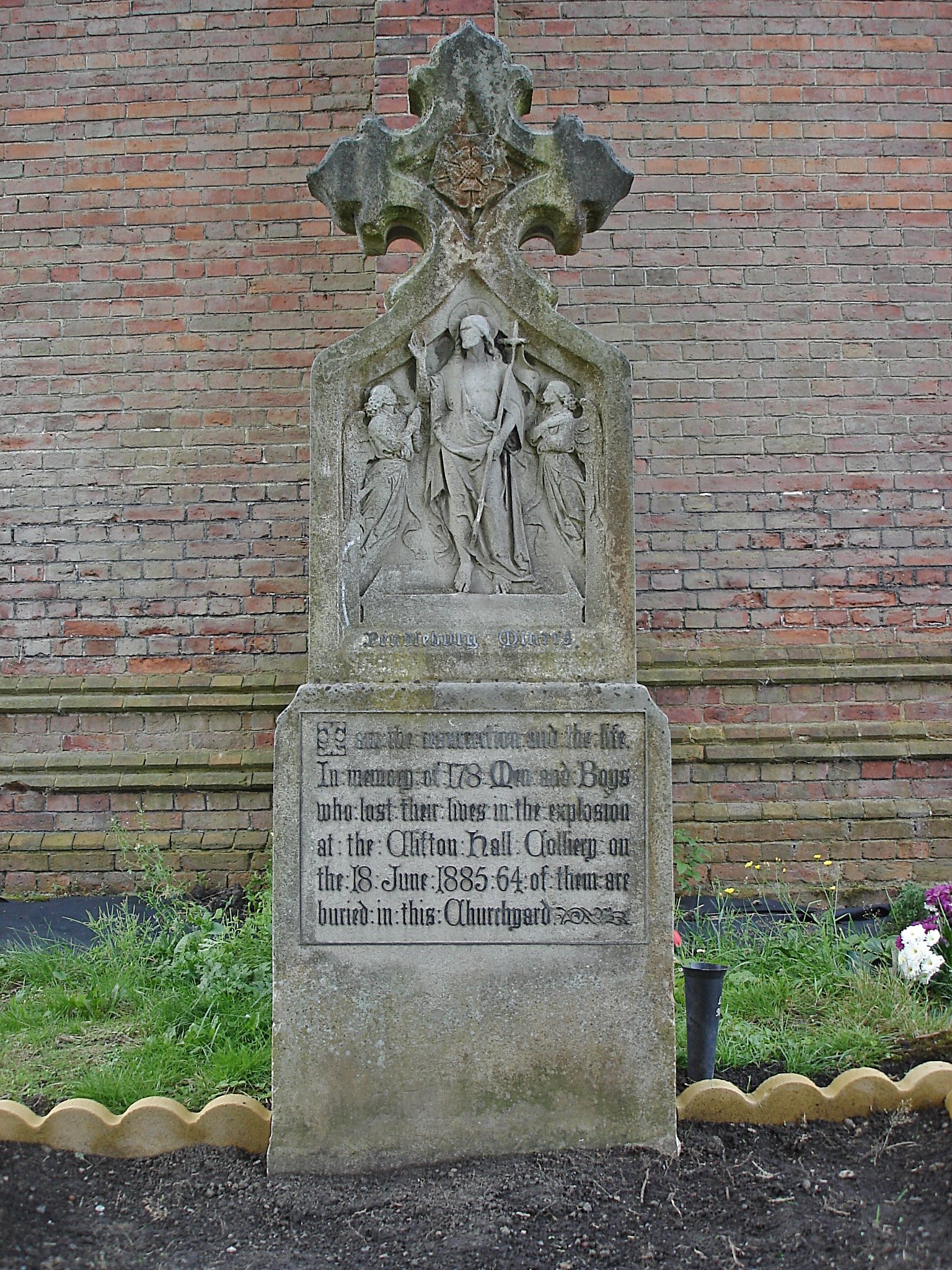
A memorial stands outside St Augustine's church, Pendlebury, beneath the east window, to the 178 men and boys killed. Sixty-four of them are buried in the churchyard.
What's uncertain
Points where sources disagree or the record could not be settled; both accounts are kept. All open questions in the archive.
- Morley's official report tabulates 177 deaths and lists 177 names, and the plan of the mine showing where the bodies were found marks only 157 positions. (disputed) 1
- The title of the minutes of proceedings in the same official report says 178 men and boys were killed; the memorial at St Augustine's records 178, and the Durham Mining Museum and modern accounts follow that figure. (disputed) 1,2
Recorded claims
Individual factual claims, each attached to the source(s) that support it below. Where sources disagree, both are kept.
- Morley's report distributes the 177 deaths he tabulates as follows: 158 in the Trencherbone mine, from burns, injuries or carbonic acid gas; nine in the tunnel towards Agecroft, suffocated; seven at home from the shock of their burns; one at home from the gas; and two at Salford Hospital from the shock of burns. 1
- Morley's official report tabulates 177 deaths and lists 177 names, and the plan of the mine showing where the bodies were found marks only 157 positions. (disputed) 1
- The title of the minutes of proceedings in the same official report says 178 men and boys were killed; the memorial at St Augustine's records 178, and the Durham Mining Museum and modern accounts follow that figure. (disputed) 1,2
Related terminology
Mining terms this disaster is structurally linked to, with the nature of the relationship.
- Afterdamp (contextual relationship)
Nine men died of it in the escape tunnel to Agecroft and ten more were trapped by it for thirteen hours in number 3 East, the one district the explosion missed. - Furnace Ventilation (contextual relationship)
Named 3 times in this record, first in the contributing factors: “…witness told the inquiry should not have been worked with them. Furnace ventilation, all the return air from the Trencherbone passing over an open fire.…” - Goaf (contextual relationship)
The source of the gas. Firedamp collected in the void left where the weak roof bridged over the goaf and broke away from the rock above, out of reach of the firemen's inspections, and the first blast drew still more of it out. - Powered Roof Supports (contextual relationship)
Named in this record’s investigation: “…number 2 level had been ignited at a lighted candle placed against a chock in John Dyke's working place. Morley recorded his doubts about…” - Royal Commission (contextual relationship)
Named in this record’s changes to practice: “…explosion — the argument Galloway had been making and which the Royal Commission on Explosions in Mines was then examining.”
Photographs & further reading
This page doesn't try to reproduce everything — these are the best original sources found for this disaster.
The workings, the goaf, the lights and the explosion, worked closely from Morley's official report and the nine-day inquest.
View sourceThe museum's roll of those killed at the colliery, the 1885 dead among them.
View sourceSources
- (secondary) Clifton Hall Colliery — Wikipedia
- (primary) Clifton Hall Colliery — Durham Mining Museum
Record created: 10 September 2026 · Last researched: 10 September 2026