 MineArchive
Desford Colliery
| Location | Half a mile south of Bagworth, Leicestershire — 52.6640, -1.3350 (approximate) |
|---|---|
| Commodity | Coal |
| Type | Coal |
| Worked | 1900 (coal from 1902)–10 February 1984 |
| Maximum depth | Unknown. Local borings proved the seams at between 100 and 133 yards. |
| Operators | Desford Coal Company (1900–1947), National Coal Board (1947–1984) |
Overview
The most southerly of the deep collieries in the Eastern Basin of the Leicestershire coalfield, sunk from 1900 by the Desford Coal Company and worked until February 1984. It raised some 30 million tons over its life, employed nearly 1,900 in the early 1950s, and drove two drifts at Merrylees during the Second World War. Two things came out of it besides coal: a 1948 explosion that put safety lamps into every Leicestershire pit, and the Desford Chock — claimed as the first hydraulic powered roof support, invented by the undermanager and tested on the colliery fire hydrant.
History
An earlier attempt failed first. In 1875 Harrington Offley Shore, of a Sheffield banking family and living at Lindridge Hall, sank a shaft on the Lindridge estate, reckoning coal must lie under his land. He had chosen the point where the coal measures strike the Thringstone Fault: there was insufficient coal and constant flooding, pumping was ruinous, the Lindridge Coal Company ran out of money in 1877 and Shore was declared bankrupt. The shaft was capped and filled in 1975, a steam pump still in position at the bottom. The Desford Coal Company was registered in 1900. Ernest Bramall, a mining and mechanical engineer and son of the Lancashire colliery owner Henry Bramall, sank the first two shafts south-east of the long-established Bagworth Colliery: No. 1 served the Lower Main seam, No. 2 the Upper Main. A single track was laid in from the Midland Railway’s Leicester–Burton line, and the still-unfinished colliery took delivery of its first locomotive, the Countess of Warwick, that September. Coal came out of both Main seams in 1902. The pit lived through the century’s strikes: a thousand Desford men walked out in the 1912 national strike for a minimum wage, and the pit was shut for twenty-six weeks after the General Strike of 1926, with only part-time working until 1939. War brought it back to full production, three new shafts and up to 880 men underground; coal faces were given names, two of them Burma and Antwerp, so a man could say he was working in Burma. From 1942 the company drove two drifts from the surface at Merrylees, and by 1947 the combined Desford and Merrylees output was just over 600,000 tons. In 1948 an explosion at No. 1 pit, caused by naked-light working, injured fourteen men; safety lamps were used routinely throughout Leicestershire pits from then on, although they had been in use elsewhere for many years. In the 1950s the undermanager Matthew Smith invented what became known as the Desford Chock, developed further by the mine agent Sam McKee — three prototypes were tried using the colliery fire hydrant to supply the water pressure, and the inner and outer cylinders were made locally. Pithead baths and a medical centre followed; the last pit pony left in 1963; underground connection with the Merrylees drift was made in 1966. The Lower Main seam ceased production in 1982 after eighty years and the Upper Main — the first seam worked and the last — in 1983. Desford Colliery closed on 10 February 1984, weeks before the year-long strike, the coal by then of very poor quality and the pit troubled by flooding. It had produced some 30 million tons.
Geology
The Eastern Basin of the Leicestershire and South Derbyshire coalfield, divided from the western half by a major geological fault. Workable seams found at Ibstock and Bagworth in the 1820s prompted exploration further south: borings near Barlestone and Newbold Verdon proved a thick seam at 105 yards, and borings at Lindridge and Newtown Unthank in 1874 proved five seams between 100 and 133 yards. The Lindridge shaft failed because it stood where the measures meet the Thringstone Fault. By 1952 the colliery was working the High and Upper Main, Middle Lount, Yard and Lower Main.
Workings
Two shafts from 1900 — No. 1 the downcast and coal-winding shaft, No. 2 the upcast, used for men and materials — with three more sunk during the Second World War. Both original winding engines were twin-cylinder horizontals by Wood & Gee of the Barley Brook Foundry, Wigan, 1901 and 1902, rebuilt with piston-valve cylinders by Worsley Mesnes Ironworks in the early 1950s, winding at 37 feet per second on locked-coil ropes an inch and a quarter thick. Nine Lancashire boilers at 100 psi supplied the steam; the winders were replaced by electric ones in 1975 and 1976. The colliery had its own railway and locomotives — the Countess of Warwick in 1900, the Desford in 1908, the Desford No. 3 in 1947 — and a brickworks from 1927 with a siding connection. Ventilation and electric power were improved in the 1930s, allowing more mechanisation. From 1942 two surface drifts at Merrylees were driven by the same company, and in 1966 they were connected underground so Merrylees coal came out at Desford.
Closure
Desford closed on 10 February 1984, weeks before the year-long miners’ strike began. The coal was by then of very poor quality and the pit had flooding problems. The Lower Main seam had stopped in 1982 after eighty years, the Upper Main in 1983 — the first seam worked and the last.
What remains
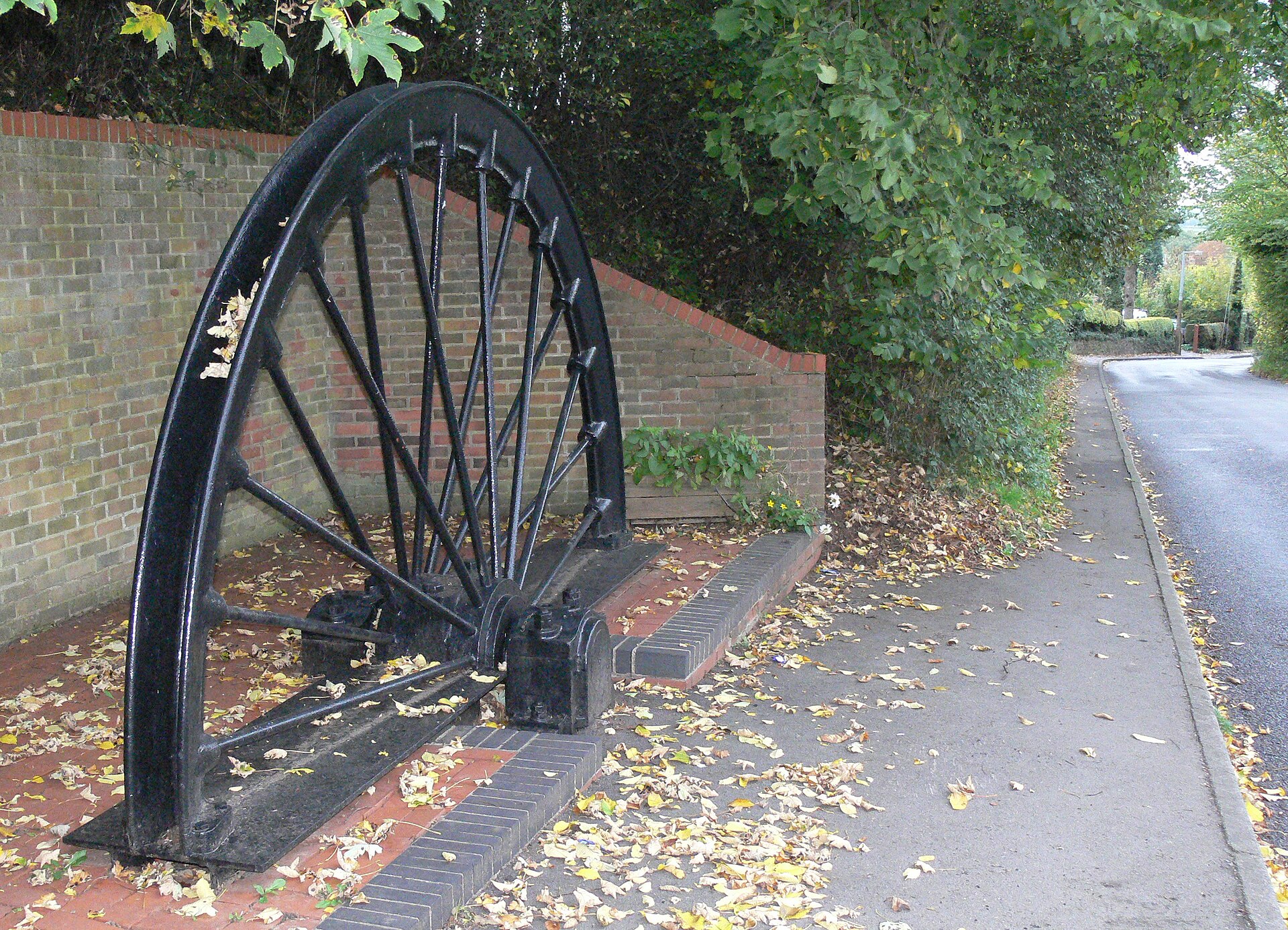
Reclamation of the derelict colliery began in 1991 and turned the 185-acre site into Bagworth Heath Country Park, with a fishing lake, walks and cycle paths, owned and managed by Leicestershire County Council. Part of the colliery winding wheel stands there as a memorial.
Part of the Desford Colliery winding wheel, kept at Bagworth Heath, and a colliery plaque. The 185-acre pit ground is now country park.
Related mines
- Bagworth Colliery — Desford was sunk in 1900 half a mile south-east of the already long-established Bagworth Colliery, and the two worked the same Eastern Basin measures. Worth knowing for a reader of either record: Bagworth Heath Country Park occupies the reclaimed Desford site, not Bagworth’s.
- Measham Colliery — The face supports on Measham’s fully mechanised Stockings retreat face of 1964 were Wild-Desford hydraulic goal post chocks — the design invented at Desford Colliery by its undermanager in the 1950s and still carrying its name a decade later.
- Merrylees Drift Mine — Merrylees was driven by the Desford Coal Company in 1942 on the strength of boreholes south of Desford, and from 1966 the two were connected underground so that Merrylees coal was wound at Desford. The 1947 output figure of just over 600,000 tons is for the two together.
Nearby mines
- Bagworth Colliery — 0.3 miles (0.6 km) N
- Merrylees Drift Mine — 0.9 miles (1.5 km) SE
- Nailstone Colliery — 1.7 miles (2.8 km) W
- Cliffe Hill Quarry — 2.4 miles (3.8 km) NE
- Norwich Chalk Mines — 2.4 miles (3.9 km) SE, Norfolk
Straight-line distance, within 9 miles (15 km). Show on the map.
Culture
- Desford Colliery Band (Music)
The band took this colliery's name in 1956 because most of its players worked there and the coal industry's welfare fund had re-equipped it.
What's uncertain
Points where sources disagree or the record could not be settled; both accounts are kept. All open questions in the archive.
- In the 1950s Matthew Smith, the undermanager at Desford Colliery, invented the Desford Chock, described as the first ever hydraulic powered roof support; Sam McKee, the mine agent, developed it further, and three prototypes were tried using the colliery fire hydrant to supply the water pressure. (uncertain) 1
Recorded claims
Individual factual claims, each attached to the source(s) that support it below. Where sources disagree, both are kept.
- In 1875 the first mine shaft on the Lindridge estate was sunk by Harrington Offley Shore. The site was where the coal measures strike the Thringstone Fault; it proved unworkable for insufficient coal and constant flooding, the Lindridge Coal Company ran out of money in 1877 and Shore was declared bankrupt. The shaft was capped and filled in 1975 with the remains of a steam pump still in position. 1
- The Desford Coal Company was registered in 1900; Ernest Bramall, a mining and mechanical engineer and the son of the Lancashire colliery owner Henry Bramall, sank the first two shafts south-east of the already established Bagworth Colliery. No. 1 shaft served the Lower Main seam and No. 2 the Upper Main. Coal extraction began in 1902. 1,2
- An explosion at No. 1 pit in 1948 was caused by naked light working and injured fourteen men. Safety lamps were used routinely from then on throughout Leicestershire pits, although they had been in use elsewhere for many years. 1
- In the 1950s Matthew Smith, the undermanager at Desford Colliery, invented the Desford Chock, described as the first ever hydraulic powered roof support; Sam McKee, the mine agent, developed it further, and three prototypes were tried using the colliery fire hydrant to supply the water pressure. (uncertain) 1
- Bore holes to the south in 1942 showed workable drifts, and two drifts were driven from the surface at Merrylees by the Desford Coal Co.; the first coal came out the following year. An underground connection with the Merrylees drift mine was established in 1966 and Merrylees coal was conveyed to Desford. 1,3
- In 1952 the colliery was working the High and Upper Main, Middle Lount, Yard and Lower Main seams, with 1,492 underground and 390 surface workers. 2
- No. 1 Pit was the downcast and coal-winding shaft; its winding engine was a twin-cylinder horizontal built by Wood & Gee of the Barley Brook Foundry, Wigan, in 1901, rebuilt with piston-valve cylinders by Worsley Mesnes Ironworks in the early 1950s. No. 2 Pit was the upcast, its engine by the same makers in 1902. Both were replaced by electric winders, No. 2 in 1975 and No. 1 in 1976. 2
- The Lower Main seam ceased production in 1982 after eighty years and the Upper Main — the first and last to be worked — in 1983. Desford Colliery closed on 10 February 1984, weeks before the year-long miners’ strike, the coal by then of very poor quality with flooding problems. It had produced some 30 million tons over its working life. 1
- Work began in 1991 to reclaim the derelict colliery site; the 185-acre site was transformed into Bagworth Heath Country Park, with a fishing lake, walks and cycle paths, owned and managed by Leicestershire County Council. 1
Photographs & further reading
A year-by-year account of the colliery from the failed Lindridge shaft of 1875 to the reclamation of the site: the sinking, the locomotives, the strikes, the 1948 explosion, the Desford Chock and the 1984 closure.
View sourceThe Northern Mine Research Society’s account, reproduced with permission: the borings that preceded the pit, the seams worked and workforce in 1952, and an unusually full description of the winding engines, boilers and their replacement.
View sourceSources
- (secondary) Coal mining — Desford Heritage
- (secondary) Desford Colliery — Coal Mining in Leicestershire (reproducing Northern Mine Research Society)
- (secondary) Merrylees Colliery — Coal Mining in Leicestershire (reproducing Northern Mine Research Society)
- (primary) BGS mine plans catalogue: Desford Colliery — British Geological Survey
Record created: 7 September 2026 · Last researched: 7 September 2026