 MineArchive
Nailstone Colliery
| Location | Between Nailstone and Bagworth, Leicestershire — 52.6660, -1.3760 (approximate) |
|---|---|
| Commodities | Coal, Fireclay |
| Type | Coal |
| Worked | 1862–1967 |
| Maximum depth | 283 yards (259 m) in the upcast shaft; the workings reached 205 yards |
| Operators | Joseph Thornton (1875–1883), Nailstone Colliery Company (1887–1947), National Coal Board (1947–1987), British Coal Corporation (1987–1991) |
Overview
Sunk from 1862 between Nailstone and Bagworth, with a downcast shaft of ten feet and an upcast of eight ten yards away, reaching the Upper Main Seam at 143 yards through some eighty yards of New Red Sandstone. The shafts were deepened to 205 yards in 1868 for the Lower Main or Roaster Seam. J. J. Ellis owned it in 1866 and sold out in 1875; it closed in 1876, was working again by 1883, and passed to the Nailstone Colliery Company in 1887. The 1880 list of collieries at work returns it under Joseph Thornton. Coal winding ceased in 1967, but the site did not: the National Coal Board drove a drift here to bring out Bagworth’s coal, and Ellistown and South Leicester were linked in too, so that the whole district’s output surfaced at Nailstone until Bagworth — the last working colliery in Leicestershire — closed in 1991.
History
Shaft sinking began in 1862. The originator may have been J. J. Ellis, who later sank Ellistown, but that is not certainly known; what is known is that he owned Nailstone in 1866 and sold out in 1875. A shaky period followed and the colliery closed in 1876. It was working again under new ownership by 1883, and when that owner died in 1887 it was taken over by the Nailstone Colliery Company. The official list of collieries at work in 1880 — during the closure, or on the point of reopening — returns it as "Nailstone, Bagworth, Joseph Thornton".
A Colliery Guardian survey of 1899 describes the pit in detail. The Upper Main and Lower Main were the only seams then being worked, by longwall, the seams dipping 1 in 14 to the east; tubs were brought to the face of the working stalls for filling, hauled by ponies to the rope or horse haulage roads, and filled with forks so that the slack was left in the gob. Open flame lighting was general, the stalls tested for gas with safety lamps in the mornings, and in the Lower Main — which was liable to spontaneous combustion, so that the gobs had to be watched for outbreaks of fire — a safety lamp was kept burning at the highest point of each stall as a warning of firedamp. The colliery had six egg-ended boilers and two more for the brickworks, all at fifty pounds pressure, under a chimney ninety feet high and nine feet across inside.
Its coal went a long way for a Leicestershire pit. Beyond local sales there was a London market for house coal, the London & North Western Railway took 30,000 tons a year as locomotive coal, and some was exported through King’s Lynn. A brickworks alongside made firebricks, red bricks and earthenware drainage pipes from clay found near the colliery, much of its machinery built by Wootton Brothers of Coalville. New seams were opened as the Upper and Lower Main ran down, and by the 1950s the pit was working the Middle Lount and the Yard.
Geology
Nailstone lies in the eastern basin of the Leicestershire coalfield, where the Coal Measures are concealed beneath the New Red Sandstone: the shafts passed through some eighty yards of it before reaching coal, and the lower part of the sandstone gave water at about seventy gallons a minute, which continued after the sinking was finished. The seams dip about 1 in 14 to the east. The Upper Main had a roof of strong stone bind over seven to nine inches of inferior top coal, left up, then three feet six of hard coal fit for locomotives and fourteen inches of second-quality bottom coal, with fireclay beneath it that was used for firebricks. The Lower Main had three to fourteen feet of fireclay above it, nine inches of hard "spires" left up to form the roof, then three feet eleven of best house coal and sixteen inches of inferior; it was liable to spontaneous combustion.
Geological setting: Concealed Coalfields (well documented example), Sedimentary Beds and Seams (well documented example)
Workings
Two shafts under one tandem headgear, so that a single winding engine served both: the downcast ten feet in diameter, the upcast eight, ten yards apart, with a ladder shaft twenty yards from the downcast giving access between them. The Upper Main was reached at 143 yards and the shafts deepened to 205 yards in 1868 for the Lower Main; the upcast was later taken to 283 yards without finding anything workable. A horizontal winding engine by Death & Ellwood of Leicester replaced the original vertical one in 1874, its drum stepped — ten feet on the downcast side, fourteen on the upcast — because the two shafts wound from different depths. The timber tandem headgear was replaced about 1898 by one of pitch pine fifty feet high, and later by a massive steel structure. Ventilation was by underground furnace, moving about 45,000 cubic feet of air a minute, until a nine-foot Walker Brothers centrifugal fan was installed in 1899.
There was no pumping engine at all. Water running into the shafts was allowed to collect in the sumps and raised at night by the winding engine in wheeled wrought-iron tanks that ran into the cages, self-filling at the shaft bottom and self-discharging at the top — 459 gallons in the downcast tank and 325 in the upcast, with winding for about four hours a night.
Closure
Coal production ceased at Nailstone in 1967, but the surface plant outlived the shafts by nearly a quarter of a century. It had become National Coal Board policy in the area to drive drifts to bring coal to the surface and abandon shafts for the purpose, and a drift was put down at Nailstone to bring out Bagworth’s output; Ellistown and South Leicester were linked in as well, so the whole district’s coal surfaced here. Nailstone became a major centre for coal preparation and distribution, and those operations ceased only in 1991, when Bagworth — the last working colliery in Leicestershire — closed.
What remains
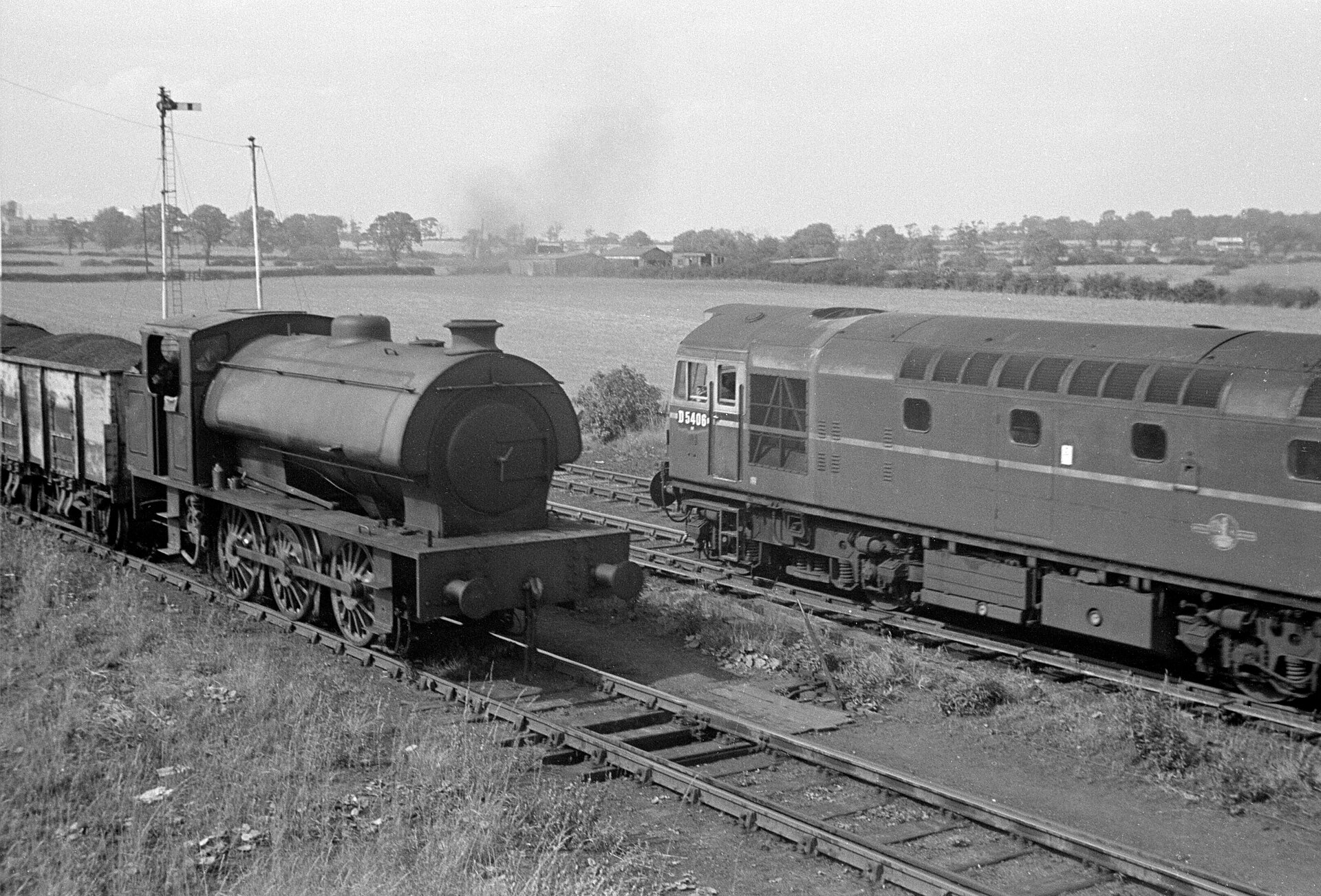
The colliery is gone. Its railway is the best-remembered part of it: a 1967 photograph shows a saddle tank bringing a coal train from Nailstone into Bagworth exchange sidings while a main line diesel passes on its way to Coalville. Nothing dated turned up of the site as it now stands that is freely licensed.
Nothing specific to the colliery is known.
Related mines
- Bagworth Colliery — The two mines were connected underground in 1966, after which Bagworth’s coal was raised, washed and dispatched at Nailstone, reaching the surface there up a one-in-four drift; a branch line and then, from 1980, a conveyor belt carried it back towards Bagworth.
- Ellistown Colliery — Ellistown’s workings were linked to Bagworth and through it to the surface at Nailstone by the Nailstone drift, so that the whole district’s output came up here after Nailstone itself stopped winding coal in 1967.
Nearby mines
- Bagworth Colliery — 1.7 miles (2.7 km) E
- Desford Colliery — 1.7 miles (2.8 km) E
- Ibstock Colliery — 2.1 miles (3.3 km) N
- Ellistown Colliery — 2.1 miles (3.4 km) N
- Merrylees Drift Mine — 2.5 miles (4.0 km) E
Straight-line distance, within 9 miles (15 km). Show on the map.
What's uncertain
Points where sources disagree or the record could not be settled; both accounts are kept. All open questions in the archive.
- J. J. Ellis owned the colliery in 1866 and sold out in 1875; it closed in 1876, was working again under new ownership by 1883, and was taken over by the Nailstone Colliery Company when that owner died in 1887. Whether Ellis originated the colliery is not certainly known. (uncertain) 2
- The BGS mine-plans catalogue holds a Mining Remediation Authority abandonment plan titled 'Nailstone' (catalogue EM903, Upper Main, dated 1940); the catalogue gives no location and the plan's details do not clearly tie it to this working, so it may belong to another of the same name. (uncertain) 4
Recorded claims
Individual factual claims, each attached to the source(s) that support it below. Where sources disagree, both are kept.
- The official list of collieries at work in 1880 returns the pit as "Nailstone, Bagworth, Joseph Thornton". 1
- Shaft sinking commenced in 1862 with two shafts — a downcast of 10 ft and an upcast of 8 ft ten yards away — reaching the Upper Main Seam at 143 yards after passing through some 80 yards of New Red Sandstones; they were deepened to 205 yards in 1868 for the Lower Main or Roaster Seam, and the upcast later to 283 yards without finding any workable seam. 2
- J. J. Ellis owned the colliery in 1866 and sold out in 1875; it closed in 1876, was working again under new ownership by 1883, and was taken over by the Nailstone Colliery Company when that owner died in 1887. Whether Ellis originated the colliery is not certainly known. (uncertain) 2
- There was no pumping as such: water feeding into the shafts was allowed to accumulate in the sumps and raised at night by the winding engine in wheeled wrought-iron tanks that ran into the cages, self-filling at the bottom and self-discharging at the top — 459 gallons in the downcast and 325 in the upcast, with winding for about four hours. 2
- Besides local sales there was a London market for house coal; the London & North Western Railway purchased 30,000 tons a year as locomotive coal, and some was exported from King’s Lynn. 2
- The Lower Main seam was liable to spontaneous combustion and the gobs had to be watched for outbreaks of fire; a safety lamp was kept burning at the highest point of each working stall as a warning of firedamp. 2
- Coal production ceased at Nailstone in 1967, but a drift was put down there to bring out Bagworth’s output, and Ellistown and South Leicester were linked in so that the whole output surfaced at Nailstone; those operations ceased in 1991 when Bagworth, the last working colliery, closed. 3,2
- The BGS mine-plans catalogue holds a Mining Remediation Authority abandonment plan titled 'Nailstone' (catalogue EM903, Upper Main, dated 1940); the catalogue gives no location and the plan's details do not clearly tie it to this working, so it may belong to another of the same name. (uncertain) 4
Photographs & further reading
A machine-by-machine account of the pit drawn from an 1899 Colliery Guardian survey, with the Northern Mine Research Society’s permission: the stepped winding drum that served two shafts of different depths, the Walker Brothers fan of 1899, the tank-and-cage arrangement that stood in for a pumping engine, and the seam sections inch by inch.
View sourceSources
- (secondary) List of coal mines UK 1880 — Coalmining History Resource Centre
- (secondary) Nailstone Colliery — Coal Mining in Leicestershire — Coal Mining in Leicestershire
- (secondary) Ellistown Colliery — Coal Mining in Leicestershire — Coal Mining in Leicestershire
- (primary) BGS / Mining Remediation Authority mine plans: NAILSTONE — British Geological Survey / Mining Remediation Authority
Record created: 6 September 2026 · Last researched: 6 September 2026