 MineArchive
Sump
| Category | Mine Workings & Access |
|---|
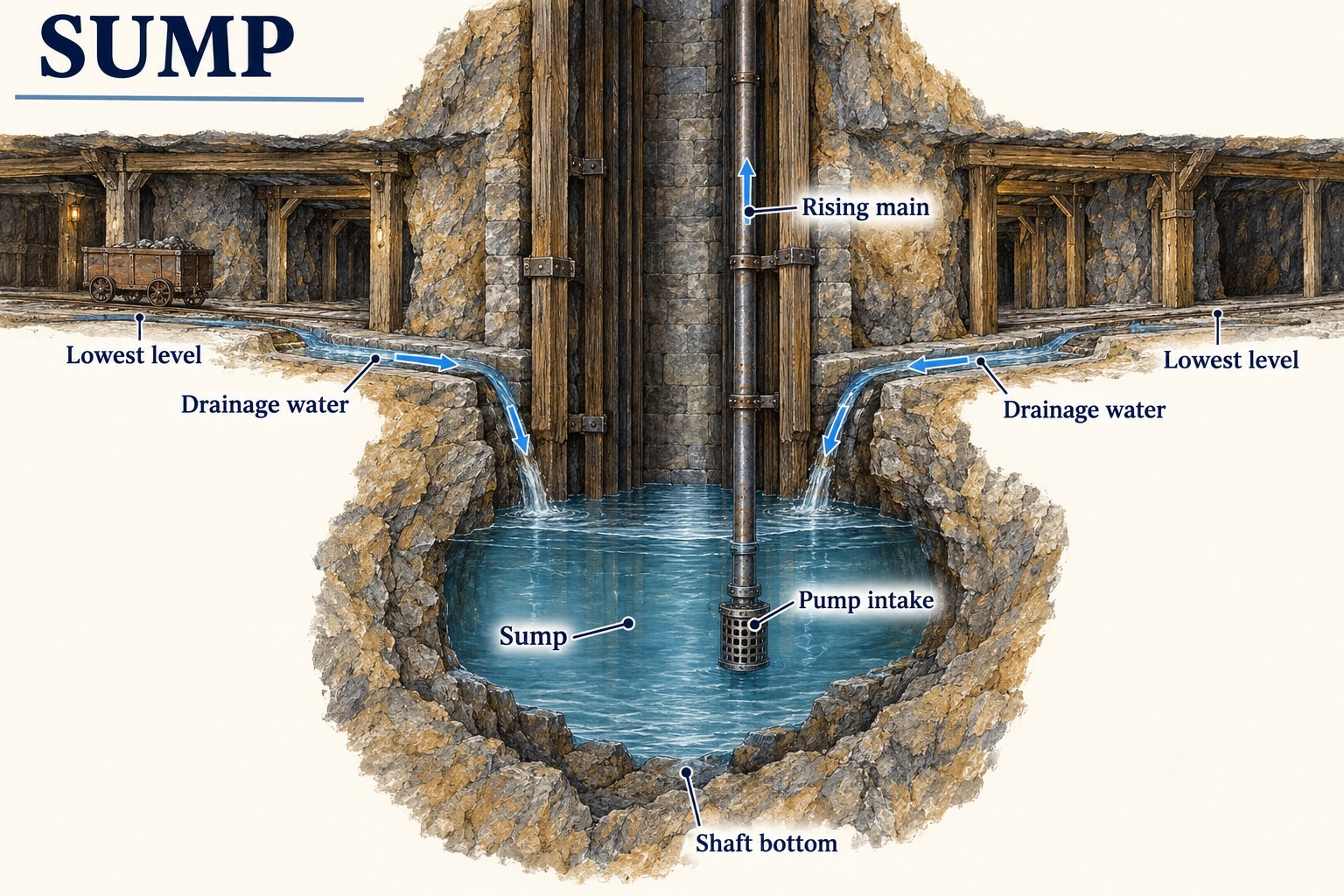
A collecting pool at the bottom of a mine shaft, or at any low point underground, where water gathered so it could be pumped or hauled to the surface.
Historical usage
Sumps are as old as underground mining itself — wherever a shaft or working ran below the water table, water draining or seeping in had to collect somewhere before it could be removed, and the lowest accessible point naturally became that collecting place. In some English mining districts a sump was known instead as a 'lodge'.
How it worked
Water flowing through a mine's workings drained by gravity to the lowest point — typically the bottom of the main shaft — where it collected in the sump; from there it was raised to surface or to a drainage adit by pumps, or in earlier periods by hand or horse-powered lifting.
Why it was used
Without a sump to collect drainage water in one place, a mine had nowhere for pumps to draw from — an unmanaged mine could quickly flood, so keeping the sump pumped out was a basic, continuous condition of keeping any deep working dry enough to work at all.
Risks & limitations
An unattended or malfunctioning sump could fill unnoticed, and a sump was also simply a deep, often unlit body of water at the base of a shaft — a fall into one, especially after an accident elsewhere in the mine, could easily be fatal.
Regional variation
The word is general across British coal and metal mining and carries no dialect. It is used at two scales that are easy to confuse: the sump proper, the pool at the very bottom of a shaft below the lowest working level, and any low catchment point in a level or roadway where water is gathered before being lifted. In shaft sinking the same word is used again for the temporary pool kept below the advancing shaft bottom, which the sinkers must keep pumping out ahead of themselves. Modern mine-water management uses it in the third sense of an engineered chamber holding a fixed volume against pump cycling.
Related terminology
Mines associated with this term
5 examples chosen from 28 linked records — the term page is not an index.
- Alexandra Colliery — Merseyside (well documented example)
Named in this record’s history: “…all of them gone through the scaffolding into the water of the sump. Joseph Naylor, who had been the engineman for eight or nine years…” - Caplecleugh Mine — Cumbria (well documented example)
Named in this record’s history: “…900 metres over 18 metres of height to the west -- far enough that a sump at the western end connected the Caplecleugh workings directly…” - Grassmoor Colliery — Derbyshire (well documented example)
Named in this record’s history: “…sunk in 1861 and was 382 yards deep with a further seventy yards of sump, 452 yards in all. The company sought limited liability in 1884, in…” - Wistow Mine — North Yorkshire (well documented example)
Named twice in this record, first in the history: “…1981 and was carried on to a full depth of 411 metres to form a sump. Production began in June 1983, the first in the complex to start.…” - Annesley Colliery — Nottinghamshire (well documented example)
Named in this record’s history: “…of the working life behind that growth — a man drowned in the sump in 1865, a fourteen-year-old killed by a fall of roof in 1869, a run…”
Disasters associated with this term
5 examples chosen from 20 linked records, most direct relationship first.
- Great Laxey Mine scaffold collapse (direct cause)
The four men killed in 1904 fell into the sump at the bottom of the workings and drowned. - Aberaman Colliery explosion, 1855 (contextual relationship)
Named twice in this record, first in the summary: “…men and boys, one of them a sixteen-year-old haulier blown into the sump and drowned.” - Alexandra Colliery overwinding accident, 1879 (contextual relationship)
Named in this record’s narrative: “…fell to the bottom of the shaft. The bodies lay in the water in the sump, three in the cage, two at each end of it and two beneath it. At…” - Barrow Colliery shaft accident, 1874 (contextual relationship)
Named twice in this record, first in the summary: “…platform collapsed and dropped them 30 feet into the flooded sump of a shaft then being sunk for the new Barrow pits at Bryncethin,…” - Bickershaw Colliery shaft accident, 1932 (contextual relationship)
Named 3 times in this record, first in the summary: “…through the bottom of Bickershaw's No.3 shaft into a water-filled sump on 10 October 1932, drowning 19 of them in one of British mining's…”
Sources
- (secondary) A Cornish mining glossary — Cornish Mining World Heritage Site (UNESCO)
- (secondary) Mine dewatering — Sump Pumping — SlideShare
- (secondary) Shaft sinking — Wikipedia
- (secondary) Sump — Wikipedia
Record created: 22 August 2026 · Last researched: 9 September 2026