 MineArchive
Great Laxey Mine scaffold collapse
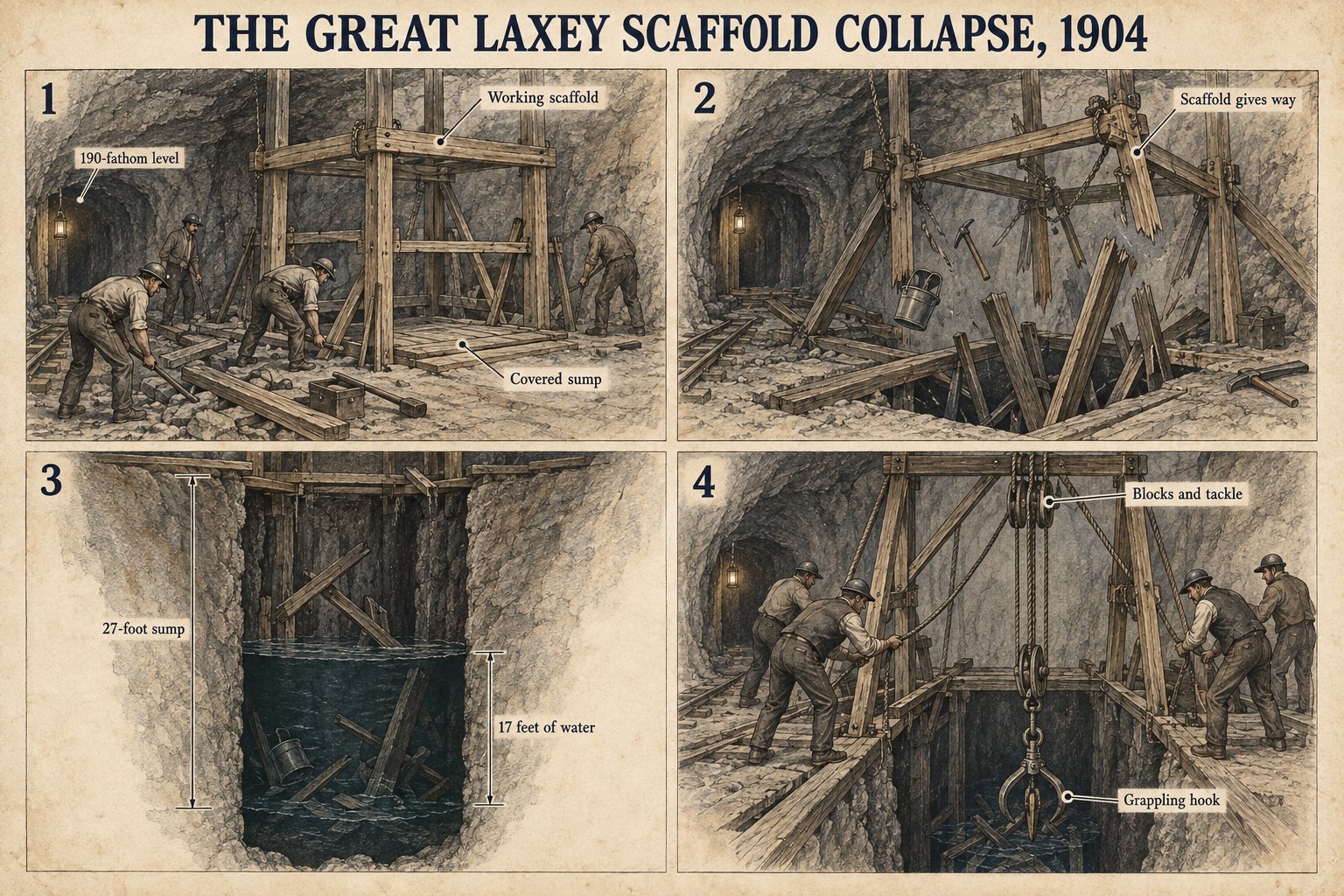
A working scaffold gave way underground, and the four men on it fell into a water-filled sump about 17 feet deep. All four drowned, including the youngest, 18-year-old Henry Lewis Gelling.
| Date | 10 December 1904 |
|---|---|
| Mine | Great Laxey Mine |
| Region | Isle of Man |
| Type | Collapse / Roof Fall |
| Fatalities | 4 (The four men killed were John Thomas Gawne, aged 41; John Thomas Quayle, 40; Robert Wade, 26; and Henry Lewis Gelling, 18.) |
| Context | During active mining |
What happened
The four men went down for a shift beginning at six in the morning of Saturday 10 December 1904, due to end at two. They were working at the 190 fathom level, about midway between the Engine Shaft and the Welsh Shaft — a level that had been a footway until the mine flooded in 1901 and had lain under water for several years since. Their job was to clear the debris, examine the level and prepare it for repair so it could serve as a footway again.
When the four failed to come to the surface at two the alarm was raised, and a search party set off at three. At the 190 fathom level they found collapsed timbers where a scaffold had stood around a covered sump — a hole cut in the floor of a level towards the level below, used here for ventilation. This one did not break through to the lower level: it was about 27 feet deep and held about 17 feet of water, to within ten feet of its covering. The scaffold had given way and the men had fallen in. There was no sign of a rock fall to explain it, and the suggestion at the time was that they had been testing the covering when it collapsed. Two of the men's watches had stopped a few minutes apart shortly after half past eleven, which fixed the time.
Grappling hooks and blocks and tackle were sent for. The first body came up at seven in the evening, two more at nine and eleven. The fourth man could not be found: the search went on through the night, through Sunday, and it was one o'clock on Monday morning before his body was recovered.
Rescue & recovery
The search party reached the 190 fathom level at about three in the afternoon and worked with grappling hooks, blocks and tackle to recover the men from the flooded sump — three bodies out between seven and eleven that night, and the fourth not until one o'clock on the Monday morning, some thirty-eight hours after the scaffold gave way.
Investigation & inquiry
An inquest opened on Tuesday 13 December 1904, presided over by James Gell, High Bailiff of Castletown, deputising for Samuel Harris. No finding on why the scaffold failed is recorded. The contemporary account says there was no rock fall in the vicinity to account for it, and that the men may have been testing the sump covering at the time.
Memorials & commemoration
The four were buried at Lonan churchyard on Tuesday 13 December 1904, the same day the inquest opened, the service taken by the vicar of Lonan, John Quine. The Great Laxey Mining Company was represented by its chairman, the mine manager and the mine secretary. Children from Minorca Sunday School, of which John Gawne was a member, and the Laxey Brass Band, of which John Quayle was a member, attended.
Recorded claims
Individual factual claims, each attached to the source(s) that support it below. Where sources disagree, both are kept.
- Four miners, including 18-year-old Henry Lewis Gelling, drowned on 10 December 1904 after a scaffold collapsed and they fell into a water-filled sump. 1
- The four men killed were John Thomas Gawne, aged 41, John Thomas Quayle, 40, Robert Wade, 26, and Henry Lewis Gelling, 18. 2
- The sump was about 27 feet deep, did not break through to the level below, and held about 17 feet of water to within ten feet of its covering; the men fell in when the scaffold around it collapsed, with no evidence of a rock fall. 2
- The accident was fixed at shortly after 11.30am by the watches of two of the men, which had stopped a few minutes apart. 2
- The alarm was raised when the men failed to surface at 2pm; the search began at 3pm, three bodies were recovered at 7pm, 9pm and 11pm, and the fourth not until 1am on the Monday morning. 2
- An inquest opened on Tuesday 13 December 1904 before James Gell, High Bailiff of Castletown; the funerals took place the same day at Lonan churchyard, attended by the Laxey Brass Band and children of Minorca Sunday School, to which two of the dead had belonged. 2
Related terminology
Mining terms this disaster is structurally linked to, with the nature of the relationship.
- Fathom (contextual relationship)
Named 3 times in this record, first in the narrative: “…10 December 1904, due to end at two. They were working at the 190 fathom level, about midway between the Engine Shaft and the Welsh Shaft — a…” - Level (contextual relationship)
Named 8 times in this record, first in the narrative: “…1904, due to end at two. They were working at the 190 fathom level, about midway between the Engine Shaft and the Welsh Shaft — a level…” - Shaft (contextual relationship)
Named twice in this record, first in the narrative: “…working at the 190 fathom level, about midway between the Engine Shaft and the Welsh Shaft — a level that had been a footway until the mine…” - Sump (direct cause)
The four men killed in 1904 fell into the sump at the bottom of the workings and drowned.
Sources
- (observational) Laxey Mine: one of the most influential mines in the Isle of Man — Abandoned Spaces
- (secondary) Laxey Mine — Wikipedia
Record created: 20 August 2026 · Last researched: 5 September 2026