 MineArchive
Ellistown Colliery
| Also known as | Ellestown Colliery |
|---|---|
| Location | Ellistown, near Coalville, Leicestershire — 52.6960, -1.3630 (approximate) |
| Commodities | Coal, Fireclay, Ironstone |
| Type | Coal |
| Worked | 1874–1991 |
| Maximum depth | 329 yards (301 m) to the Lower Main or Roaster Seam |
| Operators | Joseph Joel Ellis (1874–1885), Ellistown Colliery Company Limited (?–1947), National Coal Board (1947–1987), British Coal Corporation (1987–1991) |
Overview
Ellistown was begun in 1874 by Joseph Joel Ellis, who had acquired the land or the mineral rights over a large area around the site, and gave his name to the village that grew with it. Two shafts were finished by 1876 and a third started soon after, sunk in the deepest part of the eastern basin through the concealing New Red Sandstone to the Lower Main or Roaster Seam at 329 yards, where it was nine feet two inches thick. The geology was unusually kind — a dip of about 1 in 14 and no major faulting — and the colliery went on to be the largest in the basin, still working the Upper Main in 1952 with nearly a thousand people. It was linked to South Leicester in 1957 and later to Bagworth, its coal eventually surfacing at Nailstone, and closed with Bagworth in 1991.
History
The colliery was commenced in 1874 by J. J. Ellis, who had been able to acquire either the lands or the mineral rights over a large area around the site, and who went on acquiring them for many years afterwards; at least one contemporary publication gave the name as "Ellestown". Colonel Joseph Joel Ellis died in 1885 and the village of Ellistown is named after him. Two shafts were completed by 1876 and a third begun soon afterwards. The official list of collieries at work in 1880 returns the pit as "Ellistown, Bagworth, J. J. Ellis".
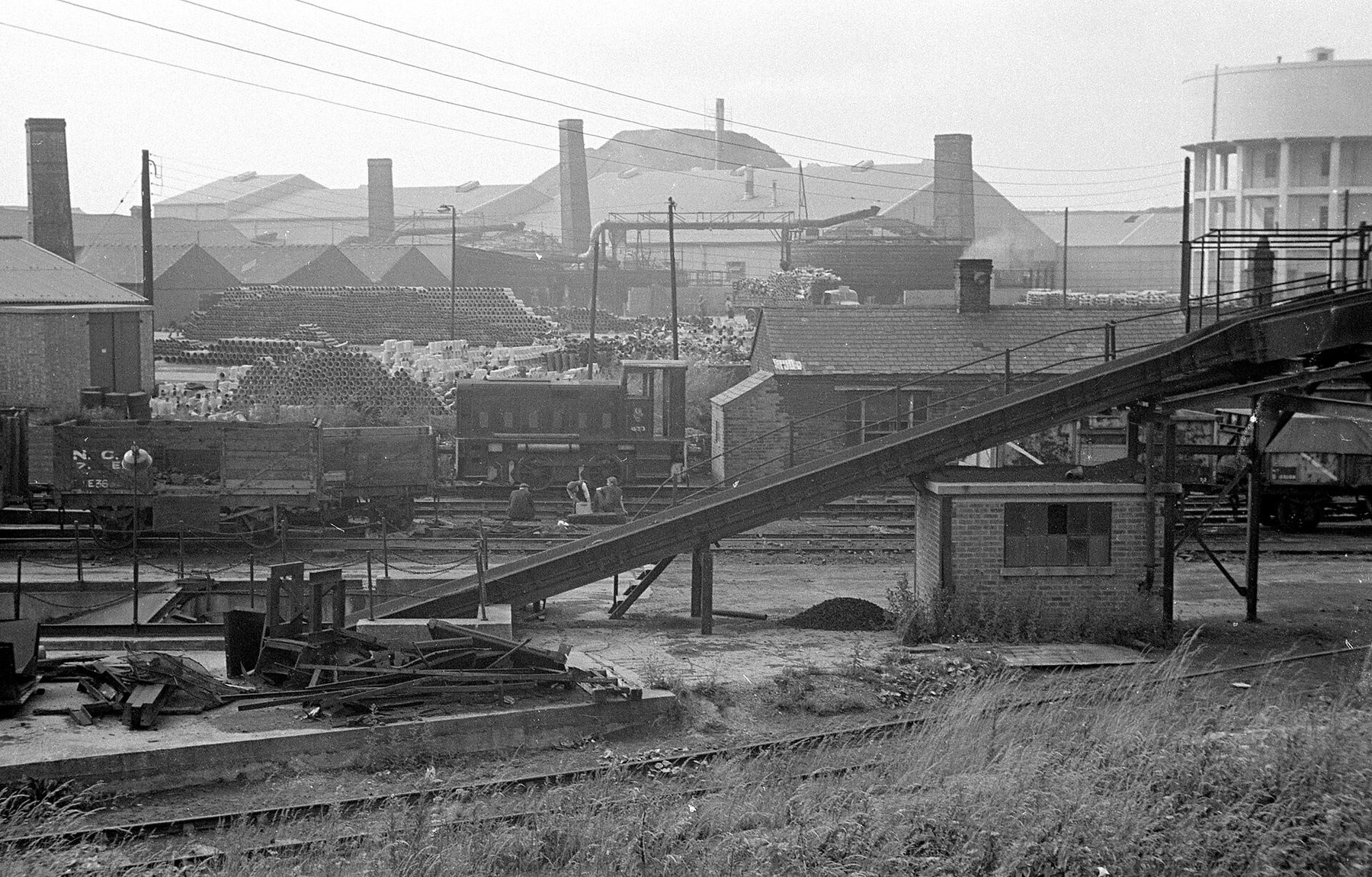
The early years were not smooth. The management got into trouble with the Inspector of Mines for failing to report an explosion and for failing to maintain adequate ventilation, and there were disputes over mineral rights and a lengthy dispute with the Leicestershire Miners Association in which, the local record notes, the miners came out best. Despite that, Ellistown became a very successful colliery and the largest in the eastern basin of the Leicestershire coalfield, the extent of its reserves indicated by the Upper Main still being worked in 1952, when the pit employed 779 people underground and 214 on the surface. Two brickworks stood beside it, one making refractory linings, firebricks and sanitary pipeware and the other blue building bricks.
Under the National Coal Board the colliery was linked with South Leicester in 1957 by a roadway in the Middle Lount Seam, and later its workings were connected to Bagworth Colliery and through it to the surface at Nailstone by the Nailstone drift, after which the whole combined output came up at Nailstone. It closed with Bagworth in 1991.
Geology
Ellistown was sunk in the deepest part of the eastern basin of the Leicestershire coalfield, where the Coal Measures are entirely concealed beneath the New Red Sandstone. The geology was unusually favourable: a dip of about 1 in 14, no faulting of the strata, and — despite the sandstone overhead — no major problems with water. The No. 1 shaft reached the Lower Main or Roaster Seam at 329 yards, where it was 9 ft 2 in thick, having intersected the Upper Main at 256 yards at 5 ft 6 in. Several other workable coal seams were passed, along with four seams of good-quality fireclay and four of ironstone — which is why two brickworks grew up beside the colliery.
Geological setting: Concealed Coalfields (historical documentary reference), Sedimentary Beds and Seams (well documented example)
Workings
Three shafts: No. 1 thirteen feet in diameter, sunk to the Lower Main at 329 yards; No. 2 ten feet, to the same depth; No. 3 also thirteen feet. Winding at the outset was by a twin-cylinder horizontal engine completed in 1874 by Death & Ellwood of the Albert Works, Leicester, with 34 by 60 inch cylinders, gridiron slide valves fitted with Dawes’s patent relief frames, Stephenson valve gear for reversing, and a built-up drum twenty feet in diameter over its wood lagging; a second winder came from Wood & Gee of Wigan in 1902. Ventilation was by furnace at first and later by a Waddle open-runner fan driven by a Belliss & Morcom enclosed engine, itself replaced by an electric unit but kept as a standby into the 1970s.
The pumping arrangements outlasted everything. A Cornish-type engine was installed in 1879 to deal with the water from the New Red Sandstone, replaced by a two-throw ram pump about 150 yards down the shaft, and about 1905 a single-cylinder horizontal engine by Fraser & Chalmers of Erith was put in at the pit top to drive it — 18 by 36 inches, Corliss valves all worked from a single wrist plate in the American manner, a Porter governor on the trip gear, and a flywheel grooved for eight ropes though latterly driven by V-belts. The water it raised went to the adjacent brickworks and into the public supply; Coalville’s municipal authority had contributed to the cost of the engine, which may be why it was kept in working order until 1975, long after electric pumps had replaced it. It was removed in 1976, ostensibly for preservation.
Closure
Ellistown’s later life was one of absorption into a larger complex. It was connected to South Leicester in 1957, then to Bagworth, and finally its output came to the surface not at its own shafts but at Nailstone by way of the Nailstone drift. It closed with Bagworth in 1991.
What remains
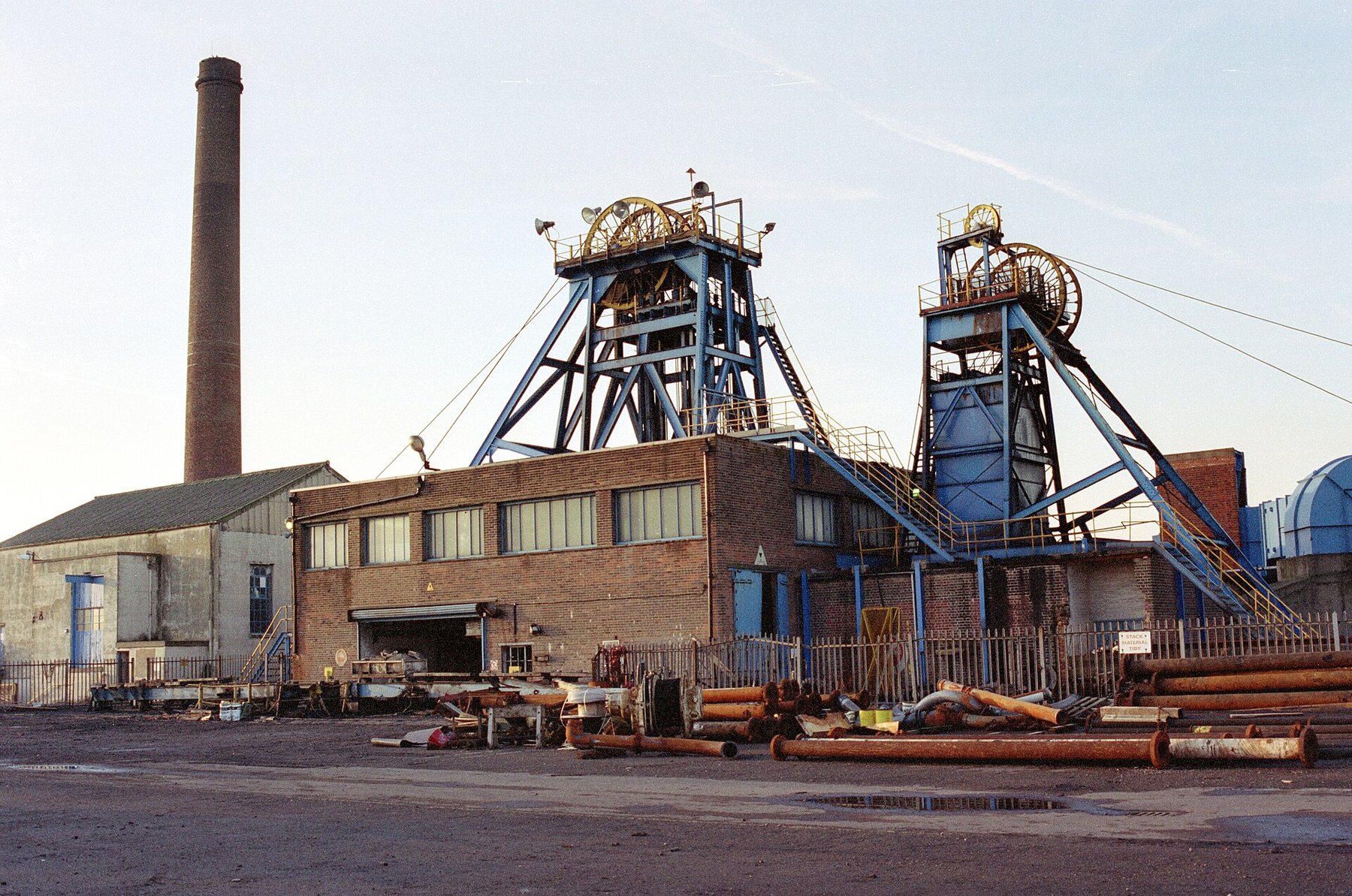
The colliery is gone; a photograph taken on 13 January 1990, in its last full year, shows the headgear and surface plant still standing. The village survives as what one visitor in 2006 called an old Leicestershire colliery village now reliant on the factories of the Bardon industrial estate, and lies just inside the eastern boundary of the National Forest.
Nothing of the colliery itself is known. Ellistown village keeps its name from the man who sank the pit and its shape from the colliery, with a working men’s club and Ellistown F.C. among the institutions that came with it. The 1905 Fraser & Chalmers pumping engine was removed in 1976, ostensibly for preservation.
Related mines
- Bagworth Colliery — The neighbouring colliery village that grew up after Ellistown was sunk in 1873 gave its name to the shared railway station, renamed Bagworth and Ellistown in 1894, and the two pits were latterly worked together as Bagworth–Ellistown.
- Nailstone Colliery — Ellistown’s workings were linked to Bagworth and through it to the surface at Nailstone by the Nailstone drift, so that the whole district’s output came up here after Nailstone itself stopped winding coal in 1967.
- South Leicester Colliery — A tunnel driven in the Nether Lount seam in 1957 joined the two collieries underground and they were worked as a single entity from then, South Leicester's shafts serving only for access and ventilation.
Nearby mines
- Ibstock Colliery — 0.8 miles (1.3 km) W
- South Leicester Colliery — 0.9 miles (1.5 km) N
- Whitwick Colliery — 1.9 miles (3.0 km) N
- Nailstone Colliery — 2.1 miles (3.4 km) S
- Bagworth Colliery — 2.2 miles (3.5 km) SE
Straight-line distance, within 9 miles (15 km). Show on the map.
Recorded claims
Individual factual claims, each attached to the source(s) that support it below. Where sources disagree, both are kept.
- The official list of collieries at work in 1880 returns the pit as "Ellistown, Bagworth, J. J. Ellis". 1
- The colliery was commenced in 1874 by J. J. Ellis, who had acquired the lands or mineral rights over a large area around the site; two shafts were completed by 1876 and a third begun soon afterwards. Colonel Joseph Joel Ellis died in 1885 and the village is named after him. 2,3
- No. 1 shaft was 13 ft in diameter and sunk to the Lower Main or Roaster Seam at 329 yards, where it was 9 ft 2 in thick, having intersected the Upper Main at 256 yards at 5 ft 6 in; No. 2 was 10 ft and sunk to the same depth, and No. 3 was also 13 ft. 2
- The shafts were sunk in the deepest part of the eastern basin with the coal measures entirely concealed below the New Red Sandstones; the dip was about 1 in 14, there was no faulting of the strata, and there were no major problems with water. 2
- In the early years the management got into trouble with the Inspector of Mines for failing to report an explosion and for failing to maintain adequate ventilation, and there were disputes over mineral rights and a lengthy dispute with the Leicestershire Miners Association in which the miners came out best. 2
- Ellistown was the largest colliery in the eastern basin of the Leicestershire coalfield, still working the Upper Main and Middle Lount seams in 1952 with 779 people underground and 214 on the surface. 2
- The 1905 Fraser & Chalmers pumping engine supplied water to the adjacent brickworks and into the public supply, and — Coalville’s municipal authority having contributed to its cost — was kept in working order until 1975, long after electric pumps replaced it; it was removed in 1976, ostensibly for preservation. 2
- The colliery was linked with South Leicester in 1957 by a roadway in the Middle Lount Seam and later to Bagworth, its combined output surfacing at Nailstone by the Nailstone drift; it closed with Bagworth in 1991. 2
- The BGS mine-plans catalogue holds a Mining Remediation Authority abandonment plan titled 'Ellistown' (catalogue EM1399, New Main, dated 1989). 4
Photographs & further reading
The fullest account of the pit, shaft by shaft and engine by engine, drawing on Northern Mine Research Society material: the 1874 Death & Ellwood winder, the Waddle fan, and the Fraser & Chalmers pumping engine that outlived the pumping it was built for because the town drank the water it raised.
View sourceSources
- (secondary) List of coal mines UK 1880 — Coalmining History Resource Centre
- (secondary) Ellistown Colliery — Coal Mining in Leicestershire — Coal Mining in Leicestershire
- (secondary) Ellistown — Wikipedia
- (primary) BGS / Mining Remediation Authority mine plans: ELLISTOWN — British Geological Survey / Mining Remediation Authority
- (observational) Ellistown Terrace Road (photographed 23 October 2006) — Kate Jewell, Geograph Britain and Ireland
Record created: 6 September 2026 · Last researched: 6 September 2026