 MineArchive
Lancashire Boiler
| Category | Structures & Machinery |
|---|
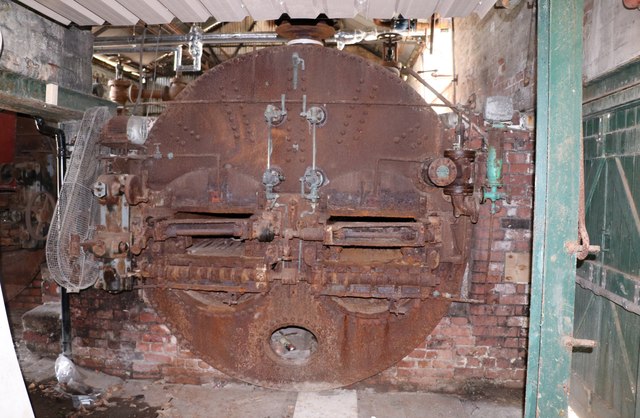
A horizontal cylindrical steam boiler with two large flues running its length, each with its own furnace at the front, set in brickwork so that the hot gases pass through the flues and then back along the outside of the shell. From the middle of the nineteenth century to the middle of the twentieth it was the commonest boiler at collieries, mills and pumping stations working at moderate pressure.
Historical usage
The Cornish boiler, Trevithick's long cylinder with a single flue, came first. William Fairbairn's Lancashire boiler of 1844 gave it two flues: he had reasoned from the thermodynamics of boilers that the grate area should be increased relative to the volume of water, and his patent of 1845 was for stoking the two furnaces alternately to reduce smoke rather than for the shell itself, which originated earlier. Galloway tubes, tapered water tubes set across the flues and patented in 1848, added heating surface. At Caphouse Colliery, now the National Coal Mining Museum, two coal-burning Lancashire boilers with mechanical stokers supplied the steam winding engine.
How it worked
The shell, up to about ten metres long, holds the two flues below the water line. Coal burns on grates at the front of each flue; a low brick wall inside the flue keeps the burning coal back and sends the gases over it, and the flues narrow towards the back. The gases pass to the rear, return along a bottom flue beneath the shell and then forward along two side flues to the chimney, so that the brick setting is part of the boiler, taking heat and giving it back and insulating the whole. Most of the heat, eighty to ninety per cent of what is transferred, passes through the flue plates, the bottom and side flues adding the rest. Safety valves, a steam stop valve and a feed that keeps the flues covered complete it, and it is large enough for a man to go in through a manhole to clean.
Why it was used
The two flues gave a large heating surface and a large steam space, and two smaller flues were less liable than one large one to collapse under pressure, so a Lancashire boiler could be worked harder than a Cornish of the same size. It raised large quantities of steam reliably with little maintenance and was simple to work, which suited a colliery that needed steam for winding, pumping, fans and compressors round the clock.
Risks & limitations
It takes a great deal of floor space and a long time to raise steam, its grates are limited by the diameter of the flues, and it cannot make high-pressure steam, so as pressures rose in the twentieth century other types took its place. Its design suits a stationary installation and nothing else.
Regional variation
The name is Fairbairn's county, where the cotton mills were its first market; the type was built and used across Britain and abroad, and the Science Museum's sectioned model came from a Wolverhampton maker.
Related terminology
Boiler House, Cornish Engine, Engine House, Pumping Engine, Winding Engine
Mines associated with this term
5 examples chosen from 22 linked records — the term page is not an index.
- Elsecar Colliery — South Yorkshire (well documented example)
Named in this record’s history: “…Association, and even then it was steamed occasionally from a Lancashire boiler in the Elsecar workshops into the 1950s. Henry Ford twice tried to…” - Mosley Common Colliery — Greater Manchester (well documented example)
Named in this record’s workings: “…shaft. Surface plant included an electric generating house of 1915, Lancashire boilers by Galloways under a tall 1916 chimney, and, from the 1962…” - South Wheal Frances — Cornwall (well documented example)
Named in this record’s surface remains: “…retains its pumping engine house, boiler house (with arches for six Lancashire boilers), winding house, air-compressor house, capstan house and the base of…” - Aspull Pumping Pit — Greater Manchester (well documented example)
Named in this record’s workings: “…pumping engine of 1894 and three electric ram pumps of 1908; five Lancashire boilers; a single-cylinder geared winder under a wooden headgear;…” - Braehead Colliery — West Lothian (well documented example)
Named in this record’s history: “…its plant on site: a dross washer and coal-picking tables, two Lancashire boilers, a 300-kilowatt generating set, coal cutters, shaker conveyors and…”
Disasters associated with this term
Included only where MineArchive's own research gives a reasonable evidential basis, with the nature of the relationship stated — not every disaster where this term might plausibly apply.
- Clyde Colliery boiler-house wall collapse, 1924 (contextual relationship)
Named twice in this record, first in the summary: “…boiler firemen at Clyde Colliery, Hamilton, were firing a battery of Lancashire boilers when the eight-foot brick wall behind them, holding back a stack of…” - Seaham Colliery boiler accident, 1901 (contextual relationship)
Named 3 times in this record, first in the summary: “A new Lancashire boiler slipped off its chocks while being set at Seaham Colliery on 18…” - Usworth Colliery boiler explosion, 1891 (contextual relationship)
Named in this record’s cause: “The centre of three Lancashire boilers in the Low Main Seam, corroded at the waterline over years of…”
Sources
- (observational) National Mining Museum: derelict Lancashire boiler (Geograph 8073851) — Geograph
- (secondary) Fire-tube boiler — Wikipedia
- (secondary) Model showing ordinary flat-ended Lancashire boiler with flanged seam flues — Science Museum Group
- (secondary) The Lancashire Boiler: Victorian ingenuity — mechanical-engineering.com
Record created: 18 October 2026 · Last researched: 18 October 2026