 MineArchive
Mosley Common Colliery
| Also known as | Stonehouse Pits |
|---|---|
| Location | Mosley Common, near Boothstown and Tyldesley, Greater Manchester — 53.5092, -2.4178 (exact) |
| Commodity | Coal |
| Type | Coal |
| Worked | 1868–1968 |
| Maximum depth | 1,000 yards (about 914 m) at No. 4 shaft after its deepening for the 1962 reconstruction; 602 yards to the Trencherbone mine as originally sunk in 1881. |
| Operators | Bridgewater Trustees (1862–1929), Manchester Collieries Ltd (1929–1947), National Coal Board (1947–1968) |
Overview
The largest colliery on the Lancashire Coalfield, sunk from 1862 by the Bridgewater Trustees to reach seams below the old Stonehouse Pits, and eventually working five shafts over some 270 million tons of coal beneath the Permian cover. Rebuilt by the National Coal Board as a 'superpit' for £7.5 million and employing 3,000, it closed in 1968 — not because the coal ran out, but after being set production targets it could not meet.
History
Work began in 1862 to sink three shafts to 500 yards in ground that had been mined for some time; the older workings there were the Stonehouse Pits, and the new colliery was put down to reach the deeper seams they had not touched. Sinking the 12-foot No. 1 shaft ran into heavy water, and massive pumps were installed from John Musgrave & Sons of Bolton, who also built a winding engine that lasted until 1964. Production began in 1868 from the Crombouke mine, some of the first miners coming from other Bridgewater Trustees pits whose reserves were running out. No. 2 was sunk to 535 yards, and No. 3, the upcast, to the same depth with a winding engine for men rather than coal.
No. 4 pit, 18 ft 6 in in diameter, was sunk to the Trencherbone mine at 602 yards in 1881, with a Haigh Foundry winding engine and a steel lattice headframe. An electric power house was built in 1915 and a tall chimney for the Galloways boiler plant in 1916.
In 1923 Nos. 1, 2 and 5 pits employed 1,338 underground and 198 at surface, while Nos. 3 and 4 employed 951 and 143. The colliery joined Manchester Collieries in 1929 when Bridgewater Collieries came into that company; the combined figures were 1,729 underground and 489 surface in 1933, and 1,711 and 531 in 1940. At nationalisation in 1947 Nos. 1 and 2 employed 978 underground and 406 surface workers, and No. 4 a further 853 and 221.
The National Coal Board then rebuilt it. No. 4 shaft was deepened to 1,000 yards and a Koepe tower winder erected in 1961; the £7.5 million reconstruction was completed in 1962, making Mosley Common one of the largest and most modern pits in the country, employing 3,000. It closed six years later with its reserves still unexhausted, and the site was cleared by 1974.
Geology
The colliery worked the Manchester Coalfield's Middle Coal Measures, reaching the deeper seams that the older Stonehouse Pits had not — the Crombouke first, then the Brassey, Seven Foot and Trencherbone. Its great asset was position: some 270 million tons of coal lay to the south beneath the Permian rocks, ground that the deepened No. 4 shaft was intended to open up.
Geological setting: Concealed Coalfields (historical documentary reference), Sedimentary Beds and Seams (well documented example)
Workings
Five shafts in the end. Nos. 1, 2 and 3 were sunk to around 500–535 yards from 1862, No. 4 to the Trencherbone at 602 yards in 1881 and later deepened to 1,000 yards, with a Koepe tower winder of 1961 replacing the older headgear. No. 3 was the upcast ventilation shaft. Surface plant included an electric generating house of 1915, Lancashire boilers by Galloways under a tall 1916 chimney, and, from the 1962 reconstruction, the modern winding and preparation plant that made the pit a showpiece.
Closure
Closed in 1968, six years after a £7.5 million reconstruction, with its coal reserves not exhausted; the pit had been set production targets it could not meet. The site was cleared by 1974.
What remains
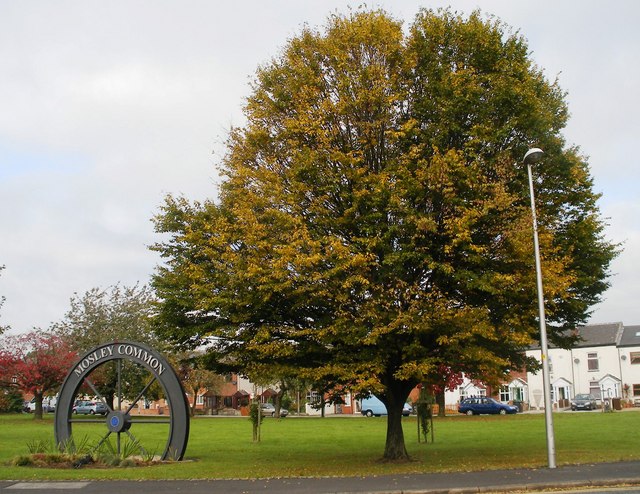
Nothing of the colliery survives; the site was cleared by 1974 and the ground has since been built over and landscaped. A marker in the village commemorates the pit.
None. The colliery was demolished and the site cleared within six years of closure.
Redevelopment
The colliery site was cleared by 1974 and has since been absorbed into the residential and open ground of Mosley Common and Boothstown.
Related mines
- Brackley Colliery — Both Bridgewater Trustees collieries, and two of only three ex-Bridgewater pits still working at nationalisation in 1947; Brackley's direct-current plant was converted and its power then drawn from Mosley Common.
- Sandhole Colliery — Sandhole drew its electricity from Mosley Common's power house, and its washery treated Mosley Common's coal until 1950.
Nearby mines
- New Lester Colliery — 1.0 miles (1.6 km) NW
- Great Boys Colliery — 1.0 miles (1.7 km) NW
- Yew Tree Colliery — 1.1 miles (1.8 km) W, Lancashire
- Ellesmere Colliery — 1.2 miles (1.9 km) NE
- Astley Green Colliery — 1.6 miles (2.5 km) SW
Straight-line distance, within 9 miles (15 km). Show on the map.
Disasters & major incidents
-
Mosley Common Colliery winding accident, 1869
25 or 26 September 1869 · Winding / Shaft Accident · 2 fatalities
Two men died at the Bridgewater Trustees' Mosley Common Colliery in September 1869 when the winding drum came out of gear as they went down the pumping pit. -
Mosley Common Colliery haulage accident, 1881
20 September 1881 · Haulage / Transport · 2 fatalities
Two young miners at the Bridgewater Trustees' Mosley Common Colliery were killed on 20 September 1881 after apparently jumping onto moving tubs on a gig-brow and overturning them. -
Mosley Common Man-Riding Accident, 1952
2 October 1952 · Haulage / Transport · 3 fatalities
On 2 October 1952 three men were killed and many injured when a man-riding train crashed at Mosley Common Colliery, near Tyldesley in Lancashire.
Recorded claims
Individual factual claims, each attached to the source(s) that support it below. Where sources disagree, both are kept.
- Work began in 1862 to sink three shafts to 500 yards, on ground already worked by the older Stonehouse Pits; production started in 1868 from the Crombouke mine. 1
- Sinking the 12-foot No. 1 shaft met heavy water, and massive pumps were installed from John Musgrave & Sons of Bolton, who also built a winding engine that survived until 1964. 1
- The colliery eventually had five shafts and became the largest on the Lancashire Coalfield, with access to around 270 million tons of coal beneath the Permian rocks to the south. 1
- No. 4 pit, 18 ft 6 in in diameter, was sunk to the Trencherbone mine at 602 yards in 1881, and was later deepened to 1,000 yards with a Koepe tower winder built in 1961. 1
- A £7.5 million National Coal Board reconstruction completed in 1962 turned the pit into a 'superpit' employing 3,000 workers, among the largest and most modern in the country. 1
- The colliery closed in 1968 after being set production targets it could not meet, though its coal reserves had not been exhausted; the site was cleared by 1974. 1
Photographs & further reading
Owners, year-by-year output and employment for each group of shafts, and a name-by-name list of the 116 recorded deaths at the colliery with the circumstances of each.
View sourceThe colliery shaft by shaft, from the 1862 sinking through the Bridgewater and Manchester Collieries years to the NCB reconstruction that preceded its closure.
View sourceSources
- (secondary) Mosley Common Colliery — Wikipedia
- (primary) Mosley Common Colliery — Durham Mining Museum
Record created: 3 September 2026 · Last researched: 3 September 2026