 MineArchive
Astley Green Colliery
| Location | Astley, Tyldesley, Greater Manchester — 53.4933, -2.4453 (exact) |
|---|---|
| Commodity | Coal |
| Type | Coal |
| Worked | 1908–1970 |
| Operators | Clifton and Kearsley Coal Company (1908–?) |
Overview
The last deep mine sunk in the Manchester coalfield, whose sole surviving headgear and winding engine anywhere on the Lancashire coalfield were saved from demolition by campaigners and now form the Lancashire Mining Museum.
History
Astley Green Colliery was sunk from 1908 by the Clifton and Kearsley Coal Company to work reserves in the south Lancashire coalfield, and went on to become the last deep mine sunk in the wider Manchester coalfield. At its height the colliery employed around 2,000 men. In the early hours of 7 June 1939 an explosion of firedamp struck while men were fighting an underground fire more than a mile from the pit bottom; five men died, including the pit manager, who was killed leading the firefighting effort, and four more were injured. Mines rescue teams from Boothstown Mines Rescue Station responded but were themselves driven back by further explosions, hampering recovery efforts for hours. It was the first serious accident at the colliery since its sinking three decades earlier, and was significant enough to be raised in the House of Commons the following month. The colliery finally closed on 3 April 1970, with demolition beginning the same year; sustained pressure from Lancashire County Council, local museums and archaeologists secured the preservation of the headgear and winding engine for Number 1 shaft, along with its travelling crane and shed.
Geology
Astley Green worked coal seams of the south Lancashire coalfield.
Workings
Coal was raised via deep shafts served by steam winding engines, with underground workings extending well over a mile from the pit bottom by the time of the 1939 disaster.
Closure
The colliery closed on 3 April 1970, with the last coal wound that day; demolition of most surface structures began immediately afterwards.
What remains
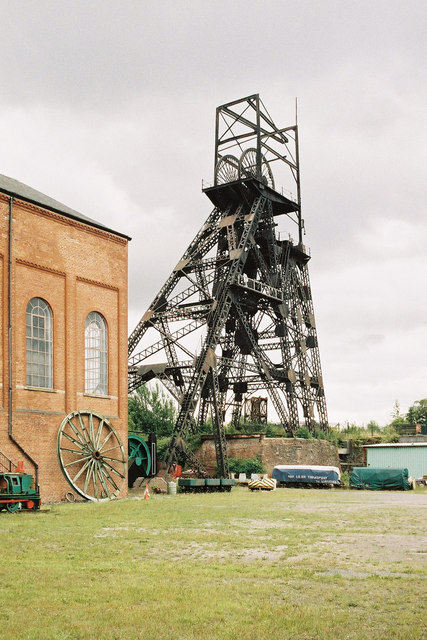
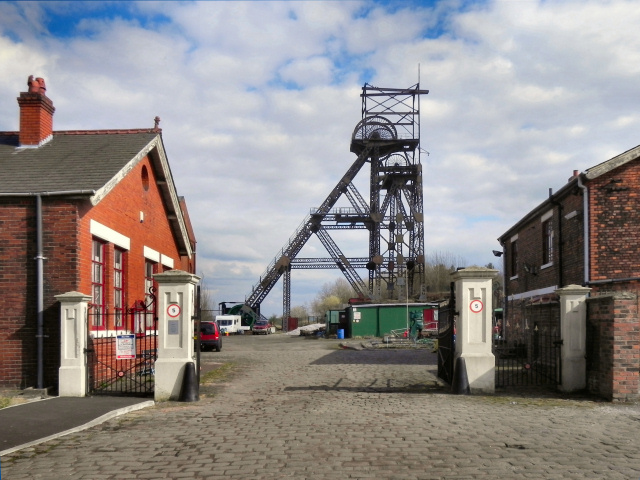
The preserved Number 1 shaft headgear and winding engine, protected as a Grade II Scheduled Monument, now form the centrepiece of the Lancashire Mining Museum on the site.
The colliery's original headgear — nearly 30 metres tall, built by Head Wrightson of Stockton-on-Tees in 1910-11 with 20-foot sheaves — survives complete with its winding engine, travelling crane and engine shed, alongside a collection of colliery locomotives and a replica miner's cottage.
Related mines
- Bickershaw Colliery — Neighbouring Lancashire coalfield pits around Leigh, worked into the Coal Board years.
- Chanters Colliery — Lancashire coalfield pits a few miles apart in the Tyldesley and Atherton district.
Nearby mines
- Gin Pit Colliery — 1.2 miles (2.0 km) NW
- Nook Colliery — 1.4 miles (2.2 km) NW
- Yew Tree Colliery — 1.5 miles (2.4 km) N, Lancashire
- Great Boys Colliery — 1.6 miles (2.5 km) N
- Mosley Common Colliery — 1.6 miles (2.5 km) NE
Straight-line distance, within 9 miles (15 km). Show on the map.
Disasters & major incidents
-
Astley Green Colliery explosion, 1939
7 June 1939 · Explosion · 5 fatalities
A firedamp explosion struck Astley Green Colliery in the early hours of 7 June 1939 while men fought an underground fire over a mile from the pit bottom, killing five men including the pit manager and injuring four more; mines rescue teams were themselves driven back by further explosions.
Recorded claims
Individual factual claims, each attached to the source(s) that support it below. Where sources disagree, both are kept.
- Astley Green Colliery was sunk from 1908 by the Clifton and Kearsley Coal Company, becoming the last deep mine sunk in the Manchester coalfield. 1
- A firedamp explosion in the early hours of 7 June 1939, during efforts to fight an underground fire over a mile from the pit bottom, killed five men including the pit manager and injured four more. 1,2,3
- The colliery closed on 3 April 1970, the last deep mine sunk in the Manchester coalfield to do so; demolition began the same year, though the headgear and winding engine for Number 1 shaft were saved by local campaigning. 1,4
- The colliery's original 1910-11 headgear and winding engine — the only surviving example on the entire Lancashire coalfield — form the centrepiece of the Lancashire Mining Museum on the site today. 4
Photographs & further reading
The sinking from 1908 by the Pilkington Colliery Company, the shafts and seams, the Yates and Thom winding engine that remains in place, and the closure in 1970.
View sourceThe Commons exchange on the 1939 accident, which is the contemporary official record of it.
View sourceSources
- (secondary) Astley Green Colliery — Wikipedia
- (primary) Accident, Astley Green Colliery (Hansard, 4 July 1939) — UK Parliament (Historic Hansard)
- (secondary) Astley Green Colliery Explosions - Tyldesley - 1939 — Northern Mine Research Society
- (secondary) Astley Green Colliery Museum — Wikipedia
- (observational) Astley Green Colliery Museum (Geograph 2316506) — Geograph Britain and Ireland, David Dixon
Record created: 21 August 2026 · Last researched: 11 September 2026