 MineArchive
Bickershaw Colliery
| Location | Plank Lane, Leigh, Greater Manchester — 53.4930, -2.5557 (exact) |
|---|---|
| Commodity | Coal |
| Type | Coal |
| Worked | c.1830 (sinking)–13 March 1992 |
| Maximum depth | No.3 shaft: 700 yards, 18 feet in diameter |
| Operators | Abram Collieries Ltd (1933–1947), National Coal Board (1947–1992) |
Overview
A Lancashire coalfield giant near Leigh, struck by three separate disasters across twenty-seven years, and the mine where Victoria Cross recipient Alfred Robert Wilkinson, a former Manchester Regiment lieutenant, died an ordinary miner's death from carbon monoxide poisoning in 1940.
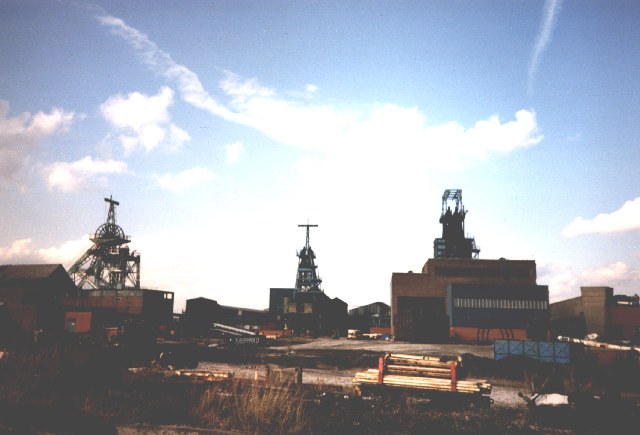
History
Turner and Ackers sank Bickershaw's first shaft around 1830; the colliery was substantially redeveloped from 1872 with new No.1 and No.2 shafts, deepened further in 1877. The pit amalgamated with Abram Collieries in 1933 and passed to the National Coal Board on the 1947 nationalisation of the coal industry. Bickershaw worked a long sequence of Lancashire coalfield seams — Crombouke, Pemberton Five Feet, White and Black, King Coal, Peacock, Plodder, Arley, Trencherbone and Haigh/Yard Plodder — the Plodder seam alone over three metres thick.
Among those who died at Bickershaw was Lieutenant Alfred Robert Wilkinson VC, who had been awarded the Victoria Cross for delivering a message under sustained machine-gun and shell fire at the Battle of the Selle in October 1918 while serving with the Manchester Regiment; he later worked as a miner at Bickershaw and died there of carbon monoxide poisoning on 18 October 1940, a single fatality rather than a mass-casualty event. The colliery was also struck by three larger disasters across 27 years: a shaft accident in 1932 that killed 19 men, an explosion in 1942 that killed 6, and a further explosion in 1959 that killed 5 (see Disasters, below).
From 1975 Bickershaw became the central winding colliery for a linked group that also included Golborne and Parsonage collieries. After Golborne closed in 1989, Bickershaw's production target rose to 20,000 tonnes a week, but the colliery consistently missed it; British Coal judged the pit unprofitable, and Bickershaw and Parsonage closed together on 13 March 1992, a closure union officials at the time called political.
Geology
Bickershaw worked a long sequence of Lancashire coalfield seams, including Crombouke, Pemberton Five Feet, White and Black, King Coal, Peacock, Plodder, Arley, Trencherbone and Haigh/Yard Plodder; the Plodder seam alone exceeded three metres in thickness.
Workings
No.3 shaft, 700 yards deep and 18 feet in diameter, was fitted with the 'Visor' automatic overwind-prevention device, made by John Wood and Sons of Wigan; from 1975 the colliery became the central coal-winding point for a linked underground group that also included Golborne and Parsonage collieries.
Closure
British Coal closed Bickershaw and the linked Parsonage Colliery together on 13 March 1992, after the pit consistently missed an increased production target set following the 1989 closure of Golborne Colliery; union officials called the closure political.
What remains
The derelict colliery site began redevelopment planning in the mid-1990s, with proposals for housing and employment space; part of the site is now Bickershaw Country Park.
Related mines
- Abram Colliery — Neighbours on the Bickershaw Hall estate; the Abram company merged with Bickershaw in 1933 to form Bickershaw Collieries Ltd.
- Astley Green Colliery — Neighbouring Lancashire coalfield pits around Leigh, worked into the Coal Board years.
- Golborne Colliery — Connected underground in 1975; Golborne's coal was thereafter wound at Bickershaw once Golborne's own winding ceased in 1977.
Nearby mines
- Parsonage Colliery — 1.3 miles (2.0 km) NE, Lancashire
- Priestners Colliery — 1.4 miles (2.2 km) NE
- Sovereign Colliery — 1.4 miles (2.2 km) NE
- Abram Colliery — 1.7 miles (2.7 km) NW
- Wigan Junction Colliery — 1.7 miles (2.7 km) NW
Straight-line distance, within 9 miles (15 km). Show on the map.
Disasters & major incidents
-
Bickershaw Colliery fall of stone, 1864
27 April 1864 · Collapse / Roof Fall · 2 fatalities
A thirteen-year-old horse driver and a collier were killed by a fall of stone at Ackers, Whitley and Company's Bickershaw Colliery on 27 April 1864. -
Bickershaw Colliery shaft accident, 1932
10 October 1932 · Winding / Shaft Accident · 19 fatalities
An overwound cage carrying 20 men plunged through the bottom of Bickershaw's No.3 shaft into a water-filled sump on 10 October 1932, drowning 19 of them in one of British mining's worst shaft accidents. -
Bickershaw Colliery explosion, 1942
5-6 January 1942 · Explosion · 6 fatalities
An explosion in No.4 pit's Rise Unit, probably caused by spontaneous combustion igniting gas in sealed-off old workings, killed 6 men shortly before midnight on 5 January 1942. -
Bickershaw Colliery explosion, 1959
10 October 1959 · Explosion · 5 fatalities
Carbon monoxide from an explosion in an abandoned district of the Plodder Seam killed 5 men at Bickershaw Colliery on 10 October 1959.
Recorded claims
Individual factual claims, each attached to the source(s) that support it below. Where sources disagree, both are kept.
- Turner and Ackers sank Bickershaw's first shaft around 1830; new No.1 and No.2 shafts followed from 1872, deepened in 1877, and the colliery amalgamated with Abram Collieries in 1933 before passing to the National Coal Board in 1947. 1
- The colliery worked the Crombouke, Pemberton Five Feet, White and Black, King Coal, Peacock, Plodder, Arley, Trencherbone and Haigh/Yard Plodder seams, the Plodder seam alone exceeding three metres in thickness. 1
- Lieutenant Alfred Robert Wilkinson, awarded the Victoria Cross for actions with the Manchester Regiment at the Battle of the Selle in October 1918, later worked as a miner at Bickershaw and died there of carbon monoxide poisoning on 18 October 1940. 2
- From 1975 Bickershaw became the central coal-winding colliery for a group linked underground with Golborne and Parsonage collieries. 3
- Bickershaw and Parsonage Collieries closed together on 13 March 1992, after the pit consistently missed an increased production target set following Golborne Colliery's 1989 closure; union officials called it a political closure. 1,3
- Located at about 53.493 N, 2.556 W. 1
Sources
- (secondary) Bickershaw Colliery — Wikipedia
- (secondary) Alfred Robert Wilkinson — Wikipedia
- (secondary) Bickershaw Colliery — Northern Mine Research Society
Record created: 27 August 2026 · Last researched: 27 August 2026