 MineArchive
Priestners Colliery
| Also known as | Priestner's Colliery, Priestner Pits |
|---|---|
| Location | Westleigh, Leigh, Greater Manchester — 53.5069, -2.5322 (approximate) |
| Commodity | Coal |
| Type | Coal |
| Worked | By 1870–1934 |
| Maximum depth | 540 yards (to the Trencherbone) |
| Operators | John Speakman & Sons (1870–1873), Wigan Coal & Iron Co. (1877–1930), Wigan Coal Corporation Ltd (1930–1934) |
Overview
A two-shaft Westleigh colliery, begun by John Speakman and bought by the Wigan Coal & Iron Company in 1877. It was deepened to 540 yards, employed over 1,200 people in 1923 and closed in 1934.
History
Priestners Colliery stood at Westleigh, on the western side of Leigh. John Speakman held it from 1870 until his death in 1873, and in March 1877 the Wigan Coal & Iron Company bought it from his executors. Its two shafts were first sunk to the Crombouke (Ince Four) at 214 yards and the Bickershaw Seven Feet at 348 yards. Wigan Coal & Iron later deepened them to 540 yards to reach the Trencherbone, passing the Hindley Green Yard and Four Feet on the way.
Through the 1890s and 1900s No. 1 Pit worked the Crombouke and No. 2 the Bickershaw Seven Feet, both for household coal. Employment rose from 478 in 1894 to 931 in 1915. From 1916 only the Hindley Green mines were worked. In 1923 the colliery employed 1,213 people and raised about 230,000 tons. In October 1881 two miners were killed when a banksman's mistake sent a tub down onto the cage carrying them and six others up the shaft.
The Wigan Coal Corporation took over in 1930. By 1933 the workforce had fallen to 416, and the colliery closed in 1934. The bronze First World War plaques put up at the No. 1 and No. 2 Pits in June 1920 were moved to the porch of St Paul's Church, Westleigh, after the closure.
Geology
Lancashire Coal Measures: the Crombouke (Ince Four Feet) at 214 yards, the Bickershaw Seven Feet at 348 yards, the Hindley Green Yard and Four Feet, and the Trencherbone (Hindley Green Five Feet or Wigan Nine Feet) at 540 yards. Pyrites was returned with the coal in 1915.
Workings
Two shafts. No. 1, the upcast, had a 20 by 54-inch winding engine with single-deck cages. No. 2, the downcast, had a 36 by 72-inch Haigh Foundry engine with double-deck cages carrying two tubs a deck. A 20-foot Guibal fan was followed in 1904 by a Walker 'Indestructible' fan driven by a cross-compound engine. A turbo-compressor supplied compressed air, and Lancashire boilers raised steam.
Closure
Closed in 1934 under the Wigan Coal Corporation. The Bickershaw Seven Feet workings had been abandoned in 1904, and the Crombouke, Brassey and Westleigh Six Feet workings shared with Parsonage in 1925. The reason for closure is unknown.
What remains
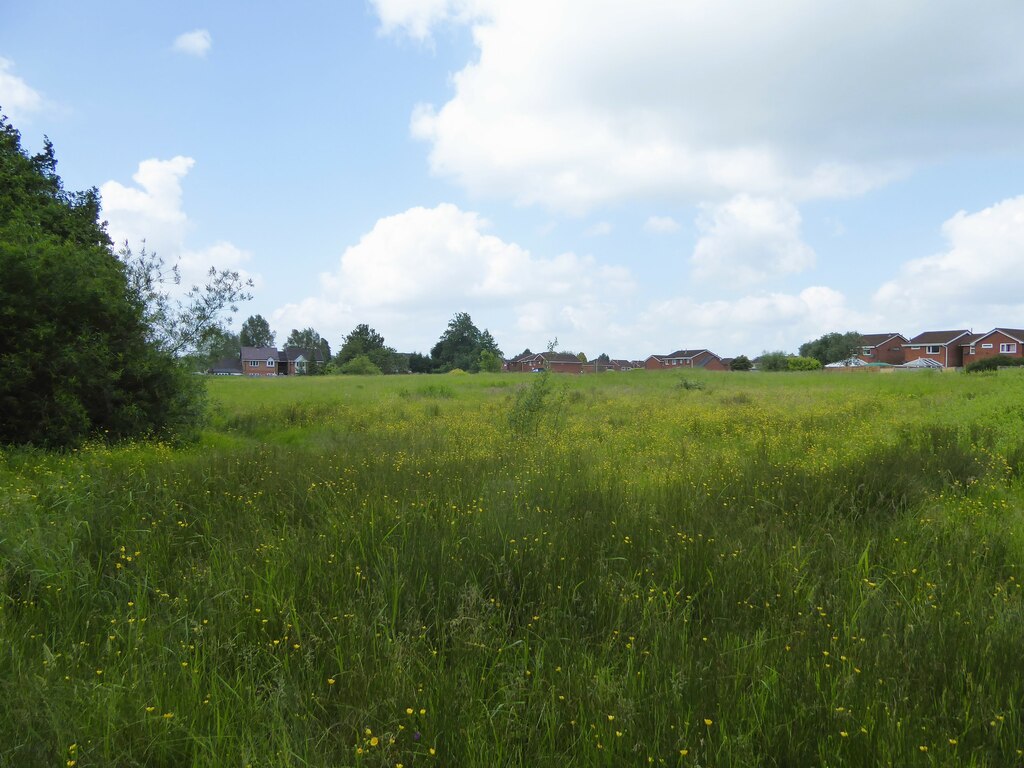
A 2024 photograph shows the site as a large open space south of the housing on Congresbury Road.
Redevelopment
Unknown.
Related mines
- Bedford Colliery — Both Speakman family collieries in Leigh before 1877.
- Parsonage Colliery — Workings planned together with Parsonage in the Crombouke, Brassey and Westleigh Six Feet.
- Sovereign Colliery — Wigan Coal & Iron Company neighbour in Westleigh; their war-memorial plaques hang together in St Paul's Church.
Nearby mines
- Sovereign Colliery — 0.0 miles (0.0 km) NE
- Parsonage Colliery — 0.5 miles (0.8 km) SE, Lancashire
- Howe Bridge Colliery — 1.0 miles (1.6 km) NE
- Lovers Lane Colliery — 1.2 miles (1.9 km) NE
- Bickershaw Colliery — 1.4 miles (2.2 km) SW
Straight-line distance, within 9 miles (15 km). Show on the map.
Recorded claims
Individual factual claims, each attached to the source(s) that support it below. Where sources disagree, both are kept.
- Bought by the Wigan Coal & Iron Company from the executors of John Speakman in March 1877. 1
- The shafts were first sunk to the Crombouke at 214 yards and the Bickershaw Seven Feet at 348 yards, and later deepened to 540 yards to the Trencherbone. 1
- Employed 1,213 people in 1923, 1,009 of them underground. 2
- Employed 387 underground and 70 at the surface in 1896. 3
- Closed in 1934. 1,4
- First World War plaques installed at the No. 1 and No. 2 Pits in June 1920 were moved to the porch of St Paul's Church, Westleigh, after the pits closed. 4
- Plans of the Bickershaw Seven Feet workings were deposited as abandoned in 1904. 5
- Its Crombouke, Brassey and Westleigh Six Feet workings were planned with Parsonage's and abandoned in 1925. 6
- A 2024 photograph shows the site as an open space south of Congresbury Road. 7
Photographs & further reading
Owners, shafts, winding and ventilation plant, output and closure, from the G. Hayes collection.
View sourceOwners, seams and employment from the lists of mines, and recorded fatalities.
View sourceThe 1920 colliery plaques now in the porch of St Paul's Church, Westleigh, with 2018 photographs.
View sourceSources
- (secondary) Priestner's Colliery — Northern Mine Research Society
- (primary) Priestners Colliery — Durham Mining Museum
- (secondary) Westleigh, Greater Manchester — Wikipedia
- (secondary) Wigan Coal and Iron Company, Sovereign and Priestner Pits, St Paul's Church Westleigh — War Memorials Online
- (primary) Mine plan: Priestners, Bickershaw Seven Feet (abandoned 1904) — British Geological Survey
- (primary) Mine plan: Priestners Nos. 1 and 2 and Parsonage, Crombouke, Brassey and Westleigh Six Feet (abandoned 1925) — British Geological Survey
- (observational) Site of former colliery (photograph, 2024) — Geograph
Record created: 1 October 2026 · Last researched: 2 October 2026