 MineArchive
Bickershaw Colliery shaft accident, 1932
An overwound cage carrying 20 men plunged through the bottom of Bickershaw's No.3 shaft into a water-filled sump on 10 October 1932, drowning 19 of them in one of British mining's worst shaft accidents.
| Date | 10 October 1932 |
|---|---|
| Mine | Bickershaw Colliery |
| Region | Greater Manchester |
| Type | Winding / Shaft Accident |
| Fatalities | 19 (The sole survivor, James Sharpe (47), suffered broken bones and head injuries and lived with permanent disabilities afterward. The dead included firemen, haulers and miners aged 20 to 64, most from Leigh and the surrounding area.) |
| Injuries | James Sharpe, the sole survivor, suffered broken bones and head injuries. |
| Context | During active mining |
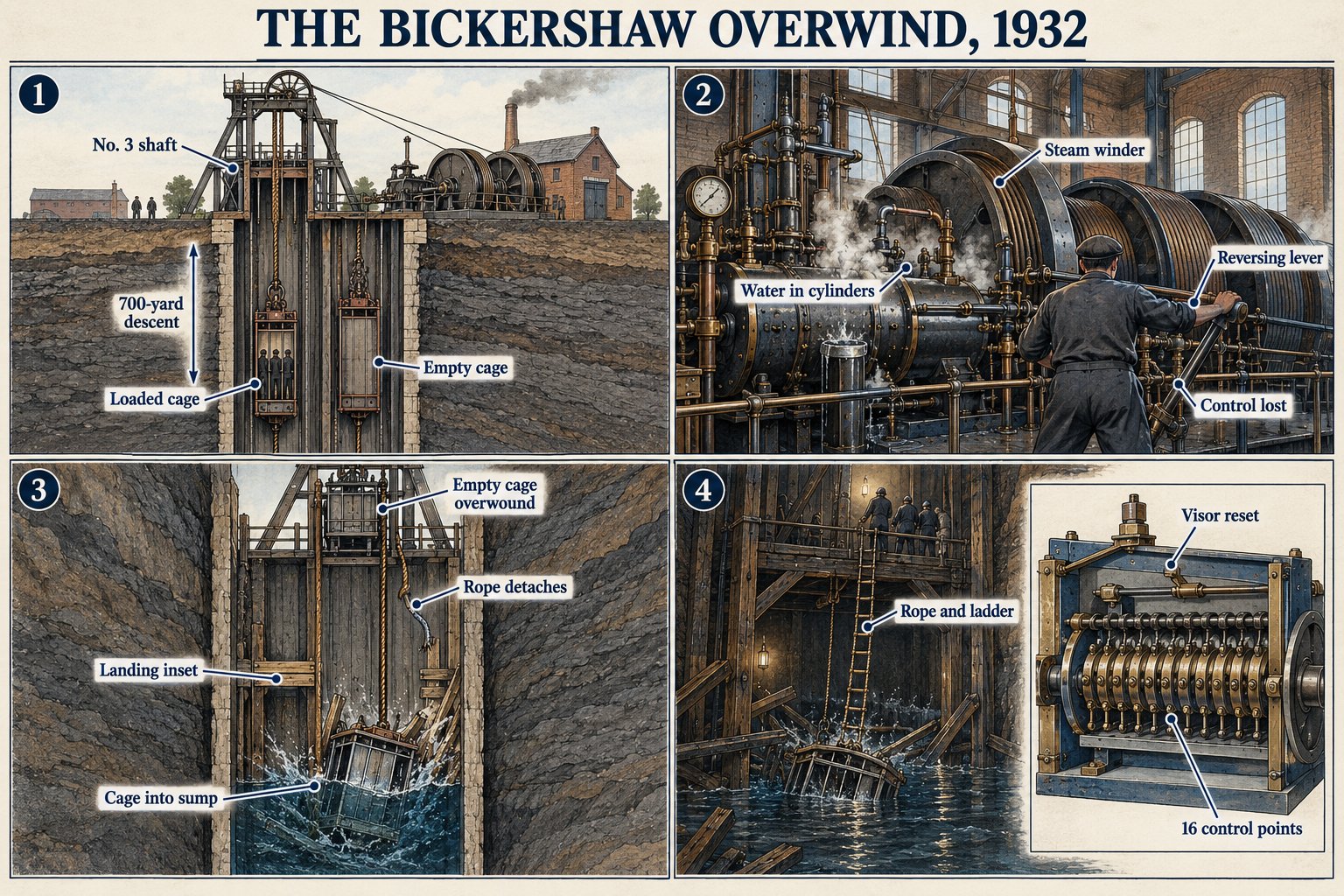
Cause
The coroner's jury found the winding engine itself was not faulty, attributing the accident to an error of judgement by the engineman, Hitchen, in reversing the winding lever; condensing water in the engine cylinders was found to have compromised his control of the descent.
What happened
At 5:55am a cage carrying 20 men began its descent of the 700-yard, 18-foot-diameter No.3 shaft; shortly after, an overwind occurred, the cage plunging past the landing inset and through wooden support timbers before crashing into water in the sump, 14 feet below the inset level, coming to rest on a platform protecting suspension weights. At the same time, the ascending, empty cage shot up into the headgear, becoming suspended in the 'bell platform' as its winding rope detached and crashed through the engine house roof.
Rescue & recovery
A night shift worker at the pit bottom used a rope and then a ladder to help rescue the sole survivor, James Sharpe; the cage was subsequently raised to recover the 19 dead.
Investigation & inquiry
The coroner's jury blamed an error of judgement by the winding engineman, Hitchen, rather than a fault in the engine, and recommended maintaining reasonable water levels in the sump. The automatic overwind-prevention device, known as the 'Visor', was immediately recalibrated to provide 16 control points across the last 90 yards of the wind, far more than the three points it had used before the accident.
Changes to practice & legislation
The Visor overwind-prevention system's recalibration to 16 control points in the final 90 yards of winding, up from three, was a direct response to this accident.
Recorded claims
Individual factual claims, each attached to the source(s) that support it below. Where sources disagree, both are kept.
- The coroner's jury attributed the accident to an error of judgement by winding engineman Hitchen in reversing the winding lever, with condensing water in the engine cylinders having compromised his control. 1,2
- 19 of the 20 men in the cage drowned when it plunged into the water-filled sump at the bottom of No.3 shaft; the sole survivor, James Sharpe, suffered broken bones, head injuries and permanent disability. 2
- The automatic overwind-prevention 'Visor' device was recalibrated from three control points to sixteen across the final 90 yards of winding as a direct result of the accident. 2
Related terminology
Mining terms this disaster is structurally linked to, with the nature of the relationship.
- Cage (contextual relationship)
Named 5 times in this record, first in the summary: “An overwound cage carrying 20 men plunged through the bottom of Bickershaw's No.3…” - Engine House (contextual relationship)
Named in this record’s narrative: “…'bell platform' as its winding rope detached and crashed through the engine house roof.” - Headgear (contextual relationship)
Named in this record’s narrative: “…At the same time, the ascending, empty cage shot up into the headgear, becoming suspended in the 'bell platform' as its winding rope…” - Overwind (direct cause)
An overwind of the ascending cage, caused by an error of judgement at the winding lever, is the confirmed cause of this disaster, sending the cage into the shaft-bottom sump rather than the headgear. - Sump (contextual relationship)
Named 3 times in this record, first in the summary: “…through the bottom of Bickershaw's No.3 shaft into a water-filled sump on 10 October 1932, drowning 19 of them in one of British mining's…” - Winding Engine (contextual relationship)
Named in this record’s cause: “The coroner's jury found the winding engine itself was not faulty, attributing the accident to an error of…”
Sources
- (secondary) Bickershaw Colliery — Wikipedia
- (secondary) Bickershaw Colliery Shaft Accident - Leigh - 1932 — Northern Mine Research Society
Record created: 27 August 2026 · Last researched: 27 August 2026