 MineArchive
Overwind
| Category | Ground Conditions & Hazards |
|---|
A winding accident in which a cage, skip or kibble overruns its intended stopping point at the top of a shaft, driving it into the headgear pulley or sheave with potentially fatal force, or, if the winding rope then fails or detaches, letting it fall back down the shaft.
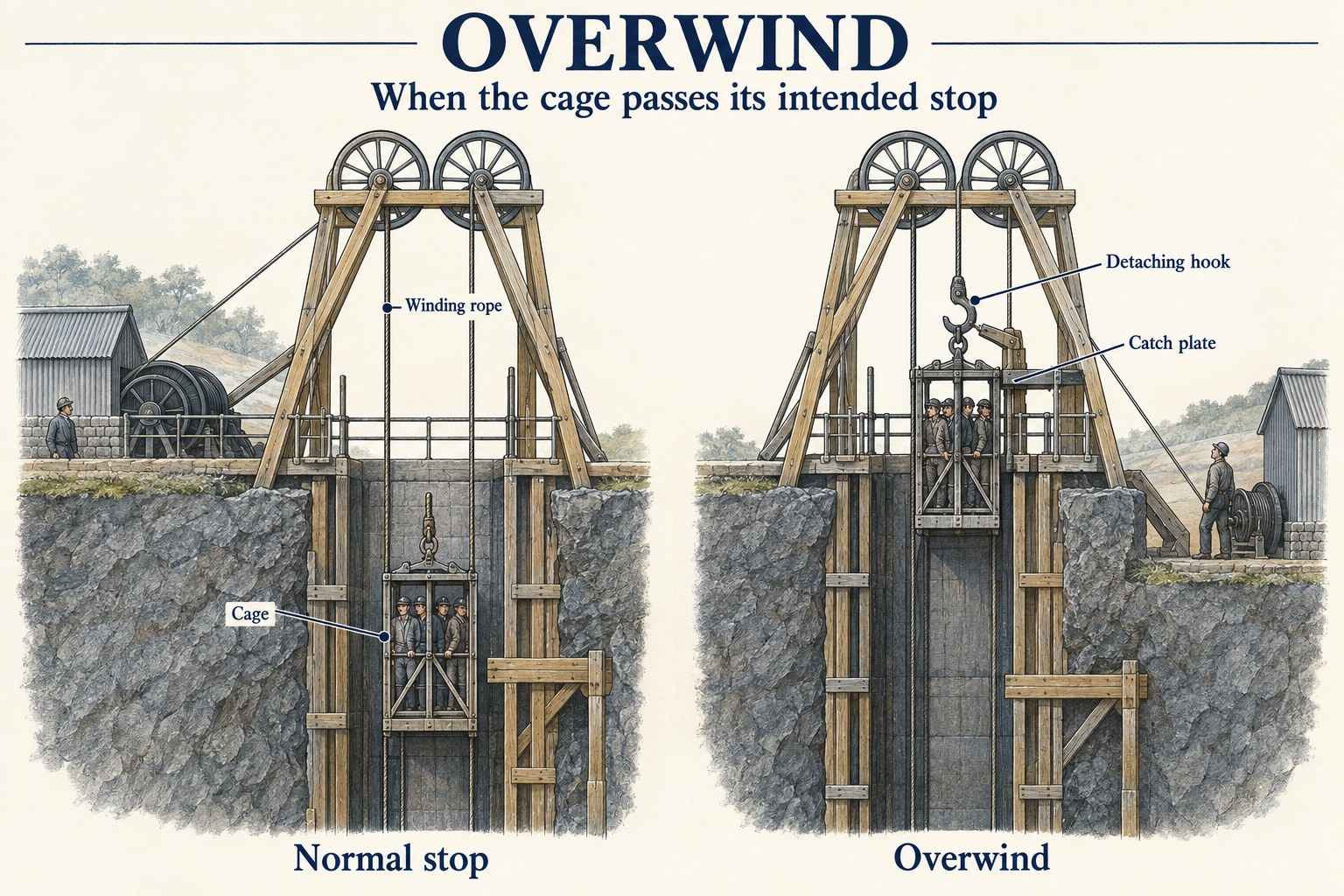
Historical usage
Overwinds were a recognised hazard from the earliest days of steam winding, and remained one of the most consistently lethal categories of mining accident into the 20th century, since a single moment's loss of control over a winding engine could kill everyone in a cage at once. Two disasters on this site were caused directly by overwinds a little over seventy years apart: ten men and boys died at Far Green Colliery, Hanley, in 1859, when a distracted engineman let the ascending cage run fifty feet past its limit into the pulley; nineteen of twenty men drowned at Bickershaw Colliery in 1932 when a cage plunged past the landing and into a flooded shaft-bottom sump after the engineman misjudged the winding lever.
How it worked
An overwind happens when a winding engine fails to stop the cage at the correct point, whether from mechanical failure, a signalling error, or (as at both Far Green and Bickershaw) a simple lapse of attention or judgement by the engineman controlling the engine by hand. Once devised, the standard mechanical safeguard was the detaching hook, fitted between the winding rope's shackle and the cage's own suspension gear, sitting beneath an open-ended, bell-shaped catch plate mounted in the headgear below the pulley wheels. If the cage overwound into the bell, the hook's own construction — typically several pivoted plates held by a shearable pin — forced it to release the rope while a separate locking pin dropped into a slot, suspending the cage safely in the headgear rather than letting it fall. A parallel line of defence developed around automatic engine controls: centrifugal governors and cam-driven indicators that tracked the cage's true position and applied the brakes automatically if a human engineman did not, regardless of distraction or error.
Why it was used
Overwind prevention was never optional in the sense that a mine chose to install it for advantage — it existed purely to contain a hazard inherent to winding itself, the moment a rope-borne cage is entrusted to a single engine and a single pair of eyes.
Risks & limitations
Early collieries, including Far Green in 1859, had no overwind protection at all beyond the engineman's own attention; detaching hooks were introduced in 1865, only six years after Far Green's disaster, but the industry adopted them slowly, and some collieries still had none even by 1908. Automatic contrivances to prevent overspeeding and overwinding, and means of detaching an overwound cage, were not made a general legal requirement until 1911. Even fully engineered detaching-hook systems were not infallible: as late as 1995, 104 people died at the Vaal Reefs mine in South Africa when a safety detaching hook opened during an overwind and let the cage fall around 400 metres to the shaft bottom — a reminder that the underlying hazard, not just the absence of a safeguard, is what makes overwinding dangerous.
Related terminology
Mines associated with this term
5 examples chosen from 6 linked records — the term page is not an index.
- Blaengwynfi Colliery — Neath Port Talbot (well documented example)
Named in this record’s summary: “…a shaft was being sunk from about 1889 and eight sinkers died in an overwind in 1891. The NMRS places the Glyncorrwg pits here and returns…” - Donisthorpe Colliery — Leicestershire (well documented example)
Named in this record’s workings: “…and anti-stall valves on the back of the cylinders in case of an overwind. It had been overhauled by J. Jessop of the London Steam Crane…” - Gospel Oak Colliery — West Midlands (well documented example)
Named twice in this record, first in the summary: “…two men died together there, twice from firedamp and once from an overwind, and the inspector's verdict on the 1860 explosion was want of skill…” - Little Raith Colliery — Fife (well documented example)
Named in this record’s history: “…to 850 in 1920. On 15 August 1883 four colliers were killed in an overwind, and on 22 January 1897 a fireman, James Graham, and an engineman,…” - Robroyston Colliery — Glasgow (well documented example)
Named in this record’s summary: “…seams, with its last plans abandoned in 1933. On 28 March 1924 an overwind sent one cage into the headgear and the other into the sump;…”
Disasters associated with this term
5 examples chosen from 10 linked records, most direct relationship first.
- Bickershaw Colliery shaft accident, 1932 (direct cause)
An overwind of the ascending cage, caused by an error of judgement at the winding lever, is the confirmed cause of this disaster, sending the cage into the shaft-bottom sump rather than the headgear. - Cwmneol Colliery overwind, 1855 (direct cause)
The cage was overwound into the headgear. - Far Green Colliery shaft accident, 1859 (direct cause)
The disaster this record documents is a textbook overwind: a distracted engineman let the ascending cage run fifty feet past its stopping point and into the headgear pulley. - Brookhouse Colliery Overwind, 1958 (contextual relationship)
Named in this record’s summary: “An overwind in the No. 1 downcast shaft at Brookhouse Colliery injured 36 of the…” - Garth Merthyr Colliery overwinding, 1897 (contextual relationship)
Named in this record’s cause: “…the cage fell the depth of the shaft. The Inspector attributed the overwind to a momentary loss of concentration by the engineman, who blamed…”
Sources
- (secondary) Bickershaw Colliery Shaft Accident - Leigh - 1932 — Northern Mine Research Society
- (secondary) Far Green Colliery Shaft Accident - Hanley - 1859 — Northern Mine Research Society
- (secondary) Shaft Safety — fifepits.co.uk
Record created: 27 August 2026 · Last researched: 27 August 2026