 MineArchive
Far Green Colliery shaft accident, 1859
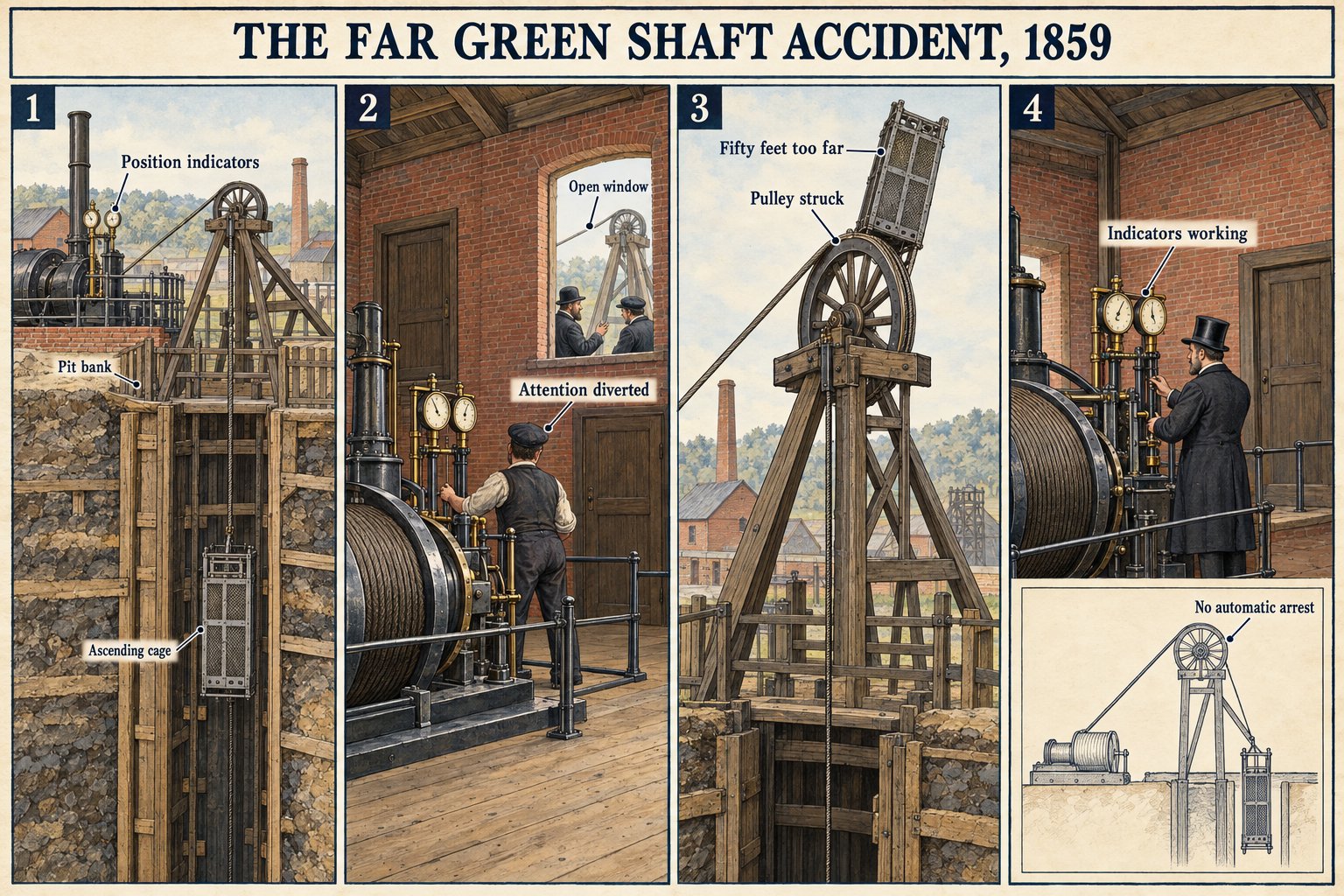
An ascending cage carrying sixteen men and boys overwound fifty feet past its normal stopping point and struck the headgear pulley at Far Green Colliery on 5 November 1859, after the winding engineman was briefly distracted; ten died.
| Date | 5 November 1859 |
|---|---|
| Mine | Far Green Colliery |
| Region | Staffordshire |
| Type | Winding / Shaft Accident |
| Fatalities | 10 (The ten dead were Edward Barton Knowles (14), Thomas Jones (14), Henry Walklate (22), Eli Griffiths (18), Owen Williams (11), William Vernall (16), William Hughes (14), William Beard (11), Richard Yates (17) and Thomas Bellas (36) — six of them boys aged 11 to 17.) |
| Injuries | Six men in the ascending cage and eleven in the descending cage were injured, sustaining broken bones, contusions and shock. |
| Context | During active mining |
Cause
Winding engineman James Gallon was distracted when the overlooker, Tellett (referred to elsewhere as Williams), and the timekeeper, Williams, entered the engine house; when Gallon leaned forward to answer a question about whether they were in his way, his attention left the indicator gauges for a few seconds, during which the ascending cage rose fifty feet beyond its safe limit and struck the pulley at the top of the headgear.
Contributing factors
The engine house door was fastened shut, but its window facing the pit bank stood open, allowing the overlooker and timekeeper to engage the engineman in conversation while he was winding; no automatic device existed at this date to prevent or arrest an overwind.
What happened
Men were being changed at two o'clock on Saturday 5 November 1859, sixteen coming up in the cage and twelve going down in the other. The first three loads of men had come up normally. On the fourth, with the ascending cage a few seconds from the bank, Samuel Tillett, a collier just out of the pit, and Edward Williams, who kept the men's time, went into the engine house out of the rain to take the time, as they did only in wet weather, and one of them asked the engineman, James Gallon, whether they were in his way. Gallon turned to ask what had been said, and in that second and a half the cage ran on past the bank, up the headgear and over the pulley wheel. Six of its occupants were thrown out and fell the 507 feet to the bottom of the shaft; three were thrown onto the iron plates of the pit bank and killed; a fourth, Thomas Bellas, was taken to the North Staffordshire Infirmary and died there within two hours. The twelve in the descending cage were all more or less hurt. The dead were mostly boys: Owen Williams and William Blore were eleven, Edward Knowles, Thomas Jones and William Hughes fourteen, William Vernall sixteen, Richard Yates seventeen, Edward Griffiths eighteen, Henry Walklate twenty-two and Bellas thirty-six.
Rescue & recovery
George Rhodes, a horse driver who had been standing in the top of the cage, was thrown clear and found lodged on the woodwork between the two pulley wheels, insensible; he lay there for some hours before he was brought down, and gave evidence at the inquest uninjured. Six others in the ascending cage were hurt, one with a broken thigh and one with a broken arm. The bodies were carried home by cart; William Vernall was identified by his clothes, his tobacco box and three buttons on his waistcoat that a neighbour had sewn on herself.
Investigation & inquiry
The inquest opened at the Mason's Arms before the coroner and the jury went first to North Street to view the bodies and then to the pit, where the engine was worked in their presence and they inspected the indicators. The engineman, Gallon, was already in custody. Thomas Wynne, HM Inspector of Mines for North Staffordshire, had gone out to Lord Granville's works on the Monday, had the engine wound and stopped repeatedly by the other engineer and found not the slightest difficulty in stopping it; he measured 63 feet from the pit mouth to the engine handle and 39 feet from the ground to the pulley axle, found the indicators working 'exceedingly well', and said the accident could only be accounted for by the engineman's neglect to stop, 'only a second and a half too late'. He could not too strongly disapprove of the two men at the engine-house window but said that did not excuse the engineman, who was the guardian of his own place under Rule 33, which forbade anyone unauthorised to enter it. Gallon, told the police that the fault was entirely his own, and produced testimonials from previous employers and from a large number of Lord Granville's workpeople.
Legal & regulatory aftermath
The jury returned a verdict of manslaughter against James Gallon, with a rider that the accident would not have happened had the two men not entered the engine house, and that the rule restricting the engine house ought to be strictly enforced; the Inspector and Lord Granville's mining agent, Mr Bourne, agreed that the two men could not themselves be reached in law. Gallon was convicted of manslaughter at Staffordshire Assizes and sentenced to six weeks' imprisonment. Wynne's one recommendation on the machinery was that the brake, used at the Big Pit only to fasten the engine, should be applied on every wind so that the engineman grew habituated to it.
Changes to practice & legislation
The disaster came at a pivotal moment in the development of overwind-prevention technology: detaching hooks, designed to release a cage from its rope and catch it in the headgear during an overwind, were introduced within a few years, in 1865, though the mining industry was slow to adopt them even decades later.
Memorials & commemoration
None recorded.
Recorded claims
Individual factual claims, each attached to the source(s) that support it below. Where sources disagree, both are kept.
- Engineman James Gallon was distracted by the overlooker and timekeeper entering the engine house; in the few seconds his attention left the indicator gauges, the ascending cage rose fifty feet beyond its safe limit and struck the headgear pulley. 1
- Ten men and boys died, aged 11 to 36, including Owen Williams and William Beard, both 11 years old. 1
- Engineman James Gallon was convicted of manslaughter and imprisoned for six weeks; the inspecting officer noted at the time that new inventions to prevent overwinding were about to be proposed, and detaching hooks were introduced within a few years, in 1865. 1
- The ten dead were Edward Knowles (14), Thomas Jones (14), Henry Walklate (22), Edward Griffiths (18), Owen Williams (11), William Vernall (16), William Hughes (14), William Blore (11), Richard Yates (17) and Thomas Bellas (36). 2
- Six of the cage's occupants fell some 507 feet down the shaft, three were killed on the pit bank and one died in the infirmary; all twelve in the descending cage were injured. 2
Related terminology
Mining terms this disaster is structurally linked to, with the nature of the relationship.
- Cage (contextual relationship)
Named 4 times in this record, first in the summary: “An ascending cage carrying sixteen men and boys overwound fifty feet past its normal…” - Detaching Hook (contextual relationship)
Named in this record’s changes to practice: “…pivotal moment in the development of overwind-prevention technology: detaching hooks, designed to release a cage from its rope and catch it in the…” - Engine House (contextual relationship)
Named 3 times in this record, first in the cause: “…to elsewhere as Williams), and the timekeeper, Williams, entered the engine house; when Gallon leaned forward to answer a question about whether they…” - Headgear (contextual relationship)
Named 4 times in this record, first in the summary: “…overwound fifty feet past its normal stopping point and struck the headgear pulley at Far Green Colliery on 5 November 1859, after the winding…” - Heapstead (contextual relationship)
Named twice in this record, first in the contributing factors: “The engine house door was fastened shut, but its window facing the pit bank stood open, allowing the overlooker and timekeeper to engage the…” - Overwind (direct cause)
The disaster this record documents is a textbook overwind: a distracted engineman let the ascending cage run fifty feet past its stopping point and into the headgear pulley.
Sources
- (secondary) Far Green Colliery Shaft Accident - Hanley - 1859 — Northern Mine Research Society
- (secondary) Over-Winding 'Big Pit' Far Green Hanley (John Lumsdon) — North Staffordshire Mining Group
- (secondary) List of coal mines UK 1880 — Coalmining History Resource Centre
Record created: 27 August 2026 · Last researched: 8 September 2026