 MineArchive
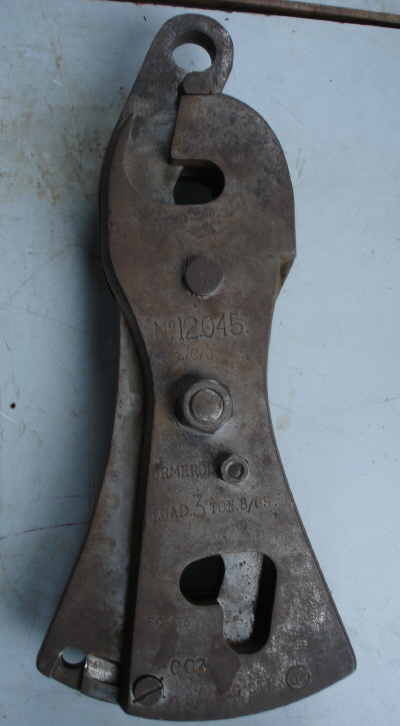
Detaching Hook
| Also known as | Ormerod Hook (After Edward Ormerod of Gibfield Colliery, Atherton, the principal British make.), Ormerod Link (The maker's own name for the device.), Safety Link (A general name for the same fitting.), Self-detaching Hook (The form the Science Museum Group uses for its example.) |
|---|---|
| Category | Structures & Machinery |
A safety device fitted between the winding rope and a cage or skip which, if the cage is wound past its stopping place at the top of the shaft, releases the rope and holds the cage suspended in the headgear instead of letting it be dragged over the pulleys or drop back down the shaft.
Historical usage
Detaching hooks belong to the second half of the nineteenth century and to one Lancashire colliery in particular. Edward Ormerod was mining engineer to Fletcher, Burrows and Company at Gibfield Colliery, Atherton; his father George had been the firm's chief engineer, and an overwind at the company's Volunteer Pit at Howe Bridge, which sent a cage through the headgear and the engine house roof, is said to have set him thinking. He devised and tested his hook at Gibfield and demonstrated it before an audience of the Fletchers, colliery officials and members of the public, descending twenty yards alone in the cage and having himself rewound at speed. The device took a gold medal at the Manchester Mechanical and Industrial exhibition of 1875 and a silver at the Franco-British Exhibition of 1908, and is still manufactured. John King's hook, patented the same year, is the other principal make, and has a record of its own here. By the twentieth century a detaching hook was not a choice but a legal requirement. The Coal Mines Act 1911 listed, among the provisions governing winding, both automatic contrivances to prevent overspeeding and overwinding and 'means for detaching the ascending cage in the event of an overwind'. Ormerod is buried at Atherton, and a small stone in front of his grave carries a picture of the hook.
How it worked
The device is in two parts: an open-ended, bell-shaped plate fixed in the headgear below the pulley wheels, and the hook itself, fitted between the rope shackle above and the cage's suspension gear below. In the Ormerod pattern the hook is built from three plates, two outer and one inner, pivoted on a central bolt and held in position by a copper pin passing through all three; the rope shackle sits in slots cut in the plates, and the cage hangs from a second shackle whose pin passes through a shaped slot lower down. On an overwind the hook is drawn up into the bell, whose narrow throat squeezes the lower part of the plates together. That shears the copper pin and opens the slot at the top, releasing the rope. At the same moment projections on the plates are forced outwards and catch on the top of the bell, while the lower shackle's pin drops into a vertical slot and locks the three plates together — so the cage is left hanging in the bell, off the rope, instead of falling. The hook can be reset and reconnected by hand once the fault is cleared. Ormerod's device was nicknamed the 'butterfly' in the trade, from the shape of the opened plates.
Why it was used
Winding is the one operation in a mine that puts every man in a cage at the mercy of a single engine and a single pair of eyes. A detaching hook does not prevent an overwind; it turns one from an event that kills everybody aboard into an equipment failure that leaves them stranded in the headgear.
Risks & limitations
The hook protects the ascending cage only. Following a shaft incident at Bickershaw Colliery, an Overwind Protection Committee concluded that the greatest danger in an overwind was in fact the speed at which the descending cage struck the bearers at the shaft bottom, and regulations of 1937 required an automatic contrivance to keep that landing speed below five feet a second. Nor is the hook itself infallible, whatever is sometimes claimed for it: a Fife record of shaft accidents includes an overwind at Shawfield in Lanarkshire in 1925 in which four died and the detaching hook failed to operate. The mechanism depends on its copper pin and catch plate being correctly set and maintained, and an Inspector of Mines in 1897 argued against making hooks compulsory precisely because they were not entirely reliable, brought their own anxiety about detaching or breaking in the shaft, and had in one case broken while a cage was running. The archive's own records carry another: at Medomsley Colliery in 1923 an ascending cage turned and struck a cast-iron bunton at eighty feet, the detaching-hook jaws broke, and the cage fell.
Regional variation
None. The two principal British makes, Ormerod's and King's, were sold throughout the coalfields and abroad rather than being local patterns.
Mines associated with this term
Included only where MineArchive's own research gives a reasonable evidential basis — not every mine where this might plausibly apply.
- Bamfurlong Colliery — Greater Manchester (well documented example)
Named in this record’s history: “…twin-cylinder horizontal winders with Cornish valves and Ormerod detaching hooks, six underground haulage engines, compressed-air pumps sending water…” - Garth Merthyr Colliery — Bridgend (well documented example)
The Inspector's report on the 1897 overwind at Garth Merthyr argued against making detaching hooks compulsory, the winding engine there having no automatic overwind protection at all.
Disasters associated with this term
Included only where MineArchive's own research gives a reasonable evidential basis, with the nature of the relationship stated — not every disaster where this term might plausibly apply.
- Far Green Colliery shaft accident, 1859 (contextual relationship)
Named in this record’s changes to practice: “…pivotal moment in the development of overwind-prevention technology: detaching hooks, designed to release a cage from its rope and catch it in the…” - Garth Merthyr Colliery overwinding, 1897 (contextual relationship)
Named twice in this record, first in the summary: “…to prevent overwinding, and the Inspector declined to recommend that detaching hooks be made compulsory.” - Medomsley Colliery cage accident, 1923 (contextual relationship)
Named in this record’s cause: “…ascending cage turn and strike a cast-iron bunton at 80 feet; the detaching-hook jaws broke and the cage fell.” - Naval Colliery Ely Pit cage accident, 1909 (contextual relationship)
Named in this record’s changes to practice: “Gray said he favoured steam brakes and detaching hooks, which were not then compulsory.”
Sources
- (secondary) Edward Ormerod — Wikipedia
- (secondary) Edward Ormerod — Engole
- (secondary) Ormerod self-detaching hook (object Y2002.19/T1787) — Science Museum Group
- (secondary) Shaft Safety — fifepits.co.uk
Record created: 24 September 2026 · Last researched: 24 September 2026