 MineArchive
Pinxton Colliery
| Location | Pinxton, near Alfreton, Derbyshire — 53.0836, -1.3304 (exact) |
|---|---|
| Commodity | Coal |
| Type | Coal |
| Worked | 1788–March 1950 |
| Maximum depth | 130 yards (No. 2 shaft) |
| Operators | Coke and Co. (1788–?), Pinxton Collieries Ltd. (?–1947), National Coal Board (1947–1950) |
Overview
The old pits of the Coke family at Pinxton, begun with No. 1 pit in 1788 and worked as a group of shallow shafts until the last closed in March 1950. Their coal opened the Mansfield and Pinxton Railway in 1819, and King's detaching hook was proved at No. 1 pit in 1873.
History
Pinxton Colliery was a group of numbered pits around Pinxton, on the Derbyshire side of the border with Nottinghamshire. The Reverend D'Ewes Coke, rector of Pinxton and South Normanton, inherited the Brookhill estate in 1780, formed the Pinxton Collieries Company and in 1788 sank No. 1 pit, also called Sleights, the first deep mine in the parish. He helped to finance the Cromford Canal and its Pinxton branch to carry the coal south, and from the profits of the colliery founded a local school and an educational charity. He died in 1811. His son John was involved in the Mansfield and Pinxton Railway, and on 13 April 1819 the first rail-borne coal from Pinxton reached Mansfield, where a pile of it was set alight in the market place and burnt through the night.
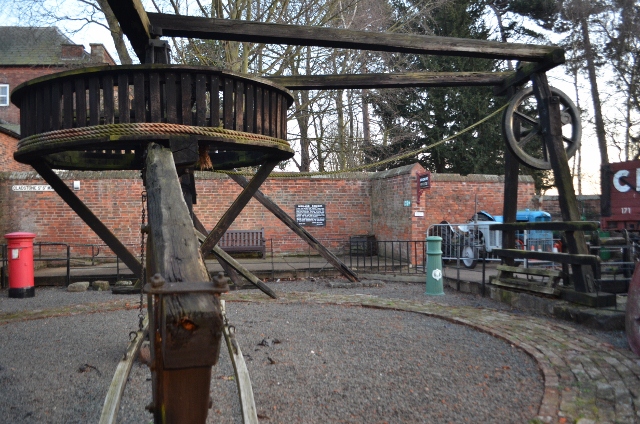
A second shaft beside the first, No. 6, was sunk in 1852 to the Deep Soft seam, 20 yards above the Deep Hard, and in 1856 a road 32 yards long was driven through faulted ground to join the two seams. Nos. 4 and 5 shafts, to the north, were closed in 1860. No. 2 pit, at the bottom of Sleights Lane, was the upcast, ventilated first by a furnace, from 1872 by a steam-driven Waddle fan and from 1925 by an electric fan. In 1873 John King's detaching hook, which stops a cage being drawn up over the headstock pulley, completed its trials at No. 1 pit. A horse gin built at Langton Colliery in 1844 was later used at Pinxton.
In 1894 the four working pits employed 921 people: No. 1 in the Deep Hard, No. 2 in the Silkstone, No. 3 in the Tupton and No. 6 in the Deep Soft. Coke and Co. are returned as the owners; in 1900 Pinxton Collieries Ltd. held the four Pinxton pits and two at Langton, 1,745 people in all, under the manager B. Madew. On 10 April 1902 two stallmen, Edward Haywood Bradshaw and Edward Haywood, were killed in the Deep Hard when the sprags gave way as they holed the coal and a large block fell on them.
From 1908 the company sank Brookhill Colliery close by, far deeper, and it became the winding centre for all the Pinxton pits. No. 3 stopped winding coal in 1910, when Brookhill's headings reached its Low Main reserves, and was kept as an air and escape shaft with a small electric winder. The four pits still employed 1,289 people that year, but by 1915 only No. 2 is returned, with 89 people in the Silkstone seam.
The Deep Soft workings of Nos. 1 and 6 were abandoned in the mid-1930s. No. 2, also called Plymouth, passed to the National Coal Board in 1947 and by one account stopped turning coal that year; a list of the collieries taken over gives both Pinxton and Plymouth No. 2 a closing date of March 1950, and the plan of the Yard seam at No. 2 is dated 3 March 1951. The same list dates Pinxton from 1938 and Plymouth No. 2 from 1940. The shaft stayed open as Brookhill's upcast, and for pumping, until that colliery closed. No. 3 shaft was filled in 1955 and its headgear taken down in 1958.
Geology
Coal Measures of the Derbyshire and Nottinghamshire coalfield, at shallow depth. The pits worked the Deep Soft, the Deep Hard 20 yards below it, the Tupton or Low Main, the Silkstone and the Yard seams. The ground between the Deep Soft and the Deep Hard at No. 1 pit was faulted.
Geological setting: Sedimentary Beds and Seams (well documented example)
Workings
At least six numbered shafts. No. 1 (Sleights, 1788) and No. 6 (1852) stood together, working the Deep Hard and the Deep Soft, with a cage in each shaft carrying two trams of up to a ton of coal, wound by flat hemp rope. No. 2, 130 yards deep, was the upcast, and No. 3 was 112 yards deep. Nos. 4 and 5 lay to the north of Nos. 2 and 3. After 1910 Nos. 1, 3 and 6 served as air intakes with the Brookhill shaft.
Closure
No. 3 stopped winding coal in 1910 once Brookhill's headings reached its reserves, and the Deep Soft at Nos. 1 and 6 was abandoned in the 1930s. No. 2 (Plymouth), the last pit, is recorded as ceasing to turn coal in 1947 and as closing in March 1950; the plan of its Yard seam is dated 3 March 1951. The shaft was kept as the upcast for Brookhill Colliery.
What remains
The collieries and coke ovens at Pinxton have been replaced by an industrial estate, and the old colliery village has all but disappeared.
A winding wheel named for John King stands in Pinxton. The horse gin used at the colliery has been re-erected at Nottingham Industrial Museum.
Related mines
- Brookhill Colliery — Pinxton Collieries' 1908 deep pit, which took over winding for the old Pinxton shafts.
- Langton Colliery — Both belonged to Coke and Co. and Pinxton Collieries Ltd., and a horse gin built at Langton in 1844 was later used at Pinxton.
Nearby mines
- Brookhill Colliery — 0.9 miles (1.4 km) E
- Pye Hill Colliery — 1.3 miles (2.0 km) S, Nottinghamshire
- Langton Colliery — 1.7 miles (2.7 km) E, Nottinghamshire
- South Normanton Colliery — 1.8 miles (2.9 km) NE
- B Winning Colliery — 2.2 miles (3.5 km) N
Straight-line distance, within 9 miles (15 km). Show on the map.
What's uncertain
Points where sources disagree or the record could not be settled; both accounts are kept. All open questions in the archive.
- The Low Main seam at Pinxton No. 3 was abandoned in 1905. (uncertain) 6
- Opened in 1938. (disputed) 9
Recorded claims
Individual factual claims, each attached to the source(s) that support it below. Where sources disagree, both are kept.
- No. 1 (Sleights) pit was sunk in 1788 by the Reverend D'Ewes Coke. 1
- The first rail-borne coal from Pinxton colliery reached Mansfield on 13 April 1819. 2
- No. 6 shaft was sunk in 1852 to the Deep Soft seam, close to No. 1. 1
- Nos. 4 and 5 shafts were closed in 1860. 1
- John King's detaching hook completed its trials at Pinxton No. 1 colliery in 1873. 3
- In 1894 the four pits employed 921 people in the Deep Hard, Silkstone, Tupton and Deep Soft seams. 4
- In 1900 Pinxton Collieries Ltd. held Pinxton Nos. 1, 2, 3 and 6 and Langton Nos. 7 and 9, employing 1,745 people. 5
- Two stallmen were killed by a fall of coal in the Deep Hard seam on 10 April 1902. 4
- No. 3 pit, 112 yards deep, ceased winding coal in 1910. 1
- The Low Main seam at Pinxton No. 3 was abandoned in 1905. (uncertain) 6
- The Deep Soft seam at Pinxton Nos. 1 and 6 was abandoned in 1934 and 1936. 7,8
- No. 2 pit ceased turning coal in 1947 and served afterwards as the upcast shaft for Brookhill. 1
- Pinxton Colliery and Plymouth No. 2 closed in March 1950. 9
- Opened in 1938. (disputed) 9
- The Yard seam at Pinxton No. 2 (Plymouth) was abandoned on 3 March 1951. 10
- A horse gin built at Langton Colliery in 1844 was later used at Pinxton Colliery. 11
- The collieries and coking ovens at Pinxton have been replaced by an industrial estate. 3
Photographs & further reading
Notes on each of the numbered Pinxton shafts and on the sinking of Brookhill, with early photographs.
View sourceA 1902 photograph of new boilers at No. 1 pit with a commentary, and the 1819 opening of the Mansfield and Pinxton Railway.
View sourceOwners, seams and employment for each pit from the Lists of Mines of 1894 to 1915, with the recorded fatalities.
View sourceA 2011 photograph of the horse gin from Langton and Pinxton as displayed at Wollaton.
View sourceSources
- (secondary) Pinxton and Brookhill Collieries, page 1 (Shane Phillips collection) — Healey Hero
- (secondary) Pinxton and Brookhill Collieries, page 2 (Shane Phillips collection) — Healey Hero
- (secondary) Pinxton — Wikipedia
- (primary) Pinxton Colliery — Durham Mining Museum
- (primary) Pinxton Collieries Ltd. — Durham Mining Museum
- (primary) Mine plan: PINXTON NO.3, Low Main seam, abandoned 1905 (feature 21884840) — British Geological Survey / Mining Remediation Authority mine plans catalogue
- (primary) Mine plan: PINXTON NOS. 1 & 6, Deep Soft seam, abandoned 1934 (feature 21884868) — British Geological Survey / Mining Remediation Authority mine plans catalogue
- (primary) Mine plan: PINXTON NOS.1&6, Deep Soft seam, abandoned 1936 (feature 21884870) — British Geological Survey / Mining Remediation Authority mine plans catalogue
- (secondary) Derbyshire Coalfield - Derby Area (collieries after nationalisation in 1947) — Northern Mine Research Society
- (primary) Mine plan: PINXTON NO.2 (PLYMOUTH), Yard seam, abandoned 3 March 1951 (feature 21886066) — British Geological Survey / Mining Remediation Authority mine plans catalogue
- (observational) Early Whim Gin (Ashley Dace, 2011) — Geograph Britain and Ireland
Record created: 1 October 2026 · Last researched: 2 October 2026