 MineArchive
Langton Colliery
| Location | Kirkby-in-Ashfield, near Pinxton, Nottinghamshire — 53.0915, -1.2914 (approximate) |
|---|---|
| Commodity | Coal |
| Type | Coal |
| Worked | 1842 (sinking)–1968 |
| Maximum depth | 487 yards |
| Operators | Pinxton Collieries Ltd. (?–1947), National Coal Board (1947–1968), Coke and Co. |
Overview
A Kirkby-in-Ashfield colliery sunk from 1842, worked by Coke and Co. and Pinxton Collieries, linked to Kirkby Colliery in the 1960s and closed in 1968.
History
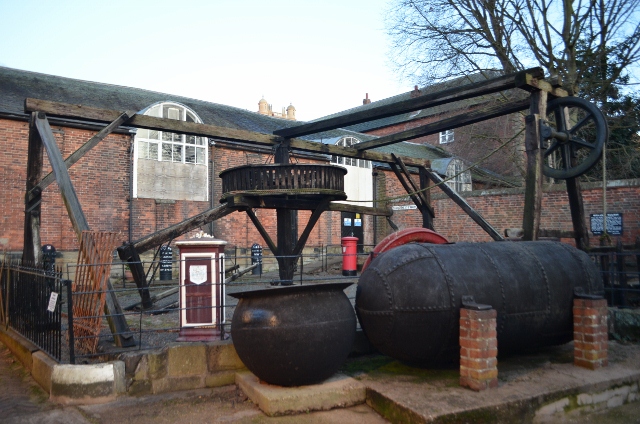
Langton Colliery stood at Kirkby-in-Ashfield, eleven and a half miles north-north-west of Nottingham, near Pinxton; the National Coal Board listed it as Langton, Pinxton. Sinking began in 1842, and the earliest recorded owners were Coke and Co. A horse gin built for the colliery in 1844, later used at Pinxton Colliery, survives.
By 1894 it had two working pits: No. 7, where 346 men worked the Deep Soft seam for household coal, and No. 9, where 291 worked the Deep Hard for manufacturing coal. No. 8 Pit was working the Waterloo seam by 1905, and in 1910 the three pits employed 1,163. Under Pinxton Collieries Ltd the colliery came to rest on No. 8, which employed 558 in 1933 and 580 in 1940. At nationalisation in 1947 Langton employed 802 and raised 250,000 tons a year.
By 1967 it was 487 yards deep, and 700 men produced 430,000 tons from the Black Shale and Waterloo seams. The National Coal Board treated it as the third member of a combined Kirkby mine: a £3.4 million reorganisation linked Kirkby Colliery's workings to Langton's, but in 1968 the Board announced that Kirkby would close at the end of August. Langton closed in 1968, and the combined Kirkby and Langton Black Shale workings were abandoned on 24 June 1969.
Geology
Nottinghamshire Coal Measures. No. 7 Pit worked the Deep Soft and No. 9 the Deep Hard in the 1890s, and No. 8 the Waterloo from 1905; by 1967 production came from the Black Shale and Waterloo seams.
Workings
Three pits, Nos. 7, 8 and 9, returned separately until the 1920s, after which No. 8 carried the colliery. The shafts reached 487 yards. In the 1960s Langton's workings were linked underground to Kirkby Colliery's as part of a planned combined mine.
Closure
Langton closed in 1968, the year the National Coal Board closed Kirkby Colliery, to which its workings had been linked; the combined Black Shale workings were abandoned on 24 June 1969.
What remains
Unknown.
Redevelopment
Unknown.
Related mines
- Kirkby Colliery — Kirkby's 1960s reorganisation linked its workings to Langton's, which the NCB counted as the third member of the combined Kirkby mine.
Nearby mines
- Kirkby Colliery — 2.1 miles (3.4 km) NE
- Annesley Colliery — 2.3 miles (3.7 km) SE
- Pye Hill Colliery — 2.5 miles (4.0 km) SW
- Blackwell Colliery — 3.0 miles (4.8 km) NW, Derbyshire
- Underwood Colliery — 3.0 miles (4.8 km) S
Straight-line distance, within 9 miles (15 km). Show on the map.
Recorded claims
Individual factual claims, each attached to the source(s) that support it below. Where sources disagree, both are kept.
- Sinking started at Langton in 1842; by 1967 the colliery was 487 yards deep, with 700 men producing 430,000 tons from the Black Shale and Waterloo seams. 1
- Langton Colliery worked from 1844 to 1968. 2
- In 1894 No. 7 Pit employed 346 in the Deep Soft and No. 9 Pit 291 in the Deep Hard; in 1947 the colliery employed 802 and raised 250,000 tons. 1
- Kirkby Colliery's £3.4 million reorganisation linked its workings to those at nearby Langton Colliery; the NCB announced in 1968 that Kirkby would close at the end of August. 3
- The combined Kirkby and Langton workings in the Blackshale seam were abandoned on 24 June 1969. 4
- A horse gin built at Langton Colliery in 1844, later used at Pinxton Colliery, survives. 5
- On 10 April 1908 William Watson and George Caulton, datallers, were killed on the surface when an air receiver burst while they waited to descend the shaft. 1,2
Photographs & further reading
A 2011 photograph of the horse gin built for Langton Colliery in 1844.
View sourceOwners, output, employment and seams by pit from 1894 to 1947, the NCB's 1967 description and the names of those killed.
View sourceThe colliery's fatalities from 1851, with ages, home addresses and inquest places.
View sourceSources
- (primary) Durham Mining Museum - Langton Colliery (UK) — Durham Mining Museum
- (secondary) Langton Colliery - Healey Hero — Healey Hero
- (primary) Kirkby Colliery (Closure), HC Deb 26 June 1968 vol 767 cc771-82 — Hansard
- (primary) BGS mine plans: Kirkby (inc. Langton workings) (Blackshale, abandoned 24 Jun 1969) — British Geological Survey / Mining Remediation Authority
- (observational) Early Whim Gin (Geograph, Ashley Dace, 2011) — Geograph
Record created: 1 October 2026 · Last researched: 1 October 2026