 MineArchive
Bentinck Colliery
| Also known as | Bentinck Mine |
|---|---|
| Location | Kirkby-in-Ashfield, Ashfield, Nottinghamshire — 53.0904, -1.2735 (approximate) |
| Commodity | Coal |
| Type | Coal |
| Worked | 1895–2000 |
| Maximum depth | 505 yards (1967) |
| Operators | New Hucknall Colliery Company Limited (1895–1947, owner) — Sank and owned the colliery (DMM b255; Coal and Community) N. H. and B. Collieries Ltd (?–1947, owner) — Listed by the Durham Mining Museum as a later owner, before nationalisation National Coal Board (1947–1986) — East Midlands Division, Area No. 4; South Nottinghamshire Area from 1967 (Coal and Community) British Coal Corporation (1986–1994) — The NCB was renamed British Coal in 1986; Bentinck production ended 1991 (Coal and Community) Coal Investments (1994–1996, owner) — Bought the merged Annesley-Bentinck mine in May 1994 (Coal and Community) Midlands Mining plc (1996–2000, owner) — Bought Annesley-Bentinck in July 1996 and ended production in January 2000 (Coal and Community; I.A. Recordings) |
The New Hucknall Colliery Company's big pit at Kirkby-in-Ashfield, sunk in 1895. Ten men died when its cages collided in 1915; it was the county's largest colliery around 1970 and later brought Annesley's coal to the surface until 2000.
Location
Approximate location. The large pin is this mine; the small round markers are the nearest mines on record. Click one for its page. View on full map
History
The New Hucknall Colliery Company sank Bentinck Colliery south-west of Kirkby-in-Ashfield in 1895, naming it after the family name of the Dukes of Portland. The 1894 list of mines already shows 198 men at work on the sinking, and coal production began in 1896. The No. 2 shaft reached the Low Main at 440 yards and was deepened the next year to the Blackshale at 500 yards, a seam worked for only five years before it was abandoned in 1901. By 1923 it employed 2,334.
On 30 June 1915 the two cages collided in the No. 2 shaft, killing ten men (see Disasters, below).
After the 1926 strike the company pressed its men to join George Spencer's breakaway union, though about a quarter of the miners at Annesley and Bentinck stayed with the Nottinghamshire Miners' Association. Under the National Coal Board from 1947, a reorganisation costing 3.25 million pounds was preparing Bentinck by 1967 to handle Annesley's output as well as its own, and from 1968 it worked as a drift mine producing over a million tons a year. Brookhill Colliery was linked to it in 1968 as Bentinck No. 4 and absorbed in 1972. Bentinck was the largest colliery in the Nottinghamshire coalfield from the late 1960s into the early 1970s, with 2,029 NUM members in 1970. Most of its men worked through the 1984-85 strike and afterwards joined the Union of Democratic Mineworkers. The colliery produced two miners' leaders: Alfred Eggleshaw, NUM Nottingham Area president in 1956, and Neil Greatrex, later national president of the UDM.
From 1981 all of Annesley's coal came up at Bentinck, which had what was described as the largest coal preparation plant in Europe and loaded merry-go-round trains for the power stations, Radcliffe-on-Soar above all. The two collieries were merged as Annesley-Bentinck in 1988. Coal production on the Bentinck side ended in 1991, but the combined mine went on through British Coal, Coal Investments and Midlands Mining until production finished over the weekend of 29 and 30 January 2000. Bentinck's own closing date is put at 1993, 1994 or 1998.
Geology
Coal Measures of the concealed Nottinghamshire coalfield. The Deep Soft, Silkstone and Tupton were worked in 1896, the Deep Hard and Deep Soft by 1900; the Blackshale, reached at 500 yards in 1896, was abandoned in 1901. In 1967 the colliery worked the Waterloo, Low Main and Black Shale.
Workings
Three shafts, the No. 2 shaft 14 feet in diameter with double-decked cages, 440 yards to the Low Main and 500 yards to the Blackshale; the colliery was 505 yards deep in 1967. Three steam winding engines, one of them a John Warner and Son engine of about 1890 installed second-hand in 1915 and used until 1978-79. From 1968 coal came out by an inclined drift to a large preparation plant and rail loading bunker.
Closure
Bentinck's own coal production ended in 1991; the site remained the surface outlet of the merged Annesley-Bentinck mine until production stopped on 29 and 30 January 2000. By one account it closed in 1993 or 1994, by another in 1998.
What remains
The colliery site is in commercial use.
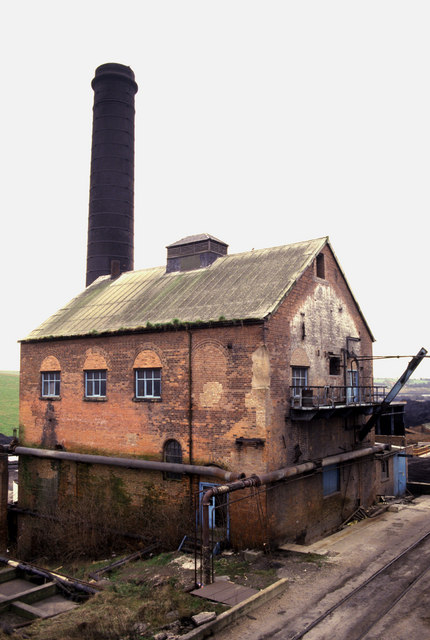
The last steam winding engine was scrapped in 1991, and its engine house, photographed in 1988, has gone.
Redevelopment
The site is occupied by commercial buildings, among them a furniture warehouse photographed in 2019.
Related mines
- Annesley Colliery — From 1981 Annesley's coal was wound at Bentinck, and the two were merged as Annesley-Bentinck in 1988; coal came up at Bentinck and men at Annesley.
- Brookhill Colliery — Brookhill was linked to Bentinck in 1968 as Bentinck No. 4 and fully absorbed in 1972.
- New Hucknall Colliery — Shared operator: both were New Hucknall Colliery Company pits.
Nearby mines
- Langton Colliery — 0.7 miles (1.2 km) W
- Brookhill Colliery — 1.5 miles (2.5 km) W, Derbyshire
- Annesley Colliery — 1.6 miles (2.6 km) SE
- Kirkby Colliery — 1.6 miles (2.6 km) NE
- South Normanton Colliery — 1.9 miles (3.1 km) NW, Derbyshire
Straight-line distance, within 9 miles (15 km). Show on the map.
Disasters & major incidents
- Bentinck Colliery cage collision, 1915
30 June 1915 · Winding / Shaft Accident · 10 fatalities
On 30 June 1915 the two cages in the No. 2 shaft at Bentinck Colliery, Kirkby-in-Ashfield, struck each other as fourteen men were being lowered and two raised. Seven men were thrown out of the descending cage and two more died in it; ten were killed and six injured.
Further reading
A history of Annesley and Bentinck from sinking to the end of production in 2000, with union and strike history.
View sourceThe inspector's account of the 1915 cage collision, with the shaft details, inquest and recommendations.
View sourceSources
- (primary) Bentinck Colliery (Durham Mining Museum) — Durham Mining Museum
- (secondary) Annesley-Bentinck (1865-2000), Coal and Community case-study pits (University of Wolverhampton) — University of Wolverhampton
- (secondary) Bentinck Colliery Shaft Accident - Kirkby-in-Ashfield - 1915 (Northern Mine Research Society) — Northern Mine Research Society
- (secondary) Bentinck Colliery fatalities (Healey Hero, Mines Rescue) — Healey Hero
- (primary) M2545 - Bentinck Colliery (Nottinghamshire Historic Environment Record) — Nottinghamshire County Council
- (secondary) Annesley-Bentinck Colliery, Compilation No. 49 (I.A. Recordings) — I.A. Recordings
- (observational) Bentinck Colliery steam winding engine (Geograph, Chris Allen) — Geograph Britain and Ireland
Record created: 5 November 2026 · Last researched: 5 November 2026