 MineArchive
Gold
| Category | Commodities |
|---|---|
| Commodity page | Gold → |
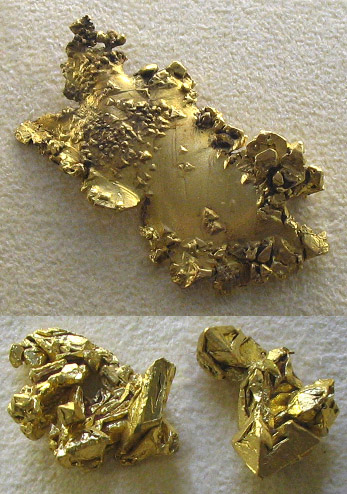
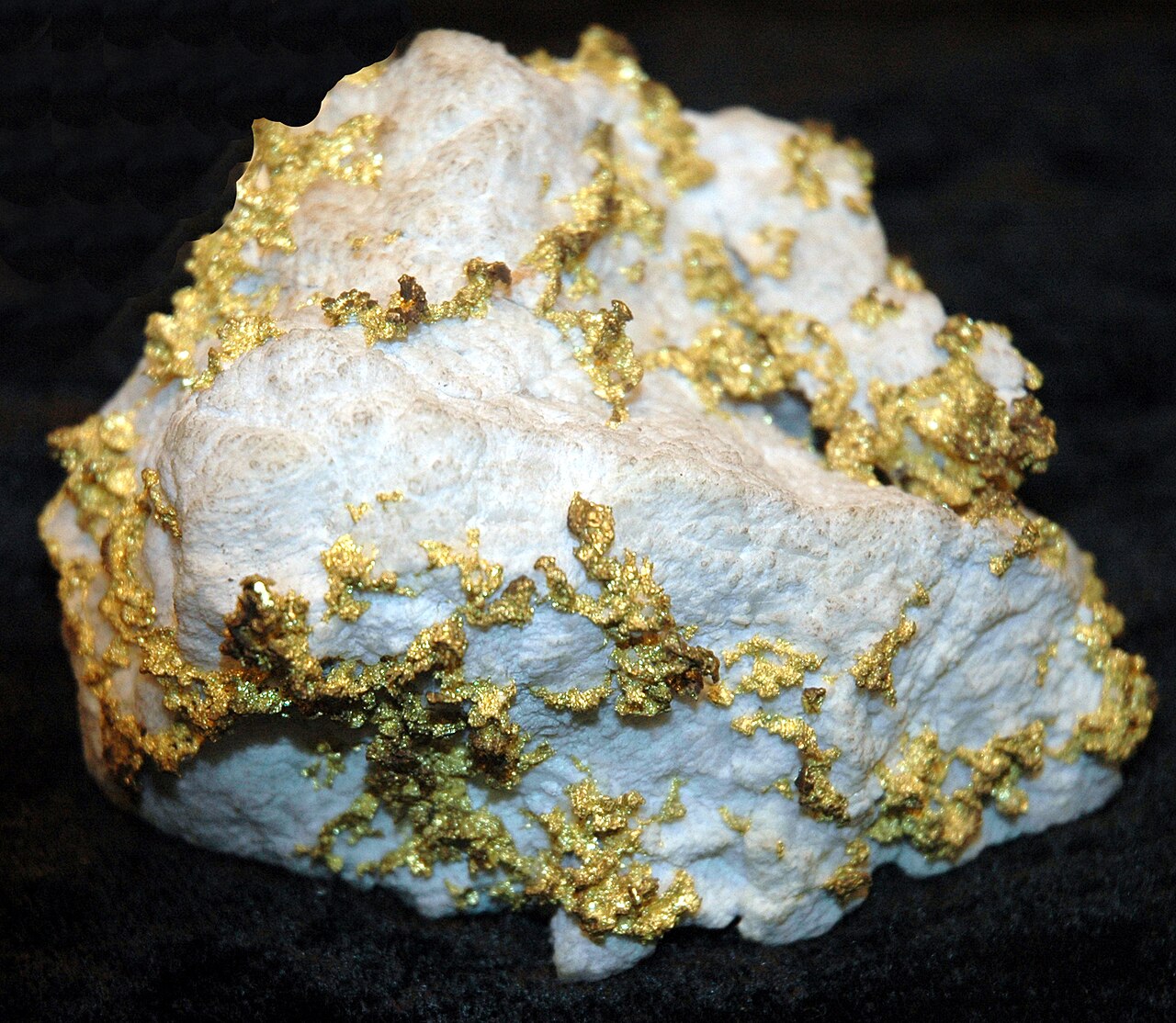
A dense, chemically inert precious metal (Au), worked in Britain both from hard-rock quartz veins and from alluvial gravels, valued throughout history for coinage, jewellery and as a store of wealth.
Historical usage
British gold working goes back to the Bronze Age, but the first large-scale operation was Roman: the Dolaucothi mines in Carmarthenshire, begun around AD 74, used aqueducts, water-power and extensive underground tunnels to work the site until around AD 300 — one of the only Roman gold mines known in Britain. Gold working continued at a small, scattered scale afterwards, particularly panning of river gravels in Scotland and Ireland, until small specks of gold noticed in Welsh lead ore during the 1840s, around Dolgellau in Gwynedd, triggered a real Welsh "gold rush" between 1862 and 1911, drawing an estimated 10,000 prospectors and founding several mines, the largest and richest being Clogau.
How it worked
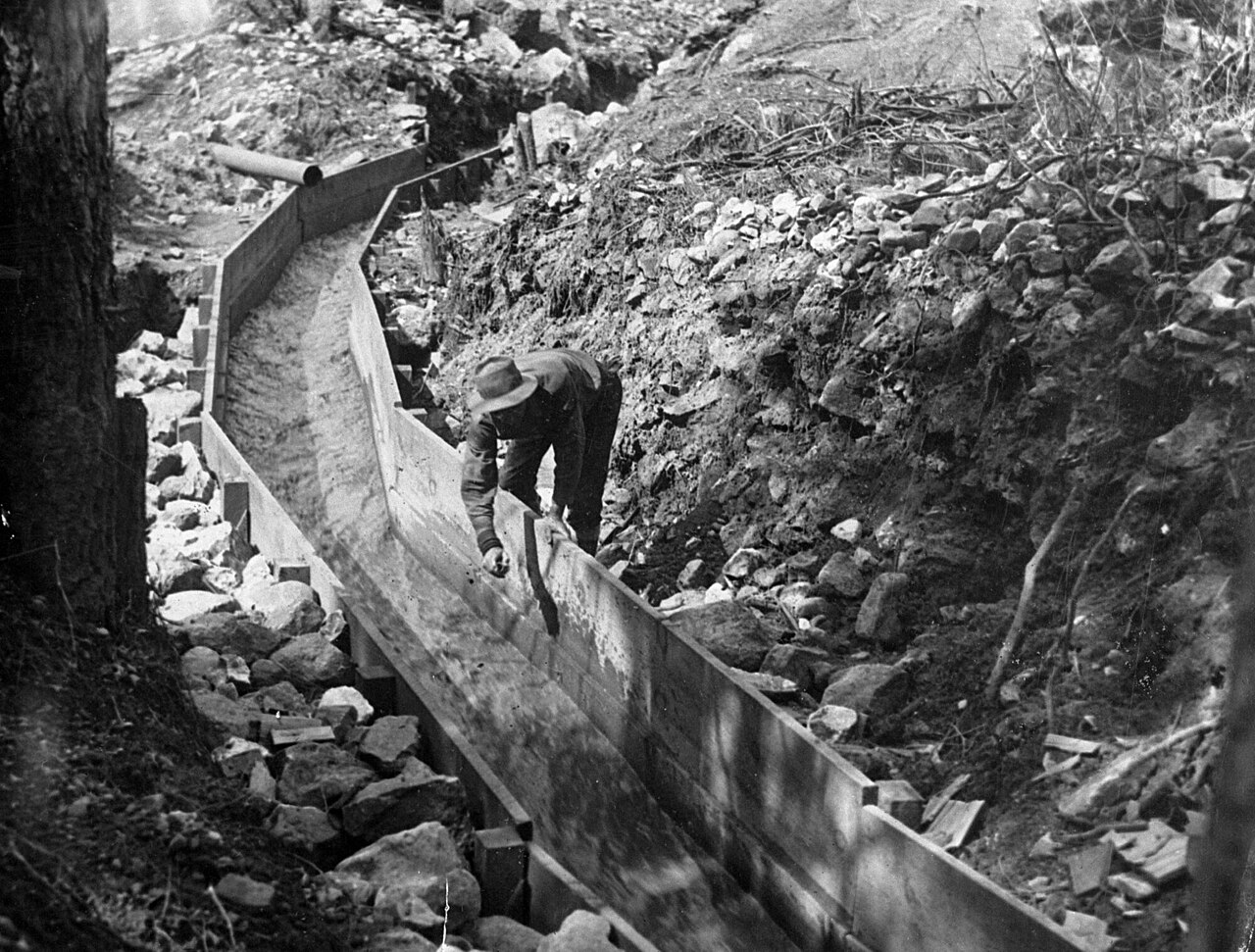
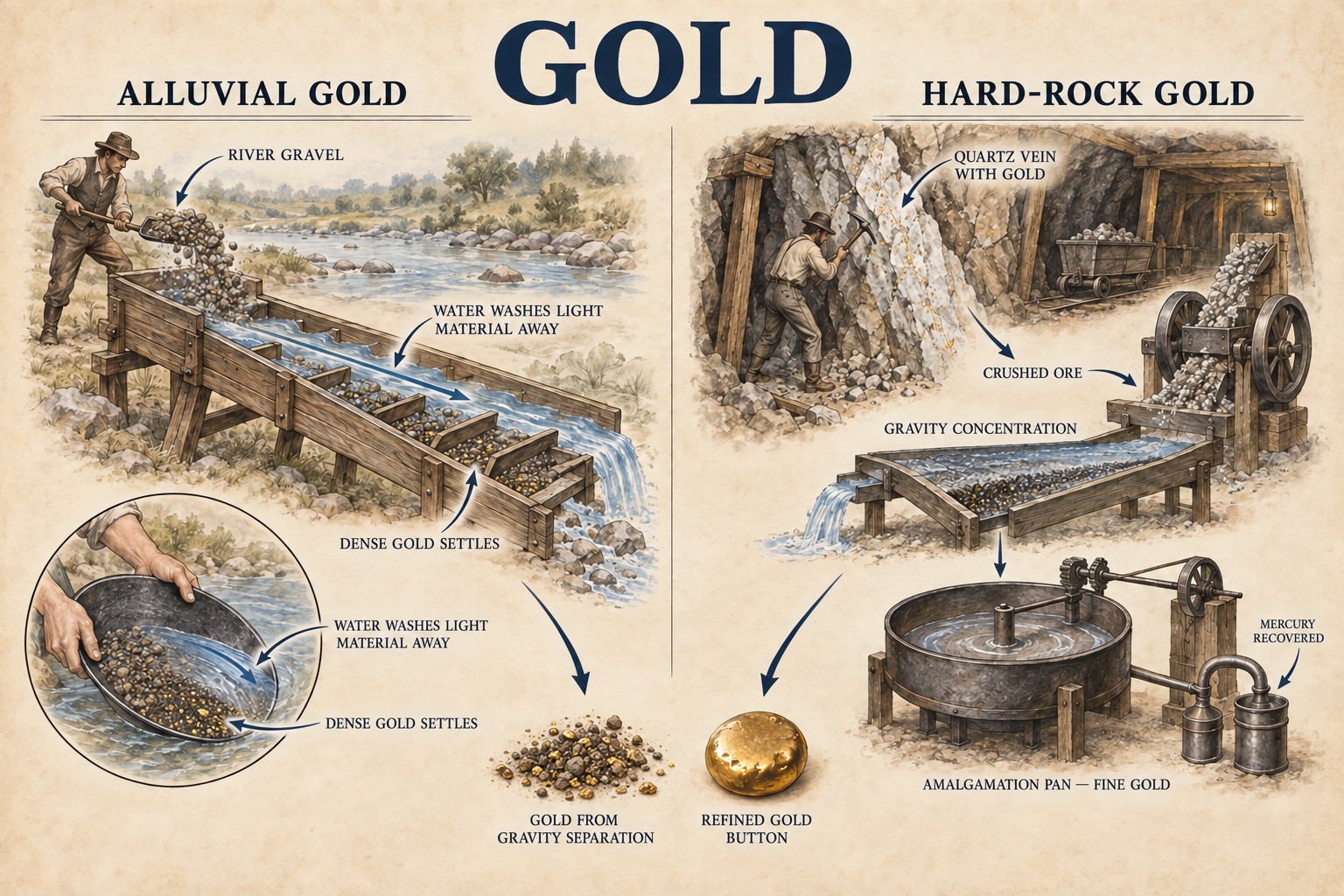
Where gold occurred as fine alluvial grains in river gravel, it was recovered by panning or sluicing, using water to wash away lighter material and let the much denser gold settle out. Hard-rock gold, bound up in quartz veins, needed the ore crushed first; simple gravity separation sufficed for coarser gold, but finer gold required amalgamation, exploiting mercury's affinity for gold. From the 1850s this was mechanised in Britain using heavy iron rollers or spheres rotating within an iron pan — the Berdan and Perkes machines being the most common — to crush ore and amalgamate the gold in one process.
Why it was used
Gold's rarity, resistance to tarnish and corrosion, and universal recognition as a store of value made it worth extracting even from very low-grade or awkward deposits that no other metal would have justified working.
Value over time
Gold's price was fixed, not traded, for most of British history: set at 89 pence an ounce in 1257, it eventually settled at a fixed £4.25 an ounce for centuries under the gold standard, with the sovereign coin (first struck for circulation in 1817, containing 0.2354 troy ounces of pure gold) built directly on that fixed value. Britain held to £4.25/oz until the 1944 Bretton Woods agreement began the move away from a fixed gold price; once gold was allowed to float freely, its price rose dramatically, passing £1,000 an ounce for extended periods during the 2010s — a price history that makes even a marginal historic working potentially worth revisiting today, which is part of why Cononish, in Scotland, is now Britain's only currently operating gold mine.
Hazards & challenges
Recovering fine gold by amalgamation meant working directly with liquid mercury, which binds to gold particles; the resulting amalgam then had to be "retorted" — heated until the mercury vaporised, leaving the gold behind. Retorting released concentrated mercury vapour directly into the air miners were breathing, and studies of comparable small-scale gold operations still using this method today find up to a third of exposed workers show signs of mercury poisoning — tremor, cognitive effects and kidney damage among them. As with lead, the danger was poorly understood or simply accepted for most of the period this technique was in use.
Risks & limitations
Almost all economically worthwhile British gold deposits are small, low-grade or difficult to access compared with major world gold provinces, which is why British gold mining has always been a marginal, boom-and-bust activity rather than a sustained industry — the Welsh gold rush itself lasted only a few decades before petering out as the richest ground was worked through.
Regional variation
Wales is by far Britain's best-known gold-producing region, with a strong modern cultural identity attached to it: pure Welsh gold, principally from Clogau, has been used for royal wedding rings since the Queen Mother's in 1923, a tradition maintained for the Queen, Princess Margaret, the Princess Royal, Diana, Camilla, Catherine and Meghan. Scotland's gold working has historically been smaller-scale and more scattered, mostly alluvial panning, though it also hosts Britain's only currently active gold mine at Cononish.
Related terminology
Hydraulic Mining, Mines Royal, Panning
Mines associated with this term
5 examples chosen from 24 linked records — the term page is not an index.
- Dolaucothi Gold Mines — Carmarthenshire (well documented example)
Dolaucothi is the only well-evidenced Roman gold mine in Britain, worked from around AD 74 to AD 300 using aqueducts, water power and extensive tunnelling. - Esgair Hir and Esgair Fraith Mines — Powys (well documented example)
Linked on an exact-phrase match in this record's own text. - Carnon Mine — Cornwall (well documented example)
Named in this record’s history: “…of the wider Carnon Valley's tin gravels, small amounts of alluvial gold were recovered alongside tin as a by-product.” - Castell Carn Dochan Mine — Gwynedd (well documented example)
Named 11 times in this record, first in the summary: “A small gold mine on the flanks of Ffridd Helyg y Moch near Llanuwchllyn,…” - Cavanacaw Gold Mine — County Tyrone (well documented example)
Northern Ireland's only gold mine to reach production. Ore output has been suspended since 2020, and the project passed from Galantas Gold to Ocean Partners UK in September 2026.
See every mine that worked gold →
Disasters associated with this term
Included only where MineArchive's own research gives a reasonable evidential basis, with the nature of the relationship stated — not every disaster where this term might plausibly apply.
- Cavanacaw rockfall and water inrush, 2018 (contextual relationship)
What a modern gold-mining incident in the UK looks like: over-charging with explosives at the working Cavanacaw mine brought 150 tonnes of roof down, narrowly missing a worker.
Sources
- (primary) Mercury hazards from gold mining to humans, plants, and animals — United States Geological Survey
- (secondary) Dolaucothi Gold Mines — Wikipedia
- (secondary) Gold in Britain — NERC Open Research Archive
- (secondary) Historical Gold Prices: 30 BCE to Today — The Balance
- (secondary) History of Welsh Gold — Clogau
- (secondary) Mercury has long poisoned gold miners — UN Environment Programme
- (secondary) Sovereign (British coin) — Wikipedia
- (secondary) The archaeology of gold mining in England — National Association of Mining History Organisations
Record created: 20 August 2026 · Last researched: 20 August 2026