 MineArchive
Hydraulic Mining
| Also known as | Monitor, Hydraulic monitor, Hydraulicking, Water jet mining |
|---|---|
| Category | Mine Workings & Access |
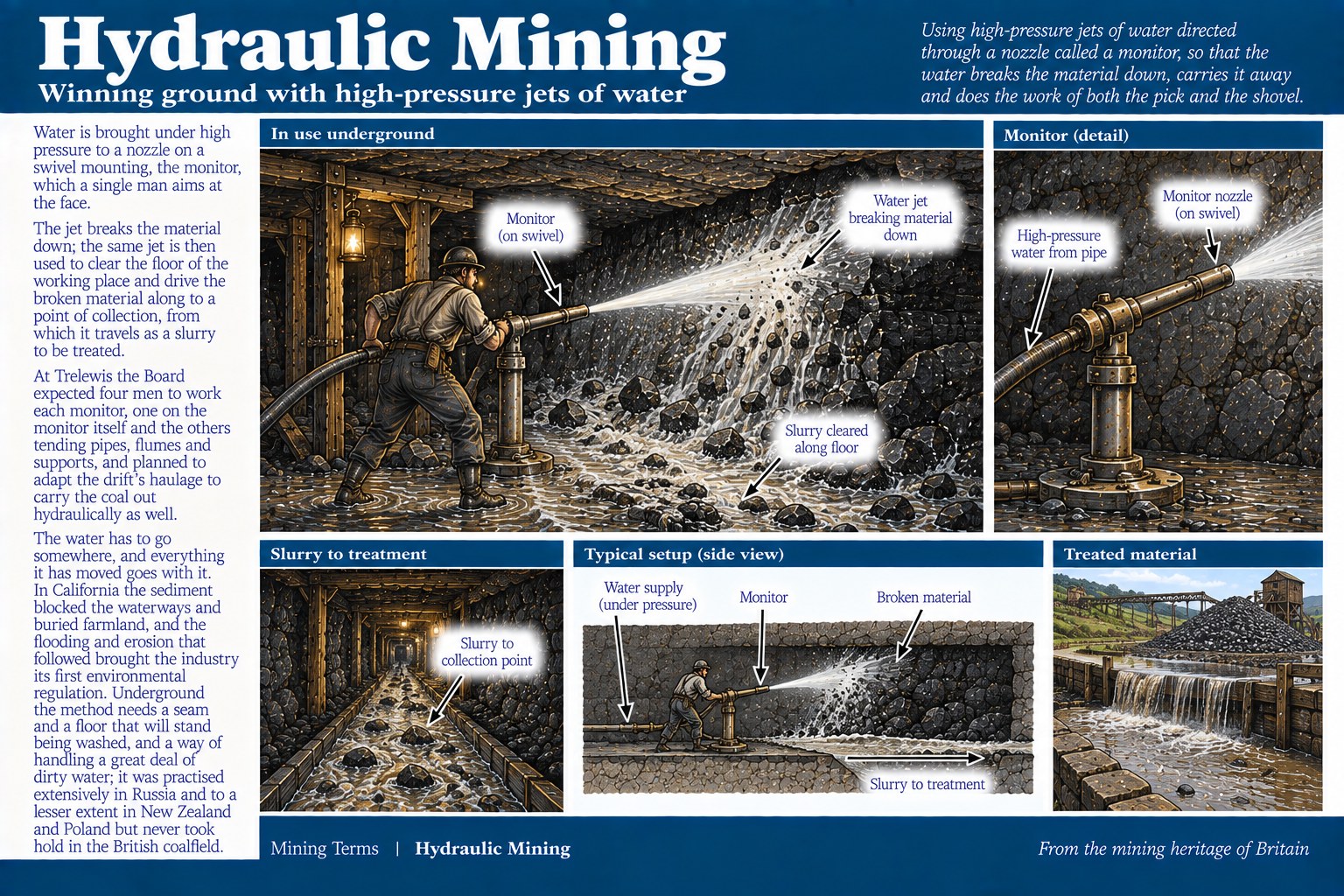
Winning ground with high-pressure jets of water directed through a nozzle called a monitor, so that the water breaks the material down, carries it away and does the work of both the pick and the shovel.

Historical usage
The technique descends from Roman methods of moving soft ground with water. Its modern form began in the California gold rush, where Edward Matteson first turned a high-pressure jet on the gold-bearing gravels near Nevada City in 1853; by the mid-1880s hydraulic mining there had recovered some eleven million ounces of gold, and done so much damage to the rivers and farmland below that it was regulated by law. In Britain it is the principal way china clay is won in Cornwall and Devon, and it was tried once on coal: in 1958 the National Coal Board installed its first experimental hydraulic mining plant at Trelewis Drift near Treharris, at an estimated cost of £48,000 over six months.
How it worked
Water is brought under high pressure to a nozzle on a swivel mounting, the monitor, which a single man aims at the face. The jet breaks the material down; the same jet is then used to clear the floor of the working place and drive the broken material along to a point of collection, from which it travels as a slurry to be treated. At Trelewis the Board expected four men to work each monitor, one on the monitor itself and the others tending pipes, flumes and supports, and planned to adapt the drift's haulage to carry the coal out hydraulically as well.
Why it was used
It is cheap, simple and safe from sparks. The Board's own case for the Trelewis trial was a higher output per manshift with equipment that was easy to operate and move; there is virtually no explosive danger in a water jet, and apart from the pumping plant the gear at the face is simple. The power-hungry part is generating the water pressure, and that can be done on the surface, where the plant is accessible and needs neither expensive housing nor flameproof electrical equipment.
Risks & limitations
The water has to go somewhere, and everything it has moved goes with it. In California the sediment blocked the waterways and buried farmland, and the flooding and erosion that followed brought the industry its first environmental regulation. Underground the method needs a seam and a floor that will stand being washed, and a way of handling a great deal of dirty water; it was practised extensively in Russia and to a lesser extent in New Zealand and Poland but never took hold in the British coalfield.
Related terminology
China Clay, Gold, Hushing, Panning, Tin Streaming, Water Pressure Engine
Mines associated with this term
5 examples chosen from 7 linked records — the term page is not an index.
- Williamthorpe Colliery — Derbyshire (well documented example)
Named in this record’s closure notes: “…Pumping was discontinued at closure and the shafts kept open to monitor the expected rise in water, but the site was later brought back into…” - Billingham Anhydrite Mine — Stockton-on-Tees (well documented example)
Named in this record’s redevelopment: “…of low-level hazardous industrial waste — incinerator fly ash, monitors, fluorescent tubes — was still being examined in the 2000s, with…” - Carclaze Pit — Cornwall (well documented example)
Named in this record’s workings: “…methods used at other St Austell clay works: high-pressure water monitors washing decomposed granite from the pit face, the resulting slurry…” - Lee Moor China Clay Works — Devon (well documented example)
Named in this record’s workings: “The traditional method was hydraulic: high-pressure water monitors were played against the pit face to break the softened granite down…” - Saddlebole Mine — Cheshire (well documented example)
Named in this record’s history: “…belongs to the National Trust, for whom the Derbyshire Caving Club monitors the mine.”
Sources
- (secondary) Hydraulic mining — Wikipedia
- (secondary) Trelewis Drift — Treharris District
Record created: 11 September 2026 · Last researched: 11 September 2026