 MineArchive
Tin Streaming
| Dialect | Cornish and Devon |
|---|---|
| Category | Prospecting & Exploration |
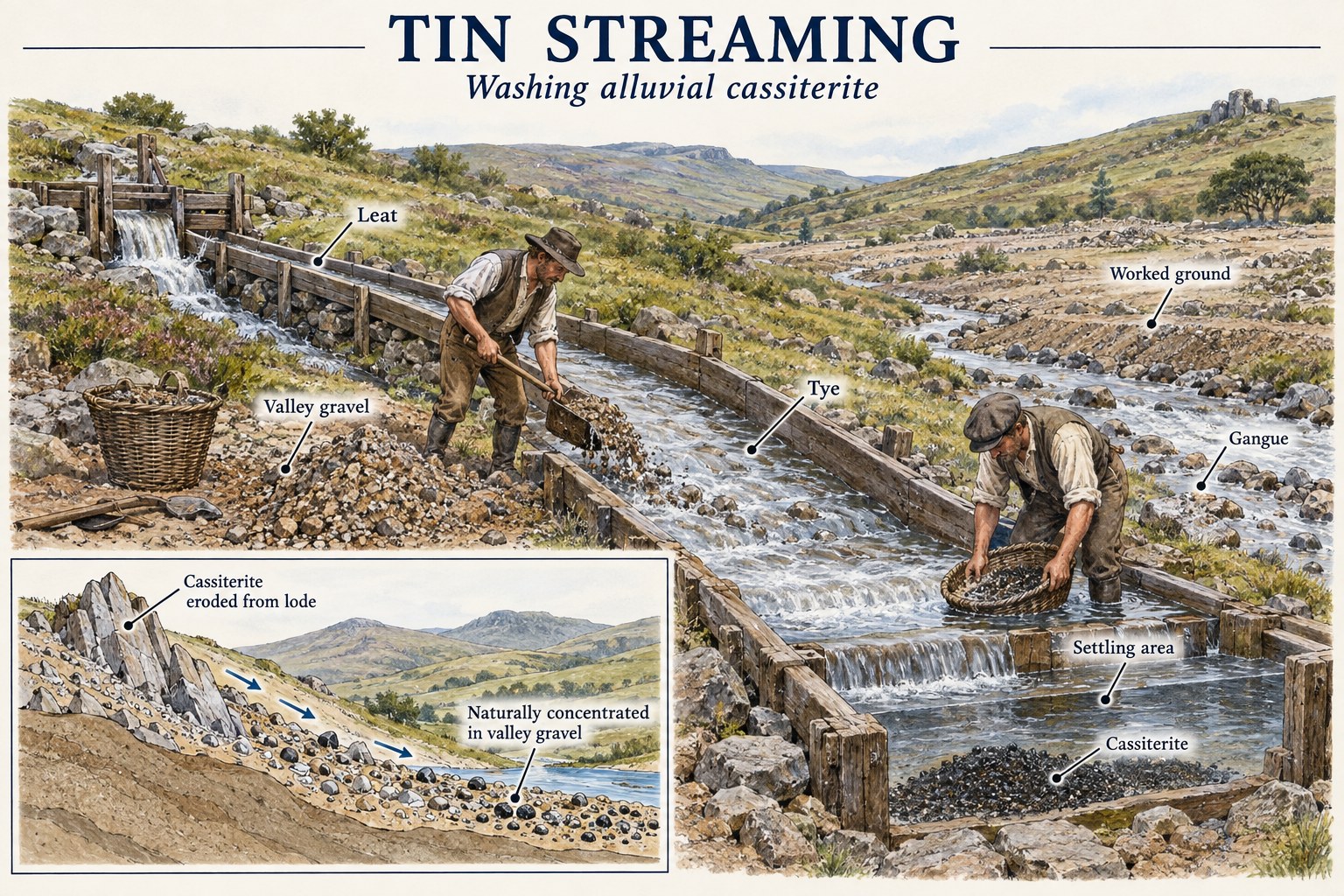
The washing of loose alluvial gravel from a stream bed or valley floor to separate out heavy grains of cassiterite (tin ore), using nothing more than moving water and gravity — the oldest and simplest way tin has ever been won in Britain.
Historical usage
Tin streaming is Dartmoor's and Cornwall's oldest recorded industry, worked since at least the Bronze Age and still the dominant form of tin production well into the medieval period; the 1330s alone are estimated to have produced more than a million pounds (roughly 2,200 tonnes) of tin a year from streaming works across Devon and Cornwall. The industry declined sharply after the 17th century as easily worked alluvial ground was exhausted, but pockets of streaming continued as a minor activity into the mid-20th century.
How it worked
Streamers diverted water via a leat to a trench, or 'tye', cut at the lower end of the ground being worked, then washed valley gravel through it; the flowing water carried away the lighter waste ('gangue') while denser cassiterite settled out, ready to be collected, further dressed and smelted. Because alluvial cassiterite has typically had its sulphide impurities removed by weathering over geological time, streamed tin was often purer than ore later won from hard-rock lodes.
Why it was used
It needed no shaft, no expensive engine and comparatively little capital — just access to a stream, a leat, and labour — making it the natural first stage of the tin industry and, for centuries, viable long after any lode mining in the same district would have been unthinkable.
Risks & limitations
Streaming could only ever recover the tin that erosion had already concentrated in valley gravels over geological time, a strictly finite resource; once a valley's alluvial ground was worked out, production could only continue by moving to fresh ground or turning to underground lode mining instead.
Regional variation
Most closely associated with Dartmoor and Cornwall, where the technique evolved from prehistoric shovel-and-basket working through progressively more organised leat-and-tye systems, before giving way from the medieval period onward to opencast and, eventually, underground lode mining as the easiest alluvial ground was exhausted.
Related terminology
Blowing Mill, Hydraulic Mining, Medieval
Mines associated with this term
5 examples chosen from 9 linked records — the term page is not an index.
- Carclaze Pit — Cornwall (well documented example)
Carclaze is thought to have begun as tin streaming in the valley below, the workings following a rich vein uphill until the whole stockwork was opened as a pit. - Gaverigan Tin Streaming — Cornwall (well documented example)
Named in this record’s history: “…following a lode underground. St Enoder parish's own history records tin streaming at Gaverigan and on the adjoining Goss Moor as a real supplement to…” - Golden Dagger Mine — Devon (well documented example)
Named in this record’s summary: “…to work commercially, closing in 1930 — bringing to an end a tin-streaming and mining tradition on the moor stretching back to the 15th century.” - Hexworthy Mine — Devon (well documented example)
Named in this record’s history: “…absorbed the smaller neighbouring Hensroost mine and the Skir Gut tin-streaming works; ore was carried from the workings to Hensroost for processing…” - Great Carnon Stream Works — Cornwall (well documented example)
Named twice in this record, first in the summary: “The most important tin-streaming operation in Cornwall in its day, working the tin-rich alluvial…”
Sources
- (primary) Dartmoor's Past Tin Industry — Dartmoor National Park Authority
- (secondary) Tin Streaming — Project Ancient Tin
Record created: 22 August 2026 · Last researched: 22 August 2026