 MineArchive
Blue Hills Mine
| Also known as | East Polberro |
|---|---|
| Location | Trevellas Coombe, St Agnes, Cornwall — 50.3194, -5.1972 (approximate) |
| Commodities | Tin, Arsenic |
| Type | Metal |
| Worked | Early 18th century–1897 |
| Maximum depth | 100 fathoms (183 m), Letcher's Shaft |
Overview
A tin mine in Trevellas Coombe near St Agnes, formed from older workings including Wheal Betsy and worked intermittently from the eighteenth century until 1897; its slate-built engine house survives and tin streaming still goes on in the valley.
History
Blue Hills Mine lies in Trevellas Coombe, at the end of the Jericho Valley near St Agnes, a valley named for the bluish slate of its sides. It grew from a group of older mines, Wheal Betsy among them, started in the early eighteenth century and closed about 1780 because of the cost of keeping them dry. With steam pumping the sett was restarted, as East Polberro from 1813 by one account and as Blue Hills from 1810 by another, and took the name Blue Hills by 1836; one history has it closed again after nine years and idle until 1858.
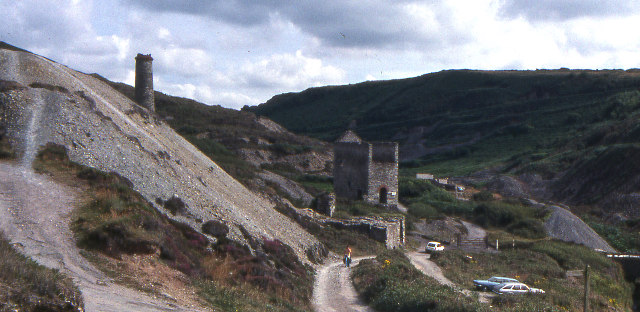
It worked tin from the Baldhu, Pink, Straggler's and Betsy lodes through Blue Burrow (66 fathoms), Engine (96 fathoms), Polyear's (45 fathoms), Letcher's (100 fathoms), Wheal Joy and Wheal Betsy Engine shafts, and employed between 50 and 150 men. Between 1858 and 1897 it produced 2,117 tons of tin and 2 tons of arsenic. From 1879 it was worked with its southern neighbour Penhalls, the two connected underground, until they separated again fourteen years later. Blue Hills closed in 1897 in the face of cheap foreign tin; an attempt to rework it in 1926 failed, and in the early twentieth century it was included in the reworking of Wheal Kitty. The main engine house, built of slate for a 60-inch pumping engine of 1869, still stands, with remains of a horizontal whim and stamps up the valley and a waterwheel that ran stamps near the beach.
Geology
Tin lodes in slate: the Baldhu, Pink, Straggler's and Betsy lodes.
Workings
Blue Burrow, Engine, Polyear's, Letcher's, Wheal Joy and Wheal Betsy Engine shafts; a 60-inch pumping engine of 1869, a horizontal whim and stamps, and a waterwheel driving stamps.
Closure
Closed in 1897 because of cheap tin imports; an attempt to rework it in 1926 failed.
What remains
The slate engine house survives; tin streaming continues in the valley at Blue Hills Tin Streams.
The slate-built engine house of 1869 and its chimney, the base of the whim and stamps, a waterwheel site and spoil tips.
Redevelopment
Part of the site is used by the Blue Hills Tin Streams workshop and museum.
Related mines
- Penhalls Mine — Neighbours connected underground and worked together from 1879.
- Wheal Kitty — Blue Hills was included in the reworking of Wheal Kitty in the early 20th century.
Nearby mines
- Penhalls Mine — 0.3 miles (0.4 km) SW
- Wheal Kine — 0.3 miles (0.5 km) SW
- Turnavore Mine — 0.4 miles (0.6 km) SW
- Wheal Friendly — 0.4 miles (0.6 km) SW
- Wheal Pell — 0.6 miles (1.0 km) W
Straight-line distance, within 9 miles (15 km). Show on the map.
What's uncertain
Points where sources disagree or the record could not be settled; both accounts are kept. All open questions in the archive.
- Started in the early 18th century and closed around 1780; restarted as East Polberro in 1813 and became Blue Hills in 1836. (disputed) 1
- Blue Hills was formed in 1810 out of smaller concerns including Wheal Betsy, closed after nine years and stood idle until 1858. (disputed) 2,3
Recorded claims
Individual factual claims, each attached to the source(s) that support it below. Where sources disagree, both are kept.
- Started in the early 18th century and closed around 1780; restarted as East Polberro in 1813 and became Blue Hills in 1836. (disputed) 1
- Blue Hills was formed in 1810 out of smaller concerns including Wheal Betsy, closed after nine years and stood idle until 1858. (disputed) 2,3
- From 1858 to 1897 it produced 2,117 tons of tin and 2 tons of arsenic. 2
- Worked until its closure in 1897 due to cheap tin imports; an attempt to rework it in 1926 failed. 1,2
- From 1879 it was amalgamated with Penhalls, the two connected underground. 2
- The main engine house, for a 60-inch pumping engine of 1869, is built of slate. 2
- Small-scale tin streaming is still active in Trevellas Coombe at Blue Hills Tin Streams. 1,3
Sources
- (secondary) Blue Hills Mine — Northern Mine Research Society
- (secondary) Blue Hills Mine — Explore Cornwall
- (secondary) Trevellas — Wikipedia
Record created: 17 October 2026 · Last researched: 17 October 2026