 MineArchive
Wheal Kitty
| Location | St Agnes, Trevaunance Cove, Cornwall — 50.3100, -5.2000 (exact) |
|---|---|
| Commodities | Tin, Copper, Iron |
| Type | Metal |
| Worked | From 1758–1930 |
| Maximum depth | 50 fathoms (by 1838) |
| Operators | Wheal Kitty and Penhall's United Ltd (1904–1930) |
Overview
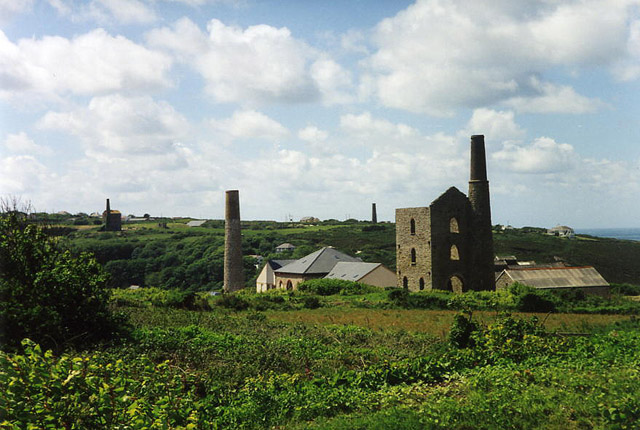
Wheal Kitty, perched on the cliffs above Trevaunance Cove at St Agnes, was first documented in 1758 and worked almost continuously until 1930 — long enough to end its life housing the last beam engine ever to work anywhere in the St Agnes mining district.
History
Wheal Kitty's sett was first documented in 1758, though consistent working is recorded from 1834; the mine closed in 1842 and reopened ten years later. By 1838 the mine had reached a depth of 50 fathoms and employed 258 people, producing tin, copper and iron pyrite. Over its working life the mine raised 13,121 tons of tin and 2,024 tons of copper. In 1904 Wheal Kitty merged with the neighbouring Penhalls Mine to form Penhalls United. At Sara's Shaft, a 65-inch Cornish engine — originally built by the Perran Foundry as a 60-inch engine in 1852 and previously used at a mine near St Hilary — was installed second-hand in 1910 when the shaft was deepened; it went on to become the last beam engine ever to work in the St Agnes mining district. Between 1926 and 1929 a new tin processing works was built at the site to extract cassiterite from ore raised at the mine, before Wheal Kitty finally closed in 1930. The company was a cost-book concern: a lease of 21 years at a royalty of one-fifteenth, later renewed from 1871 at one-twenty-second, with 4,295 shares by the 1870s, a purser in Camborne and London offices in Austin Friars, four steam engines of 34, 28.5, 20 and 20-inch cylinders and some 160 people employed. Wheal Kitty was the survivor of the many small setts on Goonlaze Downs, most of which had amalgamated into Penhalls Mine, worked on its own until 1884 before the 1904 union. After the 1930 closure the buildings served as warehouses, factories, workshops and net stores until Carrick Council bought the site in 1987 and restored the engine house as workshops.
Geology
The mine worked tin-, copper- and iron pyrite-bearing lodes within the St Agnes mining district, part of the same hydrothermal, granite-related Cornubian orefield worked across west Cornwall.
Geological setting: Hydrothermal Deposits (well documented example), Veins and Lodes (well documented example)
Workings
The mine reached a depth of 50 fathoms by 1838; Sara's Shaft was equipped from 1910 with a 65-inch Cornish engine, the last beam engine to work anywhere in the St Agnes district, and a purpose-built tin processing works was added in 1926-29.
Closure
The mine closed in 1930 after nearly a century of consistent working.
What remains
The restored Sara's Shaft engine house now forms the centrepiece of an industrial estate on the site.
Related mines
- Penhalls Mine — The two mines amalgamated in 1904 and reopened together in 1907 as Wheal Kitty and Penhall's United Ltd, working as one undertaking until 1930.
- Polberro Mine — Run with Wheal Kitty, West Kitty and Wheal Friendly as a single concern in the 1920s, sharing the 1926 dressing floor.
- Polbreen Mine — Polbreen is part of the West Kitty group, the westward continuation of the Wheal Kitty flat lodes, and was itself later renamed New Kitty; the West Kitty flat lode passes south into Polbreen and is believed to crop out near Dorcas's Lode.
- Turnavore Mine — Reopened to work the same tin veins that paid at Wheal Kitty.
- Wheal Friendly — Listed as part of Wheal Kitty Mines, and worked with Wheal Kitty as a single concern in the 1920s.
Nearby mines
- Polbreen Mine — 0.3 miles (0.6 km) W
- Turnavore Mine — 0.4 miles (0.6 km) N
- Wheal Kine — 0.4 miles (0.6 km) N
- Penhalls Mine — 0.4 miles (0.7 km) N
- Wheal Friendly — 0.5 miles (0.7 km) N
Straight-line distance, within 9 miles (15 km). Show on the map.
Recorded claims
Individual factual claims, each attached to the source(s) that support it below. Where sources disagree, both are kept.
- By 1838 the mine employed 258 people at a depth of 50 fathoms; over its working life it raised 13,121 tons of tin and 2,024 tons of copper. 1,2
- The 65-inch Cornish engine installed at Sara's Shaft in 1910 — built in 1852 and previously used at another mine — became the last beam engine to work anywhere in the St Agnes district. 1,2
- Wheal Kitty, at SW 726 510 on Goonlaze Downs, is the survivor of several smaller concerns: early 19th-century workings at Goonlaze, Wheal Pink, Wheal Vottle and about a dozen others amalgamated into Penhalls Mine, which worked on its own until 1884, while Wheal Kitty had been a very successful tin mine from at least 1830, with copper and iron pyrites on a smaller scale; in 1904 Wheal Kitty and Penhalls joined forces as Penhalls United. 2
- Cornwall Calling's 19th-century returns have Wheal Kitty held on a 21-year lease at a royalty of one-fifteenth, 180 fathoms deep below adit, worked by four steam engines of 34, 28.5, 20 and 20-inch cylinders with 160 employed, the company on the cost-book system in 1,024 shares of £4 with James B. Coulson of Penzance as purser; a later lease of 21 years from 1871 at one-twenty-second, for tin and copper, with 4,295 shares, R. H. Pike of Camborne as purser and W. Trogue as manager. About 220 people were employed in 1914; operations ended in 1930, and in 1987 Carrick Council bought the site and began the Wheal Kitty Workshops scheme, restoring the engine house as office space. 3
- The mine reopened in the 1830s for tin and copper ore, closed in 1842 and reopened ten years later; Sara's Shaft was reported to be some 950 feet deep, and about 220 people were employed in 1914. 1
- The British Geological Survey's catalogue holds abandonment plans naming Wheal Kitty with Gooninnis and Wheal Vottle (tin ore, OM5459) and in the group plans OM8157 and OM6522 (Wheal Sisters, Tincroft Consols, Tincroft Old, Trencrom, Wheal Kitty, Wheal Margaret, Wheal Mary). 4
- Located at about 50.310 N, 5.200 W. 1
Sources
- (secondary) Wheal Kitty — Wikipedia
- (secondary) Wheal Kitty (St. Agnes) — Grace's Guide
- (secondary) Wheal Kitty Mine, Cornwall (Cornwall Calling) — Cornwall Calling
- (primary) Wheal Kitty mine plans (BGS Mine Plans Catalogue) — British Geological Survey / The Coal Authority
- (primary) Wheal Kitty 20th century tin processing works, St. Agnes — Historic England (Scheduled Monument record)
Record created: 23 August 2026 · Last researched: 24 September 2026