 MineArchive
Polberro Mine
| Also known as | Royal Polberro Consols, Polberro Consols, St Agnes Consols |
|---|---|
| Location | St Agnes, on the north coast of Cornwall — 50.3140, -5.2160 (approximate) |
| Commodities | Tin, Copper |
| Type | Metal |
| Worked | By the 1730s–1941 |
| Maximum depth | 182 fathoms (1,092 feet), reached in the final reworking — the deepest in St Agnes |
Overview
One of the richest and deepest mines of the St Agnes district, and the last of them to work. Polberro was an amalgamation of several smaller setts — Wheal Kine, Wheal Pell, Turnavore, Prosper, Park and Squidler — working from as early as the 1730s. It was famous for Diamond Tin, ore so pure it needed little or no processing and could go straight to the smelters. Queen Victoria visited in 1846, after which it was Royal Polberro Consols. The tin price collapse of the 1870s closed it, a reworking followed from 1886, and it shut again in 1895 on merging with Trevaunance. A final reworking from 1937 deepened the shaft to 182 fathoms before the mine closed in 1941, ending all mining in the St Agnes area.
History
Polberro was operational as far back as the 1730s, and like many Cornish mines it was an amalgamation of smaller concerns that had each worked on their own — Wheal Kine, Wheal Pell, Wheal Turnavore, Wheal Prosper, Wheal Park and Wheal Squidler among them. Its boom came from the mid-1830s, when production peaked at around thirty tons of tin a month with some 450 people employed. In 1846 the mine was visited by Queen Victoria, and from then it was known as Royal Polberro Consols.
The mine was best known for Diamond Tin — a very high grade of ore, so pure it required little or no processing and could be sent directly from the mine to the smelters. Over its main working period it produced 4,310 tons of tin and 1,598 tons of copper.
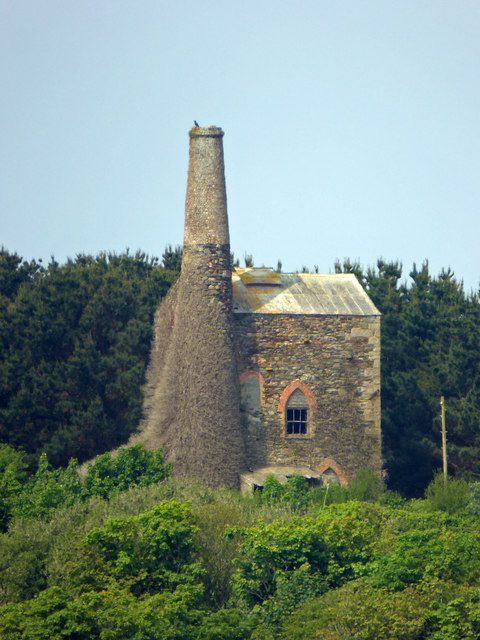
The fall in the tin price through the 1870s closed Polberro along with many of its neighbours. A reworking in 1886 dates the surviving engine house on Turnavore shaft, built for a 60-inch pumping engine, and the mine closed again in 1895 after a merger with Trevaunance Mine. A final attempt came in 1937: extensive new dressing floors were installed, the engine house was converted into the miners’ dry, and the shaft was deepened to 182 fathoms, making it the deepest mine in St Agnes. It closed for the last time in 1941, ending all mining activity in the area.
Geology
The St Agnes mining district on the north Cornish coast, worked for tin and copper. Polberro was noted for the exceptional purity of its tin ore, sold as Diamond Tin.
Workings
An amalgamation of several older setts worked as one. The surviving engine house stands on Turnavore shaft and was built in the 1886 reworking for a 60-inch pumping engine; a separate 36-inch stamps engine house stood nearby, of which only the granite bedstone for the beam remains. The dressing floors were extensive, with circular buddles dating from the early twentieth century, and concrete piers survive that carried a stone crusher and a grizzly screen fed by a wooden gantry from the shaft top. In the 1937 reworking the shaft was deepened to 182 fathoms and the engine house was converted into the miners’ dry, a lean-to at the front housing the heating boiler.
Closure
Closed in the 1870s with the fall in the tin price; reworked from 1886 and closed again in 1895 on merging with Trevaunance Mine; reworked a final time from 1937 and closed in 1941, which ended all mining activity in the St Agnes area.
What remains
The engine house on Turnavore shaft survives in good condition, still roofed, its distinctive Gothic windows some of them still framed and its bob wall bricked in from the last reworking. The dressing floors were well preserved when photographed in the mid-1990s but much was lost when a wastewater treatment plant was built, and what survives is now buried or hidden by vegetation. The site is on private land and should not be entered.
The engine house on Turnavore shaft, with its Gothic windows and bricked-in bob wall; two circular buddles on the dressing floors; concrete supports for a stone crusher and grizzly screen; and the granite bedstone of the 36-inch stamps engine house.
Related mines
- Trevaunance Mine — Merged at the end: Polberro closed in 1895 after a merger with Trevaunance Mine, and both belonged to the St Agnes Consols group that gave Polberro its alternative name.
- Turnavore Mine — One of the setts consolidated into Polberro.
- Wheal Friendly — Worked with Polberro as a single concern in the 1920s, sharing a dressing floor from 1926.
- Wheal Kine — Absorbed into Polberro: Wheal Kine was one of the smaller setts — with Wheal Pell, Turnavore, Prosper, Park and Squidler — amalgamated into the mine that became Royal Polberro Consols.
- Wheal Kitty — Run with Wheal Kitty, West Kitty and Wheal Friendly as a single concern in the 1920s, sharing the 1926 dressing floor.
- Wheal Luna — Very likely amalgamated with Polberro, with some underground workings linked; a launder from Polberro's 1940s mill crosses Wheal Luna.
- Wheal Pell — Absorbed into Polberro: Wheal Pell was one of the smaller setts — with Wheal Kine, Turnavore, Prosper, Park and Squidler — amalgamated into the mine that became Royal Polberro Consols.
- Wheal Pye — One of the setts consolidated into Polberro Mine; Wheal Pye lay at the centre of the sett.
Nearby mines
- Trevaunance Mine — 0.1 miles (0.2 km) NE
- Wheal Pye — 0.4 miles (0.6 km) NE
- Wheal Pell — 0.5 miles (0.7 km) NE
- Polbreen Mine — 0.5 miles (0.9 km) SE
- Wheal Friendly — 0.6 miles (0.9 km) E
Straight-line distance, within 9 miles (15 km). Show on the map.
What's uncertain
Points where sources disagree or the record could not be settled; both accounts are kept. All open questions in the archive.
- Over its main working period the mine produced 4,310 tons of tin and 1,598 tons of copper. (uncertain) 2
Recorded claims
Individual factual claims, each attached to the source(s) that support it below. Where sources disagree, both are kept.
- The mine was well known for producing a very high grade of ore called Diamond Tin, so pure that it required little or no processing and could be sent directly from the mine to the smelters. 1
- Like many other Cornish mines Polberro was an amalgamation of several smaller mines which had worked as individual concerns, among them Wheal Kine, Wheal Pell, Wheal Turnavore, Wheal Prosper, Wheal Park and Wheal Squidler. 1
- The mine was operational as far back as the 1730s, and its boom came from the mid-1830s when production peaked at around thirty tons of tin a month with some 450 people employed. In 1846 it was visited by Queen Victoria, and from then it was known as Royal Polberro Consols. 1
- Over its main working period the mine produced 4,310 tons of tin and 1,598 tons of copper. (uncertain) 2
- In the final reworking from 1937 the shaft was deepened to 182 fathoms, making it the deepest mine in St Agnes. The mine closed for the last time in 1941, ending all mining activity in the St Agnes area. 1
- A reworking in 1886 dates the surviving engine house on Turnavore shaft, which housed a 60-inch pumping engine; in the last reworking it was converted for use as the miners’ dry. 1
Photographs & further reading
A photographic record of the site made in the mid-1990s, with a description of the engine house on Turnavore shaft, the stamps engine site and the dressing floors, much of which has since been lost.
View sourceSources
- (observational) Polberro Mine — Cornish Mine Images
- (secondary) Polberro Mines, St Agnes Consols (Polberro Consols) — Mindat
Record created: 8 September 2026 · Last researched: 8 September 2026