 MineArchive
Wheal Friendly
| Location | St Agnes, above Trevaunance Cove, Cornwall — 50.3162, -5.2038 (exact) |
|---|---|
| Commodities | Tin, Copper |
| Type | Metal |
| Worked | c. 1860–By 1930 |
| Maximum depth | Unknown. |
Overview
A small St Agnes tin and copper mine above Trevaunance Cove that outlasted most of its neighbours by working with Wheal Kitty and Polberro as one concern, leaving a listed three-storey pumping engine house.
History
Wheal Friendly was a small mine at St Agnes, above Trevaunance Cove, at work by about 1860 and later counted among the Wheal Kitty mines. In 1887 the obituary of Captain James Evans, a St Agnes-born mine agent whose standing had suffered after the West Basset revelations, recorded that he had lately failed to get a company together to work Wheal Friendly. In 1896 H. Thomas, in his Cornish Mining Interviews, said that after tin fell seriously in 1874 the number of mines at work had dwindled and that Wheal Friendly could not battle with hard times any longer and was about to be wound up. It survived nonetheless: in the 1920s Wheal Kitty, West Kitty, Polberro and Wheal Friendly were the only mines still working in the district, because they were run as a single concern, with fresh investment in 1926 in a shared dressing floor, but by 1930 all the mines of the group had closed. Between 1860 and 1915 the mine produced 450 tons of copper and 440 tons of tin. Its 60-inch pumping engine house is dated to 1902 by one account, while Historic England dates it to about the mid to late 19th century.
Geology
Unknown.
Workings
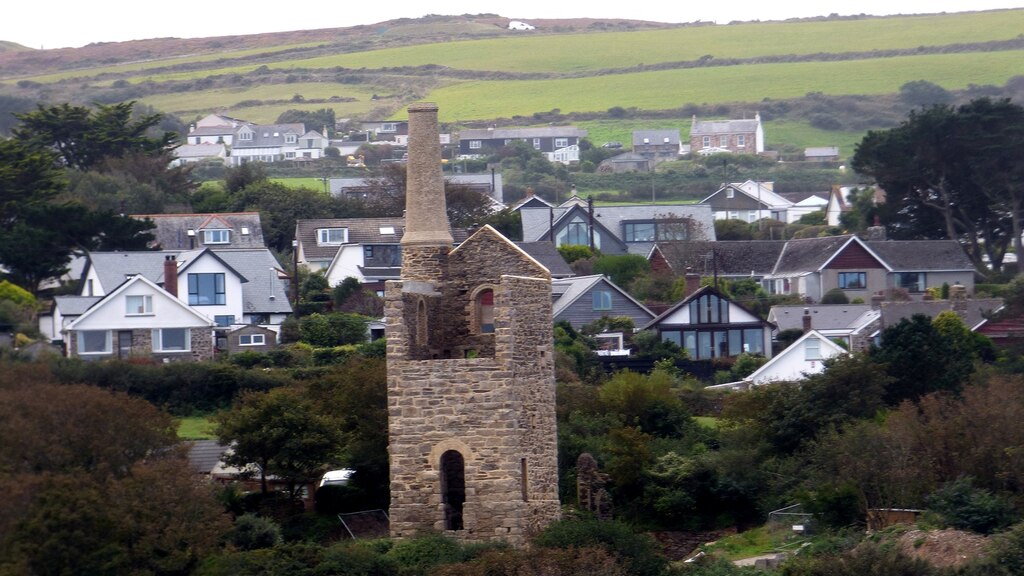
The mine was pumped from a three-storey engine house for a 60-inch pumping engine, with a cataract pit. Nearby a concrete pillar that carried a stone crusher, linked by a wooden gantry to the headgear over the shaft, survives with mounting bolts for pneumatic stamps; a dry house stands immediately north-west of the engine house.
Closure
Already said in 1896 to be about to be wound up, the mine kept going only as part of the Wheal Kitty and Polberro group, all of whose mines had closed by 1930; the Mining Remediation Authority's abandonment plan of Wheal Kitty and Wheal Friendly is dated 25 April 1934.
What remains
The engine house was listed Grade II in 1967, with a virtually complete and unaltered elevation but no surviving floors, roof or machinery. It stands among the houses of St Agnes, photographed in 2020, and a 2023 photograph shows it apparently converted into a modern dwelling.
The three-storey pumping engine house with its chimney clasping one corner, a listed dry house to the north-west, and the concrete crusher pillar.
Related mines
- Polberro Mine — Worked with Polberro as a single concern in the 1920s, sharing a dressing floor from 1926.
- Wheal Kitty — Listed as part of Wheal Kitty Mines, and worked with Wheal Kitty as a single concern in the 1920s.
Nearby mines
- Turnavore Mine — 0.2 km SE
- Wheal Kine — 0.2 km E
- Wheal Pell — 0.2 km SE
- Penhalls Mine — 0.3 km E
- Wheal Pye — 0.3 km SE
Straight-line distance, within 15 km. Show on the map.
What's uncertain
Points where sources disagree or the record could not be settled; both accounts are kept. All open questions in the archive.
- Cornish Mine Images dates the 60-inch pumping engine house to 1902; Historic England's listing dates it to about the mid to late 19th century. (disputed) 1,4
- A 2023 photograph appears to show the engine house converted into a modern dwelling. (uncertain) 6
Recorded claims
Individual factual claims, each attached to the source(s) that support it below. Where sources disagree, both are kept.
- The Wheal Friendly engine house is a Grade II listed (1967) pumping beam engine house, part of Wheal Kitty Mines, of about the mid to late 19th century, three storeys of killas and granite rubble with granite dressings, with no surviving floors, roof or machinery. 1
- In 1887 Captain James Evans's obituary recorded that he had lately failed to get a company to work Wheal Friendly. 2
- In 1896 H. Thomas said Wheal Friendly could not battle with hard times any longer and was about to be wound up. 3
- In the 1920s Wheal Kitty, West Kitty, Polberro and Wheal Friendly survived because they were run as a single concern, with re-investment in 1926 in a shared dressing floor; by 1930 the mines of the group had all closed. 3
- The mine worked in 1860–1915, producing 450 tons of copper and 440 tons of tin. 4
- Cornish Mine Images dates the 60-inch pumping engine house to 1902; Historic England's listing dates it to about the mid to late 19th century. (disputed) 1,4
- The Mining Remediation Authority's abandonment plan of Wheal Kitty and Wheal Friendly (OM11194), in tin ore, is dated 25 April 1934. 5
- A 2023 photograph appears to show the engine house converted into a modern dwelling. (uncertain) 6
Photographs & further reading
Historic England's listing description of the three-storey pumping engine house.
View sourceSources
- (primary) Wheal Friendly Engine House at SW72015115, St Agnes (list entry 1141461) — Historic England
- (secondary) Wheal Friendly Mine, Cornwall — Cornwall Calling
- (secondary) Polberro Mine, St Agnes — Cornwall Calling
- (secondary) St Agnes Mining District — Cornish Mine Images
- (primary) Wheal Kitty Wheal Friendly (abandonment plan OM11194) — British Geological Survey / Mining Remediation Authority
- (observational) Wheal Friendly (photograph, 2023) — Geograph (Rob Farrow)
- (observational) Wheal Friendly engine house (photograph, 2020) — Geograph (Sandy Gerrard)
Record created: 18 September 2026 · Last researched: 18 September 2026