 MineArchive
Mine Dry
| Also known as | Dry house, Changing house, Miners' dry |
|---|---|
| Category | Structures & Machinery |
The building where a shift changed: men came off the surface into clean clothes on one side, went underground, and came back to strip off wet and filthy gear that hung there to dry before the next shift. Part changing room, part drying room, and in practice the social centre of a mine.
Historical usage
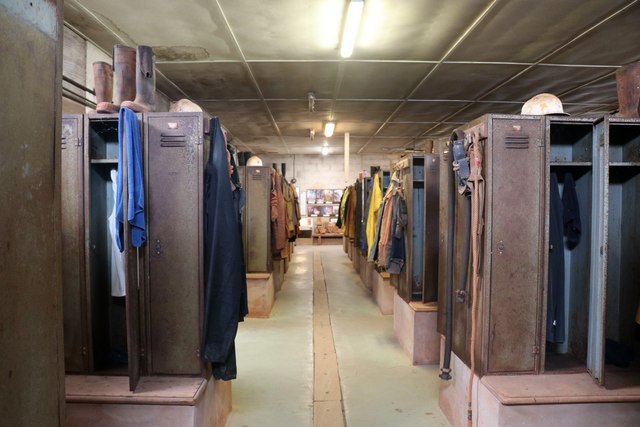
The dry is a Cornish word for a building type that every deep mine needed and that many older mines never had — for much of the 19th century miners walked home in their wet working clothes, a routine misery that did real damage in a district where men already worked in heat and climbed hundreds of fathoms of ladders at the end of a shift. Purpose-built drys, with heating, hot water and lockers, became standard through the 20th century. Geevor's survives complete: hundreds of lockers in rows, clothes still hanging where the last shift left them in 1990, and it is now among the most affecting things on the site.
How it worked
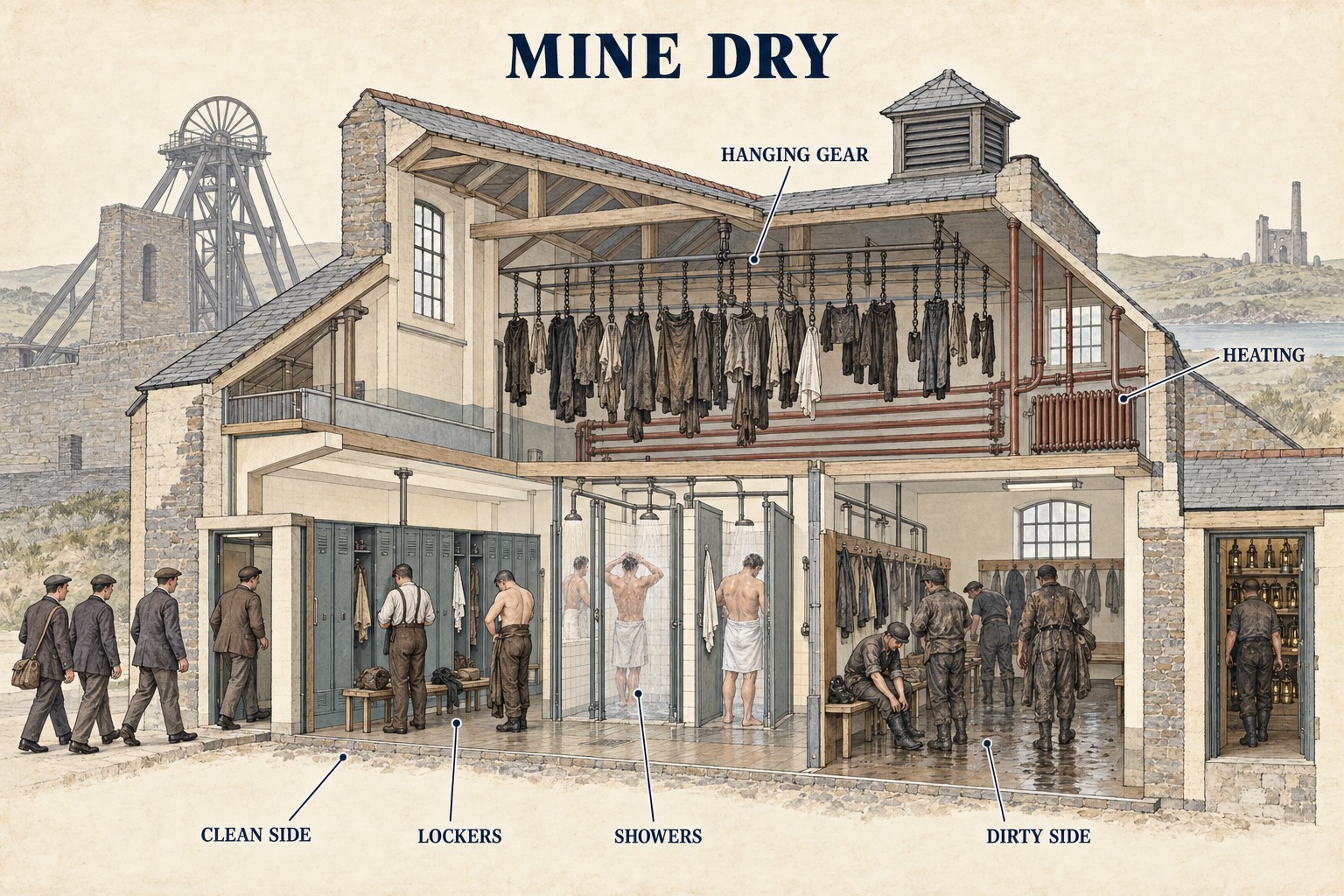
A working dry is organised around keeping the clean side clean. Men arrived, changed on the clean side, and passed through to go underground; coming off shift they returned to the dirty side, stripped, showered, and hung their wet gear — often hoisted on chains or ropes to roof level where the warm air collected, which both dried it and kept the floor clear. Heating came from the mine's own boilers or compressors; lockers held personal kit; lamp rooms and the check system for accounting for men underground were usually close by.
Why it was used
Health, mostly. Wet clothing and the walk or ride home in it were a straightforward cause of illness among miners, and a dry with hot water and heat was one of the cheapest genuine improvements in conditions a mine could make. It also concentrated the mine's timekeeping and its social life in one place: the dry was where a shift gathered, where news travelled, and where the humour of the job lived.
Risks & limitations
A dry is only as good as its heating and ventilation — an under-heated one simply becomes a room of permanently damp clothes — and as a place where dirty gear is handled it carries whatever the workings carry, dust included. Preserved drys have their own difficulty: the objects that make Geevor's so powerful are ordinary cloth, leather and paper, none of it made to last, and keeping them as they were is a conservation problem in itself.
Regional variation
'Dry' is Cornish and travelled with Cornish miners worldwide. British coalfields more often said 'pithead baths' — a related but not identical thing, built as much for washing as for drying, and from 1926 funded nationally through the Miners' Welfare Fund. Elsewhere the same building is a changehouse or dry house.
Related terminology
Bal Maiden, Captain, Miners' Barracks, Shaft
Mines associated with this term
5 examples chosen from 9 linked records — the term page is not an index.
- Geevor Tin Mine — Cornwall (surviving physical example)
Geevor's dry survives complete, left as the last shift left it in 1990. - Golden Dagger Mine — Devon (surviving physical example)
The remains of the mine's dry (changing house) survive on the valley side. - Burrow Farm Mine — Somerset (well documented example)
Named twice in this record, first in the current condition: “…open and the structure sound, with the freestanding remnant of the miners' dry standing to one side.” - Prince of Wales Mine — Cornwall (well documented example)
Named 3 times in this record, first in the history: “…surviving structures and earthworks: three engine houses, shafts, a miners' dry, at least two ore-processing floors of different dates, a probable…” - Wheal Friendship — Devon (well documented example)
Named in this record’s current condition: “…of flat-rod systems that transmitted power from the waterwheels, miners' dry buildings, and the leats and reservoirs that once fed them — much of…”
Sources
- (primary) The Dry — Geevor Tin Mine Museum
- (primary) Victory Shaft — Geevor Tin Mine Museum
- (secondary) Humour in the Industrial Workplace: Laughter in the Dry, Geevor Mine, Cornwall — Academia.edu (paper listing)
Record created: 25 August 2026 · Last researched: 25 August 2026