 MineArchive
Golden Dagger Mine
| Location | Redwater Valley, near Postbridge, Dartmoor, Devon — 50.6071, -3.8619 (exact) |
|---|---|
| Commodity | Tin |
| Type | Metal |
| Worked | worked from 1879–November 1930 |
| Operators | Moses Bawden (1879–1914) |
Overview
Golden Dagger, tucked into the Redwater Valley south of the Warren House Inn, was the last mine on Dartmoor to work commercially, closing in 1930 — bringing to an end a tin-streaming and mining tradition on the moor stretching back to the 15th century.
History
The wider Birch Tor and Vitifer mining area, of which Golden Dagger formed the southernmost part, had been worked for tin since at least the 15th century, initially by streaming alluvial tin from the valley gravels before miners began digging underground to chase the lode from around the 1750s. Golden Dagger itself was worked from 1879 by Moses Bawden, with between 30 and 40 men employed during its more active periods; intermittent working between 1882 and 1914 produced around 220 tons of black tin. The mine takes its name from a Bronze Age dagger found on the site by early prospectors, reputedly taken to Plymouth Museum and rumoured to have been destroyed in the city's bombing during the Second World War. Work continued on a reduced scale after the First World War, with recovery from old spoil tips keeping the site active even as underground working declined, before Golden Dagger finally closed in November 1930 — Dartmoor's last commercially worked mine — as low tin prices made continued operation unviable.
Geology
The mine worked tin-bearing lodes within the granite of the Dartmoor batholith, part of the same Cornubian granite intrusion responsible for the tin and copper mineralisation of Cornwall and west Devon.
Geological setting: Hydrothermal Deposits (well documented example), Veins and Lodes (well documented example)
Workings
Ore was worked from open-cast cuts and several shafts on the western side of the valley, with an adit driven to work and drain the lode; tin ore was hauled out along the adit using wagons on rails.
Closure
Golden Dagger closed in November 1930 owing to the low price of tin, the last mine on Dartmoor to be worked commercially.
What remains
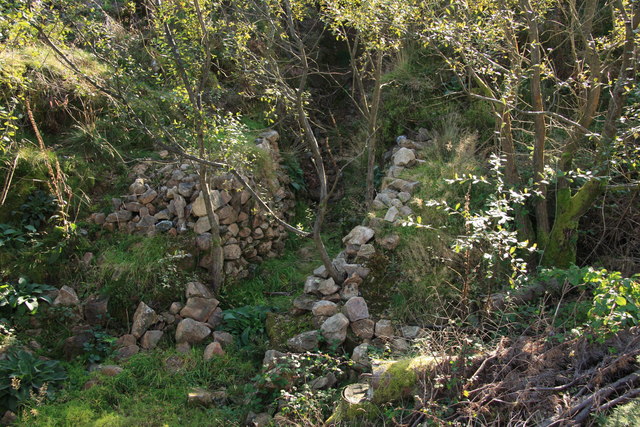
The adit entrance, now blocked by a land slip, survives along with the remains of the mine's dry (changing house) and other surface workings across the valley side.
Related mines
- Vitifer Mine (Birch Tor and Vitifer) — Golden Dagger was the southernmost part of the Birch Tor and Vitifer mining area, the lode followed from the Vitifer workings down the Redwater valley.
Nearby mines
- Vitifer Mine (Birch Tor and Vitifer) — 1.0 miles (1.6 km) SW
- Brimpts Tin Mine — 1.5 miles (2.3 km) SW
- Hooten Wheals — 3.9 miles (6.2 km) SW
- Hemsworthy Mine — 4.6 miles (7.4 km) SE
- Bagtor Mine — 5.9 miles (9.5 km) E
Straight-line distance, within 9 miles (15 km). Show on the map.
Recorded claims
Individual factual claims, each attached to the source(s) that support it below. Where sources disagree, both are kept.
- Intermittent working between 1882 and 1914 produced around 220 tons of black tin, with 30-40 men employed during active periods. 1,2
- Golden Dagger closed in November 1930, the last mine on Dartmoor to be worked commercially. 1
- The Mining Remediation Authority holds abandonment plan OM6548 for the tin-ore workings of Golden Dagger, abandoned on 1 August 1914, one of seven Golden Dagger plans in the catalogue. 3
Photographs & further reading
A walk through the mine's remains with the names and stories of the men who worked it.
View sourceSources
- (secondary) Golden Dagger Mine and Miners — Dartmoor Explorations
- (secondary) Mining in Devon Database - Golden Dagger Mine — Devon in Focus
- (primary) GOLDEN DAGGER (Mine Remediation Authority abandonment plan OM6548, BGS mine plans catalogue) — British Geological Survey / Mining Remediation Authority
- (primary) Golden Dagger mine plan — British Geological Survey / The Coal Authority
Record created: 24 August 2026 · Last researched: 24 September 2026