 MineArchive
Vitifer Mine (Birch Tor and Vitifer)
| Location | Redwater Brook valley, Warren House, Dartmoor, Devon — 50.5980, -3.8790 (approximate) |
|---|---|
| Commodity | Tin |
| Type | Metal |
| Worked | documented from 1750 (Vitifer)–1925 |
| Operators | Dartmoor Mining and Smelting Company (1780–?) |
Overview
Birch Tor and Vitifer, either side of the Redwater Brook below the Warren House Inn on Dartmoor, was probably the largest and most productive tin mine the moor ever had — the last of Dartmoor's tin mines still working when it finally closed in 1925, after a documented history stretching back to at least 1750.
History
Vitifer, on the west side of the Redwater Brook valley, and Birch Tor, on the east, were originally separate mines, first documented as 'Vitifer Mine' in 1750 and 'Burch Tor Bounds' in 1757, though the site had already been the centre of extensive surface tin streaming and opencast working since medieval times or earlier. For most of their working lives the two mines were run under shared management and are usually treated together. By the 1780s Vitifer was being operated by the Dartmoor Mining and Smelting Company, employing around 40 men by 1796, and it went on to become probably the largest and most productive tin mine on Dartmoor: between 1852 and around 1928 the combined workings produced 1,177 tons of black tin. Mining continued, with interruptions, until the mine's final closure in 1925, by which time it was the last of Dartmoor's tin mines still in production.
Geology
The mine worked tin-bearing veins and stream deposits within the granite-related Dartmoor orefield, the same hydrothermal mineralisation system worked across Cornwall's tin and copper districts to the west.
Geological setting: Hydrothermal Deposits (well documented example), Veins and Lodes (well documented example)
Workings
Workings included both underground vein mining and extensive surface stream working and opencast pits; between 1852 and around 1928 the mine produced 1,177 tons of black tin, the dressed and part-refined tin ore ready for smelting.
Closure
The mine closed for the final time in 1925, the last of Dartmoor's tin mines still working by that date. Dartmoor Explorations gives a closure in 1882, a revival of 1903 to 1913 and final abandonment about 1939, so the end of working is dated differently by different accounts.
What remains
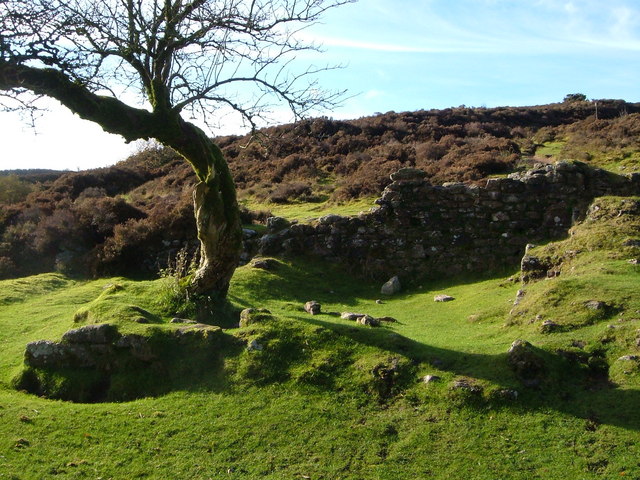
Ruined buildings, fenced shafts with unstable cappings, wheelpits, leats and spoil lie across the Redwater Brook valley on open moor.
Ruined mine buildings, fenced shafts, flooded workings and extensive spoil from stream working and opencast pits survive across the Redwater Brook valley, among the most extensive tin-mining remains on Dartmoor.
Related mines
- Golden Dagger Mine — Golden Dagger was the southernmost part of the Birch Tor and Vitifer mining area, the lode followed from the Vitifer workings down the Redwater valley.
Nearby mines
- Brimpts Tin Mine — 0.7 miles (1.1 km) S
- Golden Dagger Mine — 1.0 miles (1.6 km) NE
- Hooten Wheals — 3.0 miles (4.8 km) SW
- Hemsworthy Mine — 5.0 miles (8.0 km) E
- Hexworthy Mine — 5.1 miles (8.3 km) S
Straight-line distance, within 9 miles (15 km). Show on the map.
Recorded claims
Individual factual claims, each attached to the source(s) that support it below. Where sources disagree, both are kept.
- Vitifer was probably the largest and most productive tin mine on Dartmoor, producing 1,177 tons of black tin between 1852 and around 1928, and remained the last of the moor's tin mines still working when it closed in 1925. 1,2
- The site combines underground vein mining with extensive surface stream working and opencast pits dating back to medieval times or earlier. 1
- Thirteen shafts had been sunk and forty men were employed by 1796; Captain John Paull took the lease cheaply about 1834 after the tin slump of the 1820s; output peaked at about 150 tons of black tin a year in 1864 with 150 employed in the early 1860s; the mine closed in 1882, saw a revival of 1903 to 1913 employing 35, and by one account was finally abandoned about 1939. 2
- Foundations of the blacksmith's shop, miners' dry, carpenter's shop, dormitory, offices, manager's and captain's houses and cottages remain, with five numbered wheelpits of 38 to 45 feet, the Prideaux, Guppies, Dunstan's, Lance's, Millman's, Hambly's, New and Wall's shafts, tramways and a leat system of some twelve kilometres. 2
Sources
- (secondary) Birch Tor and Vitifer mine — Wikipedia
- (secondary) Birch Tor and Vitifer Mine (and miners) — Dartmoor Explorations
Record created: 22 August 2026 · Last researched: 24 September 2026