 MineArchive
Hooten Wheals
| Location | O Brook valley, near Hexworthy, Devon — 50.5590, -3.9070 (approximate) |
|---|---|
| Commodity | Tin |
| Type | Metal |
| Worked | 1240–1896 |
| Maximum depth | Unknown. |
| Operators | United States Army (1943–1944) |
Overview
Also known as Hexworthy Mine, a Dartmoor tin working on the O Brook with tin-streaming roots going back to at least 1240, revived commercially in the mid-19th century before finally closing in the early 20th century and later serving as a US Army training ground ahead of D-Day.
History
Hooten Wheals, later known as Hexworthy Mine, lies up the valley of the O Brook near the hamlet of Hexworthy on Dartmoor, at the site of much earlier tin streamworking; the earliest documented works nearby, at Dry Lake, date back to 1240. A licence for a mine called Wheal Unity was granted in 1845, with further tin-mining licences following between 1849 and 1854; activity resumed in the 1880s, and by 1891 the mine employed fifty men. Sources differ on exactly when work ended -- one Historic Environment Record states the lease was terminated in 1896, while another account has activity continuing a few years longer before a severe storm in 1920 finally put an end to it. In its later years, by then generally known as Hexworthy Mine, the site absorbed the smaller neighbouring Hensroost mine and the Skir Gut tin-streaming works, with ore processing carried out first at Hensroost and later back at Hooten itself. The site's final use had nothing to do with mining at all: during the Second World War it was requisitioned for American D-Day training (see Redevelopment, below).
Geology
Tin of the Dartmoor granite, worked with the neighbouring Hensroost mine and the Skir Gut tin-streaming ground; the lodes are not named on the record.
Workings
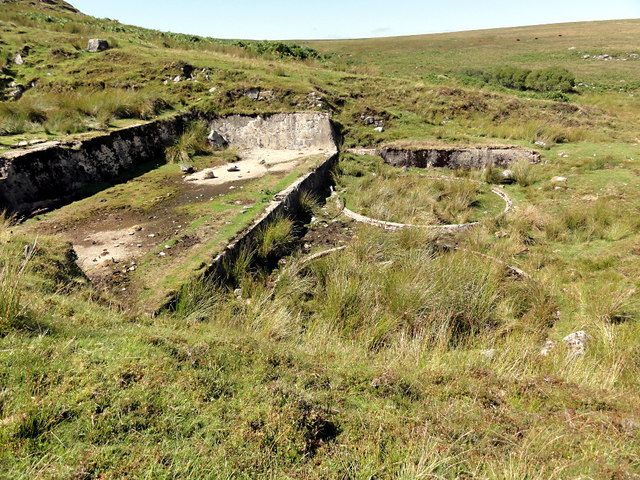
Tin streamworking from at least 1240 (nearby Dry Lake); licensed mining from 1845 (as Wheal Unity), with a dressing floor featuring circular buddles for ore processing.
Closure
Sources disagree on the exact end date -- a Historic Environment Record gives 1896 (lease terminated), while another account has activity continuing for a few years longer before a severe storm in 1920 ended it for good; both are recorded here rather than silently reconciled.
What remains
The dressing floor retains the remains of two early-20th-century circular buddles, used in the ore-processing method introduced around 1848.
A dressing floor with surviving circular buddles, plus general mine ruins along the O Brook.
Redevelopment
During the Second World War the site lay within the roughly 11,000-acre area south and south-east of Hexworthy -- referred to at the time as Scorriton -- that the War Office requisitioned for rifle, machine-gun and anti-tank firing, part of the wholesale wartime requisitioning of Dartmoor for military training. The 4th and 29th United States Divisions trained intensively on the moor in the year before D-Day. It was American troops rehearsing for the invasion who destroyed most of the mine's surviving buildings: the 1907 mill, which had housed winding gear, a blacksmith's shop and offices, was reduced to the foundations and rubble that survive today. The mine's machinery had already been stripped out between 1927 and 1938, so the wartime destruction fell on empty structures rather than working plant. Nothing on record ties a specific US unit to this exact firing range, so the well-known story of the 116th Infantry Regiment (29th Division) training in Devon ahead of its heavy losses at Omaha Beach is not asserted here as a direct connection to this site.
Nearby mines
- Brimpts Tin Mine — 2.4 miles (3.9 km) NE
- Hexworthy Mine — 2.4 miles (3.9 km) S
- Vitifer Mine (Birch Tor and Vitifer) — 3.0 miles (4.8 km) NE
- Golden Dagger Mine — 3.9 miles (6.2 km) NE
- Whiteworks Mine — 3.8 miles (6.2 km) W
Straight-line distance, within 9 miles (15 km). Show on the map.
What's uncertain
Points where sources disagree or the record could not be settled; both accounts are kept. All open questions in the archive.
- Sources disagree on closure -- one Historic Environment Record states the lease was terminated in 1896, another account has activity continuing a few years longer before a 1920 storm ended it. (disputed) 2
Recorded claims
Individual factual claims, each attached to the source(s) that support it below. Where sources disagree, both are kept.
- Tin streamworking near Hooten Wheals at Dry Lake is documented from 1240; a licence for 'Wheal Unity' was granted in 1845, with further licences 1849-1854, and by 1891 the mine employed fifty men. 1
- Sources disagree on closure -- one Historic Environment Record states the lease was terminated in 1896, another account has activity continuing a few years longer before a 1920 storm ended it. (disputed) 2
- American troops training for D-Day on the roughly 11,000-acre Hexworthy/Scorriton firing range destroyed most of Hooten Wheals' surviving buildings during the Second World War, including the 1907 mill, which had housed winding gear, a blacksmith's shop and offices. 1,3
Photographs & further reading
The official Historic Environment Record entry.
View sourceSources
- (primary) Hooten Wheals / Hexworthy Tin Mine — Heritage Gateway (Historic Environment Record)
- (secondary) Hexworthy, Devon. The Mines at Ringleshuttes and Hooten Wheals — Mindat
- (primary) The Armed Forces on Dartmoor: A Brief History — Defence Infrastructure Organisation / Dartmoor Training Area (gov.uk)
Record created: 1 September 2026 · Last researched: 1 September 2026