 MineArchive
Wartime Requisitioning
| Also known as | Requisitioned (Common inflected form used in running prose.) |
|---|---|
| Category | Later Uses & Research |
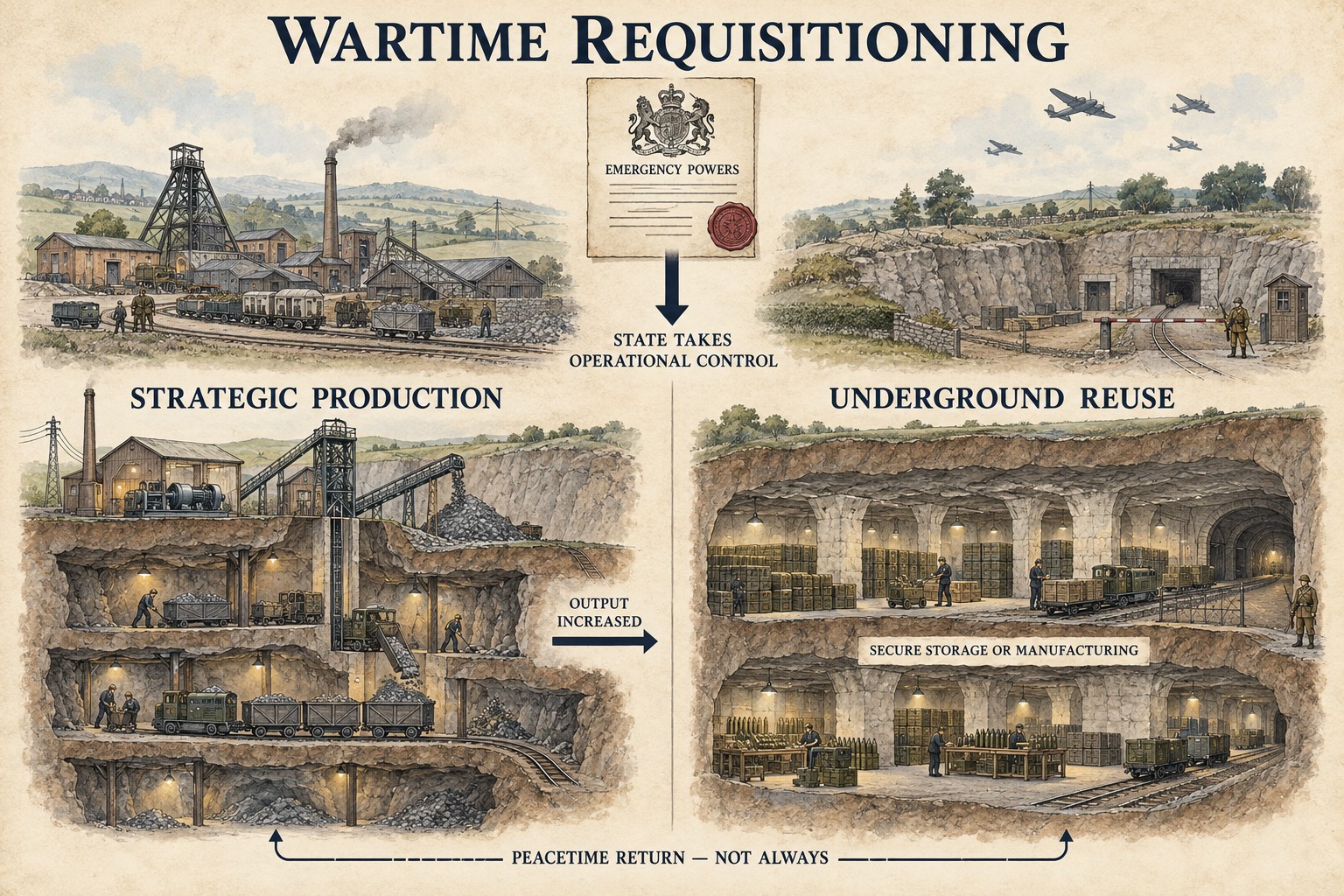
The state's practice of taking direct control of a mine or quarry in wartime — whether to force up production of a strategically valuable mineral, or to put its underground space to an entirely different use, such as ammunition storage or protected manufacturing — overriding the site's normal peacetime ownership and purpose for the duration of the emergency.
Historical usage
Government requisitioning of mines and quarries recurs across both world wars. Under the Defence of the Realm Act, the government requisitioned Cae Coch sulphur mine in North Wales in 1917, building a power plant and pushing production with a workforce of 230; a second period of state involvement followed from August 1941, when the mine was worked under the Ministry of Supply. Beer Quarry Caves in Devon were taken over during the Second World War as an ammunition store. At Box, Wiltshire, the underground stone workings around Corsham were requisitioned by the Royal Engineers in the 1930s and 40s to become one of Britain's largest Central Ammunition Depots, and part of the same underground complex was later redeveloped as Burlington, the Cold War-era Central Government War Headquarters.
How it worked
Requisitioning powers, exercised under wartime legislation such as the Defence of the Realm Act (1914-18) or equivalent Second World War emergency powers, let the government take direct operational control of a site — installing its own workforce and infrastructure to boost output of a strategic mineral, as at Cae Coch, or repurposing existing void space entirely, converting old workings into secure, bomb-proof storage or manufacturing space hidden from aerial observation, as at Box and Beer.
Why it was used
A working or disused mine offered the state two things ordinary wartime construction couldn't easily match: a strategic mineral resource that could be pushed to produce faster under direct government control, or, in the case of large disused workings, ready-made underground space, already excavated and structurally proven, that was vastly cheaper and faster to adapt for secure storage or protected industry than building new bomb-proof facilities from scratch.
Risks & limitations
Requisitioning overrode a site's normal commercial operators and could leave a mine's ordinary workforce, output and ownership arrangements disrupted well beyond the immediate emergency — Cae Coch's post-war attempt to resume ordinary mining foundered partly on inconsistent ore conditions the earlier forced wartime production had not resolved, and several requisitioned quarries, including sections of the Box complex, never returned to civilian use at all once the state found a permanent purpose for them.
Related terminology
Mines associated with this term
5 examples chosen from 11 linked records — the term page is not an index.
- Fauld — Staffordshire (well documented example)
Linked on an exact-phrase match in this record's own text. - Beer Quarry Caves — Devon (well documented example)
The mine's own recorded history explicitly describes use as an ammunition store during the Second World War. - Benallt Mine — Gwynedd (well documented example)
Benallt was requisitioned in 1941 when Atlantic convoys stopped bringing manganese ore in — the state taking over a mine because the sea route had closed. - Box Quarry — Wiltshire (well documented example)
The mine's own recorded closure notes explicitly describe requisitioning by the Royal Engineers as a Central Ammunition Depot, and later conversion to the Burlington government headquarters. - Bursledon Brickworks — Hampshire (well documented example)
Named in this record’s history: “…lakes. Bricks were made through both wars, with parts of the site requisitioned, and the family firm was amalgamated after 1945 with the Sussex and…”
Sources
- (secondary) Cae Coch Sulphur Mine — Wikipedia
- (secondary) Corsham Ammunition Depot and Standby Government Headquarters — Subterranea Britannica
Record created: 22 August 2026 · Last researched: 22 August 2026