 MineArchive
Fauld
| Location | Hanbury, near Tutbury, Staffordshire — 52.8480, -1.7460 (approximate) |
|---|---|
| Commodity | Gypsum |
| Type | Quarry |
| Worked | From the 19th century–Still active |
| Maximum depth | 90 feet (RAF ammunition depot workings) |
| Operators | Royal Air Force (1937–1966), Peter Ford & Sons (?–1944), J. C. Staton & Co., British Gypsum |
Overview
Fauld began as an ordinary Staffordshire gypsum mine, its horizontal drift workings feeding a plaster works at the tunnel mouth — until the RAF requisitioned the disused mine in 1937 to store bombs, and on 27 November 1944 it became the site of the largest explosion in British history.
History
Gypsum had been worked at Fauld, on the edge of the Needwood Forest escarpment near Hanbury, since the 19th century, with two firms, J. C. Staton & Co. and Peter Ford & Sons, driving horizontal drift mines into the Stonepit Hills; Ford's built a plaster works at the mouth of their own mine to process the gypsum on site. In 1937, with the mine disused, the Royal Air Force requisitioned the workings, some 90 feet below the hillside, to store bombs and ammunition as No. 21 Maintenance Unit. On 27 November 1944 an accident during ordnance handling triggered the largest explosion in British history, destroying the neighbouring plaster works and killing at least 70 people (see Disasters, below). RAF Fauld continued to operate as an ammunition depot after the disaster, remaining in use until 1966, and was then used by the United States Army to store ammunition from 1967 to 1973 following France's withdrawal from NATO's integrated command structure. The site was finally closed and fenced off by 1979. The gypsum under the Needwood escarpment has been worked for the best part of nine hundred years: Norman masons carved the alabaster frieze of the west doorway of Tutbury priory church from it, John of Gaunt ordered blocks from Fauld for the monument to his first wife in old St Paul's, and the Burton alabasterers of the sixteenth and seventeenth centuries cut their monuments from the same stone. Commercial working began at Fauld late in the eighteenth century, and about a century later John Staton turned from quarrying to driving horizontal drift mines into the Stonepit Hills, followed quickly by Peter Ford on the Tutbury side of the hill; by 1894 there were three working gypsum mines in Hanbury parish, Staton's and Ford's at Fauld and the Needwood Plaster and Cement Company's near Draycott-in-the-Clay. Staton's mine was then producing over 10,000 tons a year of plaster products, potters' plaster and Keene's cement among them, and in 1894 filled an order for eighteen alabaster blocks, some of fifteen tons, cut entirely by hand and hauled out by horse and wagon for a Vanderbilt mansion in New York. Ford built a plaster works at his mine mouth. By the 1930s many of the tunnels were worked out, which is why the RAF could buy 38 acres of them in 1937 (see Disasters, below); the 1944 explosion also killed six men by fumes in the adjoining working mine and engulfed Ford's plaster works when the reservoir serving it burst. Mining continues today under British Gypsum.
Geology
Gypsum occurs here within Triassic Mercia Mudstone, deposited as evaporite beds when shallow seas periodically dried out across the region; the same geology gave the district a long tradition of plaster manufacture, of which Fauld's mine and its neighbouring plaster works were part.
Geological setting: Evaporite Deposits (well documented example)
Workings
Gypsum was worked by horizontal drift mining into the Stonepit Hills escarpment; once requisitioned by the RAF, the same tunnels were adapted to store ordnance some 90 feet underground, eventually reaching a stated capacity of up to 40,000 tonnes of bombs and ammunition. Horizontal drift mines driven into the hillside rather than shafts. In the 1890s shot holes were drilled by hand auger and fired with black powder, the fuses made by hand from powder and wheat straws and lit from a candle; Staton's mine was always wet, its roadways churned to quagmires by the horses drawing the full carts out.
Closure
The 1944 explosion destroyed the depot's surface installations and the neighbouring plaster works, though the RAF continued using the site until 1966; the US Army then used it from 1967 to 1973, before the site was finally closed and fenced off by 1979. The RAF depot closed and the crater was fenced off by 1979, but the gypsum mine itself has never closed: it is worked today by British Gypsum.
What remains
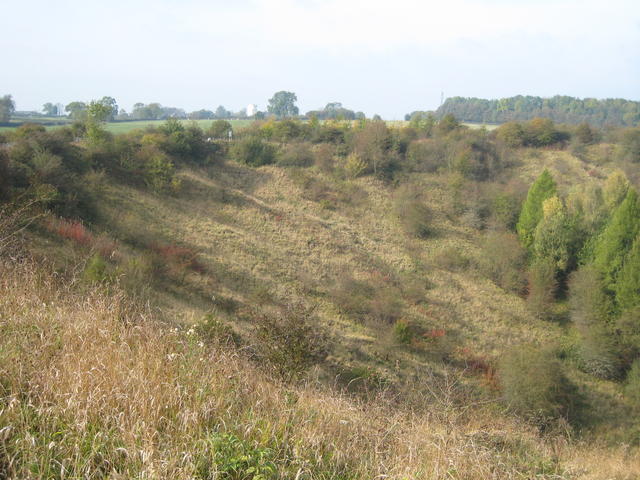
Significant quantities of unexploded ordnance are believed to remain buried at the site, and the UK government has judged their removal too costly to be feasible; the crater and surrounding area are now wooded and support over 150 recorded species, with a public trail leading to the crater from the Cock Inn at Hanbury. British Gypsum describes Fauld today as no longer a manufacturing mine: it supplies cement rock, a mixture of gypsum and anhydrite, to the cement industry from workings its own page calls extensive.
Hanbury Crater survives as one of the largest man-made craters in Britain; memorial stones, including one donated by Italy in 1990 in memory of the Italian prisoners of war killed, mark the site.
Nearby mines
- Bretby Colliery — 7.9 miles (12.8 km) SE, Derbyshire
- Cadley Hill Colliery — 8.5 miles (13.7 km) SE, Derbyshire
- Swadlincote Colliery — 9.1 miles (14.6 km) SE, Derbyshire
Straight-line distance, within 9 miles (15 km). Show on the map.
Disasters & major incidents
-
RAF Fauld explosion, 1944
27 November 1944 · Explosion · 70 fatalities
An accident during routine ordnance handling at the RAF's underground ammunition depot, built into a disused Staffordshire gypsum mine, detonated thousands of tonnes of stored explosives — the largest explosion in British history, killing at least 70 people and leaving a crater over 1,000 feet across.
Recorded claims
Individual factual claims, each attached to the source(s) that support it below. Where sources disagree, both are kept.
- Gypsum was worked at Fauld by two firms, J. C. Staton & Co. and Peter Ford & Sons, driving horizontal drift mines into the Stonepit Hills, with Ford's building a plaster works at their mine's mouth. 1
- The Royal Air Force requisitioned the disused mine in 1937 to store ammunition some 90 feet underground as No. 21 Maintenance Unit, eventually reaching a stated capacity of up to 40,000 tonnes. 2
- Gypsum and alabaster have been worked around Fauld and Tutbury for at least 850 years; Norman masons used the alabaster in Tutbury church and John of Gaunt ordered gypsum blocks from Fauld for a monument in old St Paul's. 3,4
- In 1894 three gypsum mines were working in Hanbury parish — Staton's and Ford's at Fauld and the Needwood Plaster and Cement Company's near Draycott — and Staton's produced over 10,000 tons of plaster products a year. 3
- Gypsum mining continues at Fauld under British Gypsum. 4
- The 1944 explosion killed six men by toxic fumes in the adjoining actively mined areas and engulfed Ford's plaster works when the reservoir serving it burst. 4
- Fauld Mine, opened in the early nineteenth century, is no longer a manufacturing mine and now supplies cement rock — a mixture of gypsum and anhydrite — for the cement industry. 5
Photographs & further reading
Photographs from three or four visits in late 2012 and early 2013 to the underground munitions depot in the gypsum workings, with an account of the explosion of 27 November 1944 — between 3,500 and 4,000 tonnes of ordnance, 75 people killed, and widely reckoned the largest conventional explosion ever caused — and of the depot's continued use into the early 1970s.
View sourceSources
- (secondary) Gypsum Mine, Fauld — Staffordshire Past Track
- (secondary) RAF Fauld explosion — Wikipedia
- (secondary) Tutbury local history: Gypsum Mining — Tutbury local history and information
- (secondary) The Fauld Explosion — Tutbury Museum — Tutbury Museum
- (primary) Welcome to our Fauld Mine site in Staffordshire — British Gypsum
Record created: 24 August 2026 · Last researched: 8 September 2026