 MineArchive
Bursledon Brickworks
| Location | Swanwick, near Bursledon, Hampshire — 50.8858, -1.2908 (exact) |
|---|---|
| Commodity | Brick Clay |
| Type | Mineral |
| Worked | 1897–1974 |
| Operators | Bursledon Brick Company (1897–1959), Redland Holdings (1959–1974) |
Overview
The last Victorian steam-powered brickworks left in Britain, and the claypits that fed it. It made over twenty million bricks a year at its peak, closed in 1974 when the good clay ran out and the M27 cut the site in half, and is now a museum.
History
The works were founded in 1897 by Robert and Edward Ashby, partners in the Southampton builders' merchants Hooper & Ashby, and became the Bursledon Brick Company in 1903. Expansion in the early 1900s gave the site two complexes and five chimneys. By 1935 it was producing more than twenty million bricks a year. The company merged into what became Redland Holdings in 1959, and the works closed in 1974, when the better clay had been worked out and the M27 was driven through the site. The museum's own history adds the texture: the Ashbys' first yard was at Chandlers Ford, and Bursledon was chosen for its clay and its rail and river links; the pits were dug by hand to nearly forty feet until the 1930s, when mechanical digging began and the clay came at last by overhead cable from the Swanwick pits that are now a nature reserve's lakes. Bricks were made through both wars, with parts of the site requisitioned, and the family firm was amalgamated after 1945 with the Sussex and Dorking Brick Company before the Redland merger. The museum's view of the 1974 closure adds a third cause to the motorway and the exhausted clay: a plant never modernised in its working life could not be brought up to the Health and Safety at Work Act.
Geology
The clay is London Clay of the Hampshire Basin, laid down where river silt met sand from the sea: brown and oxidised for the first few metres, blue beneath. It fires to the red brick the district is known for, which is why brickmaking concentrated here rather than anywhere else in the county.
Geological setting: Sedimentary Beds and Seams (well documented example)
Workings
Clay was dug from open pits beside the works, at first entirely by hand — gangs of men on spades, paid between ten shillings and thirty a week depending on the weather — and moved in narrow-gauge wagons hauled up an inclined plane to the top of the brick machine. From the mid-1930s mechanical diggers took over, with aerial ropeways and conveyors bringing clay in, and as the local pits were exhausted the workings spread to the larger clay field at Swanwick. Inside, a Bennett & Sayer stiff-clay machine from Derby was claimed to be capable of 40,000 bricks a day, driven by a John Wood & Sons steam engine from Wigan, and the bricks were fired in a Staffordshire-type continuous kiln of twelve chambers holding up to 26,000 each.
Closure
Production ended in 1974: the superior clay had been worked out, and the M27 motorway divided what was left of the site.
What remains
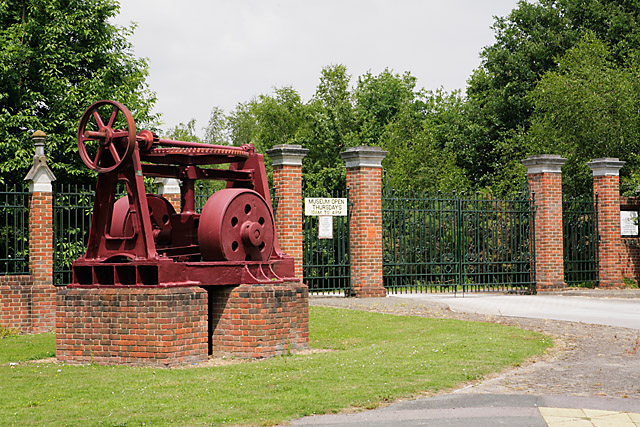
The southern section is Grade II* listed and survives as the Brickworks Museum, taken on by the Hampshire Buildings Preservation Trust for a nominal £1 and reopened to the public in 2014 after a £666,300 Heritage Lottery Fund grant. Its kiln, chimney, drying sheds, boiler and engine house all stand, and the steam engine still runs.
Kiln, chimney, drying sheds, boiler house and engine house, all Grade II* listed, with the original steam engine and brick-making machinery in place.
What's uncertain
Points where sources disagree or the record could not be settled; both accounts are kept. All open questions in the archive.
- The brickworks were founded in 1897 by Robert and Edward Ashby of the builders’ merchants Hooper & Ashby, the company being renamed the Bursledon Brick Co. Ltd in 1903. (uncertain) 1
- A local history instead dates the founding to 1896 and credits it to Edward Hooper’s partnership with the Ashby family. (uncertain) 2
Recorded claims
Individual factual claims, each attached to the source(s) that support it below. Where sources disagree, both are kept.
- The brickworks were founded in 1897 by Robert and Edward Ashby of the builders’ merchants Hooper & Ashby, the company being renamed the Bursledon Brick Co. Ltd in 1903. (uncertain) 1
- A local history instead dates the founding to 1896 and credits it to Edward Hooper’s partnership with the Ashby family. (uncertain) 2
- Clay was dug by hand by gangs earning from ten to thirty shillings a week and moved in narrow-gauge wagons hauled up an inclined plane to the brick machine; mechanical diggers, ropeways and conveyors took over from the mid-1930s. 1,2
- A Bennett & Sayer stiff-clay machine was claimed capable of 40,000 bricks a day, and by 1935 the site produced more than twenty million bricks a year, fired in a twelve-chamber continuous kiln. 1
- Production ceased in 1974, the better clay having been worked out, and the M27 motorway divided the site. 1,2
- The Ashbys' first brickyard was at Chandlers Ford; at Bursledon the clay was dug by hand from pits nearly 40 feet deep close to the buildings and brought in by narrow-gauge wagons until the pits lay too far off, mechanised digging began in the 1930s, and the clay finally came by overhead cable from the pits that are now the lakes of Swanwick Nature Reserve. The northern complex was added in 1903 and extended in 1935, bricks were made through both wars as a reserved occupation with parts of the site requisitioned, the family business amalgamated after the Second World War with the Sussex and Dorking Brick Company and became Redland Holdings in 1959, and the works closed in 1974 with the M27 splitting the site, the clay dear to win and, above all, a plant never modernised that could not meet the Health and Safety at Work Act. A Heritage Lottery Fund grant of £666,300 in 2012 created the museum, run since 2015 by the Bursledon Brickworks Museum Trust. 3
- Located at about 50.886 N, 1.291 W. 1
Photographs & further reading
County history account of the works, its clay and its people.
View sourceSources
- (secondary) Bursledon Brickworks Museum — Wikipedia
- (secondary) Bursledon Brickworks — Hampshire History
- (secondary) Our History (The Brickworks Museum, Bursledon) — The Brickworks Museum
Record created: 25 August 2026 · Last researched: 24 September 2026