 MineArchive
Box Quarry
| Location | Box, near Corsham, Wiltshire — 51.4167, -2.2667 (approximate) |
|---|---|
| Commodity | Freestone |
| Type | Stone |
| Worked | Worked from at least the 17th-18th century–1968 |
| Maximum depth | Room-and-pillar workings covering roughly 600 acres, with chambers up to around 100 feet high |
| Operators | William Jones Brewer and Thomas Lewis (1836–1841), Bath Stone Firms Ltd (1887–1968) |
Overview
The largest stone mine in Britain — a roughly 600-acre maze of room-and-pillar Bath stone workings beneath Box Hill, whose true extent only became apparent when Brunel's Box Tunnel was driven straight through it in 1841, worked commercially by rival firms until they merged in 1887, and finally closing in 1968.
History
Bath stone had been worked by room-and-pillar mining beneath Box Hill since at least the 17th and 18th centuries, but the full scale of the underground deposit only became clear when Isambard Kingdom Brunel drove the Great Western Railway's Box Tunnel through the hill between 1836 and 1841. At 1.83 miles, it was the world's longest railway tunnel on completion, built by a workforce that grew to around 4,000 men; roughly 100 navvies died during construction, chiefly from blasting accidents and water ingress that exceeded what engineers had calculated. Commercial stone mining expanded rapidly once the tunnel exposed the extent of workable rock, with competing firms including Pictors, Nobles and Stone all working the hill. By the mid-1880s competition between the many quarrying businesses had become financially ruinous, and in December 1887 seven of them — Pictor & Sons, Stone Brothers, Randell Saunders & Co, Isaac Sumsion, Corsham Bath Stone Co, R J Marsh, and Samuel Rowe Noble — merged to form Bath Stone Firms Ltd. Mining peaked in the late 19th century and continued, on a diminishing scale, until 1968. Some sources trace the hill's stone-working origins as far back as the Roman occupation of Britain, though the earliest solid documentary evidence remains the 17th-18th century workings described above. During construction of the Box Tunnel itself, contractors William Jones Brewer and Thomas Lewis worked the eastern portion of the resulting stone workings using steam power.
Geology
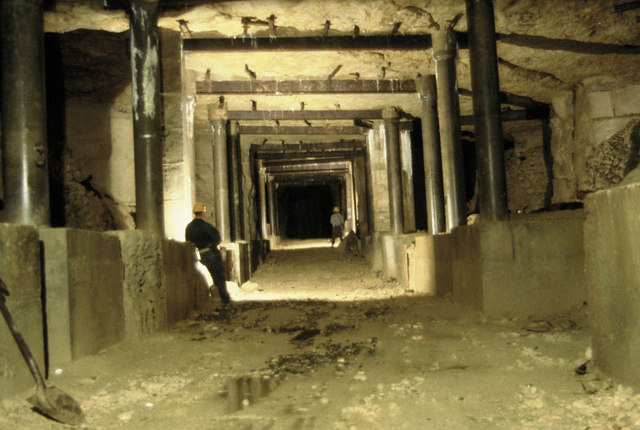
Bath Stone is a warm, honey-coloured Great Oolite limestone laid down around 168 million years ago. At Box it was worked entirely underground by room-and-pillar mining rather than open quarrying, cutting stone away in a grid of galleries while leaving massive pillars of undisturbed rock standing to support the roof above.
Geological setting: Sedimentary Beds and Seams (well documented example)
Workings
The mine was worked as a grid of rooms cut into the rock with supporting pillars left standing between them, rather than as an open pit. At the centre of the complex lies a chamber known as the Cathedral, roughly 190 feet long and up to 100 feet high, and the total worked area covers approximately 600 acres of interconnecting passages — the largest stone mine in the country.
Closure
Commercial stone mining at Box ceased in 1968. Separately, nearby quarries within the same wider underground stone-mining district around Corsham — Tunnel Quarry and Spring Quarry among them — were requisitioned by the Royal Engineers in the 1930s and 1940s as one of Britain's largest Central Ammunition Depots, and later still housed the Cold War-era Central Government War Headquarters, a strand of the district's history connected to, but administratively distinct from, Box Quarry itself.
What remains
No quarrying industry remains at Box today. Part of the underground workings are designated Box Mine, a Site of Special Scientific Interest valued chiefly for its bat population, and the wider network remains a well-known, if hazardous, destination for underground explorers.
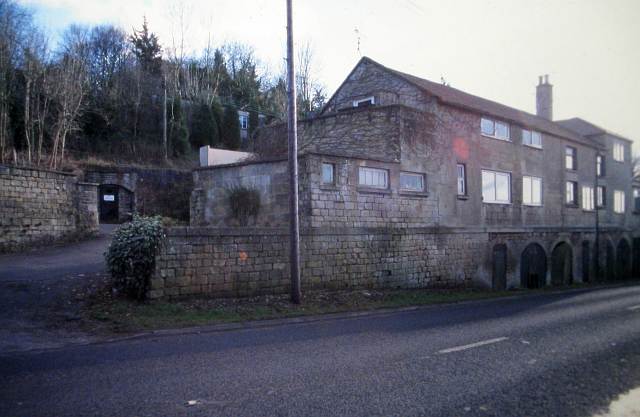
The former offices and workshops of Bath Stone Firms survive at Box as private housing, with the archway entrance to Clift Quarry, part of the wider Box Quarry system, still visible beside the road.
Related mines
- Spring Quarry — Another of the Corsham and Box freestone quarries worked in the same stone.
Nearby mines
- Spring Quarry — 1.9 miles (3.1 km) E
- Monkton Farleigh Quarry — 2.0 miles (3.2 km) S
- Browns Folly Mine — 2.1 miles (3.3 km) SW, Somerset
- Tunnel Quarry, Corsham — 2.4 miles (3.9 km) E
- Ridge Quarry — 3.6 miles (5.8 km) E
Straight-line distance, within 9 miles (15 km). Show on the map.
Recorded claims
Individual factual claims, each attached to the source(s) that support it below. Where sources disagree, both are kept.
- Box Tunnel, 1.83 miles long, was the world's longest railway tunnel when completed in 1841; its construction employed up to 4,000 workers and cost around 100 navvies' lives, primarily from blasting accidents and water ingress that exceeded calculated volumes. 1
- In December 1887, seven competing local firms merged to form Bath Stone Firms Ltd after competition between them had become financially ruinous. 2
- The mine's total worked area covers approximately 600 acres of interconnecting passages, centred on a chamber known as the Cathedral, around 190 feet long and up to 100 feet high. 2,3
- Commercial stone mining at Box ceased in 1968. 2
Photographs & further reading
An observational exploration report and photoset of the mine's underground passages.
View sourceSources
- (secondary) Box Tunnel — Wikipedia
- (secondary) Box Tunnel — Wikishire
- (secondary) Clift entrance — Geograph / Wikimedia Commons
- (primary) Box Mine Plan (BGS Mine Plans Catalogue) — British Geological Survey
- (secondary) Box Freestone Quarry, Wiltshire — TheTimeChamber
- (secondary) Box Mine — Wikipedia

Record created: 22 August 2026 · Last researched: 22 August 2026