 MineArchive
Monks Park Mine
| Also known as | Monk's Park, Sumsion's Monks, Monks North, Monks Park Northern Quarry |
|---|---|
| Location | Gastard, near Corsham, Wiltshire — 51.4137, -2.1784 (exact) |
| Commodity | Limestone |
| Type | Stone |
| Worked | 1886–March 2018 (mothballed) |
| Maximum depth | Working faces about 29 m below ground, reached by a slope shaft of 212 steps. |
| Operators | Sumsions (1886–?), Bath & Portland Stone, Hanson (?–2017), Johnston Quarry Group (2017–2018) |
Overview
An underground Bath stone quarry at Gastard near Corsham, entered by a 212-step slope shaft, opened by Sumsions in 1886. The War Department took it in 1937 but never used it; part became a Royal Navy store in the 1950s while the rest went on yielding one of the finest-grained Bath stones. Dormant from 2004, it was reopened by Hanson in 2016 and mothballed by the Johnston group in 2018.
History
Monks Park was opened in 1886 by the firm of Sumsions, Isaac Sumsion's business, and was first known as Sumsion's Monks or Monks North; it later belonged to the Bath and Portland Stone company, which became part of ARC and then Hanson. In 1937 the War Department took over the quarry for ammunition and explosives storage, as it did the other Corsham workings, but the conversion was never finished, and by 1941 the site was surplus and unused. In the 1950s about ten acres were converted over two years, with a new vertical lift shaft beside the slope shaft, to give the Royal Navy extra storage. That area was sold to Leafield Engineering in 1995 by one account and 1997 by another, and in February 2009 an underground fire in Leafield's section sent smoke into the stone workings. The rest of the quarry, about 38 acres, was worked for stone until it fell dormant in 2004 or 2005. Hanson Bath & Portland Stone reopened it after losing its lease at Hartham Park, and the first block for twelve years was winched to the surface in January 2016. Hanson sold its natural stone business to the Johnston group in autumn 2017, and in March 2018 Johnston Quarry Group mothballed the mine, putting 11 men out of work; it was offered for sale that June with about 125 hectares of underground mineral rights. Monks Park stone has been used on the Royal Crescent Hotel in Bath, The Podium in Bath, St James's Parade in Bristol and buildings in London and Oxford.
Geology
Bath stone: an oolitic limestone of the Middle Jurassic Great Oolite, here a medium- to fine-grained bed described in the 2018 sale particulars as the finest-grained Bath stone then available, soft but weathering well.
Geological setting: Sedimentary Beds and Seams (well documented example)
Workings
A room-and-pillar underground quarry of about 38 acres, entered by a slope shaft with 212 steps and a winch-hauled incline for stone and plant, with a vertical lift shaft added in the 1950s for the naval store. The workings were connected underground to Ridge Quarry until the connection was blocked by Hanson. Recent working was in districts 1 and 3; typical recent sales were 2,000-3,500 cubic metres a year.
Closure
Worked for stone until 2004 or 2005, then dormant; reopened in January 2016 and mothballed by Johnston Quarry Group in March 2018, when it was said to have become stagnant. The mine was offered for sale in June 2018 with planning consent to extract an estimated 70,000 cubic metres of remaining stone.
What remains
Mothballed and sealed. A 2020 visit found the surface disused, with the winding engine, steel and wooden wagons and an old Samson stone saw on the surface and the slope shaft securely closed.
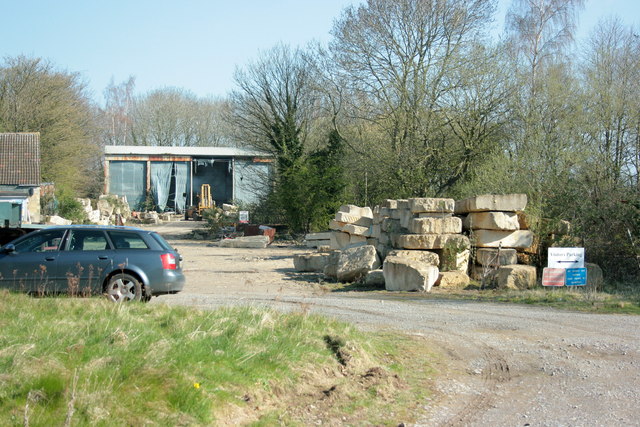
A stockyard of about three acres with a winch house, a steel-framed stone storage shed, temporary buildings and the head of the slope shaft (2018).
Redevelopment
The former Royal Navy storage area underground has been used by Leafield Engineering since it was sold in the mid-1990s.
Nearby mines
- Box Quarry — 6.1 km W
- Seend Ironstone Quarry — 10.0 km SE
- Combe Down Stone Mines — 13.7 km SW, Somerset
Straight-line distance, within 15 km. Show on the map.
People
- Rod Lafargue · manager, 2016 — General manager of Hanson Bath & Portland Stone when Monks Park reopened in 2016.
- Isaac Sumsion · founder, from 1886 — Opened Monks Park in 1886; his firm, Sumsions, gave the quarry its early name, Sumsion's Monks.
What's uncertain
Points where sources disagree or the record could not be settled; both accounts are kept. All open questions in the archive.
- The Royal Navy's storage area was sold to Leafield Engineering in 1995. (disputed) 1
- Part of the underground workings was sold by the Royal Navy to Leafield Engineering in 1997. (disputed) 3
- The mine had been dormant since 2004 before reopening in 2016. (disputed) 4,3
- The remaining area was worked for stone until 2005. (disputed) 1
- The quarry operated until 2008. (disputed) 5
Recorded claims
Individual factual claims, each attached to the source(s) that support it below. Where sources disagree, both are kept.
- Monks Park was opened in 1886 by Sumsions, initially as Sumsions Monks or Monks North. 1,2
- The War Department took over the quarry in 1937 for ammunition and explosives storage; the site was surplus in 1941 and unused until 1954, when a two-year conversion of 10 acres with a new reinforced lift shaft provided storage for the Royal Navy. 1,3
- The Royal Navy's storage area was sold to Leafield Engineering in 1995. (disputed) 1
- Part of the underground workings was sold by the Royal Navy to Leafield Engineering in 1997. (disputed) 3
- The mine had been dormant since 2004 before reopening in 2016. (disputed) 4,3
- The remaining area was worked for stone until 2005. (disputed) 1
- The quarry operated until 2008. (disputed) 5
- Hanson Bath & Portland Stone winched the first block for 12 years to the surface in January 2016, after its Hartham Park lease ended. 4,6
- Johnston Quarry Group, which bought the site in 2017, mothballed Monks Park in March 2018; 11 men were out of work. 1,2,7
- The underground quarry covers about 38 acres, entered by a slope shaft of 212 steps, with working faces about 29 m below ground. 1,2
- Monks Park stone is a medium- to fine-grained Bath stone used for ashlar and detailed masonry; estimated remaining reserves were about 70,000 cubic metres in 2018. 4,7
- The BGS / Mining Remediation Authority mine-plans catalogue holds plans filed under 'MONKS PARK & MONKS PARK WEST' and 'MONKS PARK--RIDGE & ELM MINES'. 8
Photographs & further reading
A 2020 visit to the mothballed surface: the winding engine, the slope-shaft head, wagons and a Samson stone saw.
View sourceAn account of several visits during the dormant years after 2004, with the quarry's wartime history.
View sourceSources
- (secondary) Monks Park Slope Shaft — Mendip Cave Registry and Archive
- (secondary) Monks Park Mine has been 'mothballed' — Wiltshire Gazette and Herald
- (observational) Monks Park Quarry, Wiltshire — The Urban Explorer
- (secondary) Monks Park stone mine reopens — Heidelberg Materials UK (Hanson)
- (observational) Report - Monks Park quarry - Corsham - September 2020 — 28DaysLater
- (secondary) First Monks Park Bath stone for 12 years extracted — Stone Specialist
- (primary) Monks Park Mine, Monks Lane, Corsham (sale particulars, 2018) — Savills
- (primary) BGS / Mining Remediation Authority mine plans: MONKS PARK & MONKS PARK WEST — British Geological Survey
Record created: 21 September 2026 · Last researched: 21 September 2026