 MineArchive
Whiteworks Mine
| Location | edge of Foxtor Mire, near Princetown, Devon — 50.5378, -3.9878 (approximate) |
|---|---|
| Commodity | Tin |
| Type | Metal |
| Worked | 1180–1914 |
| Maximum depth | Unknown. |
| Operators | Moses Bawden (1860–1880) |
Overview
One of Dartmoor's largest tin mines, worked intermittently from the medieval period to 1914 near Princetown, and the mining hamlet that grew up around it, whose overgrown shafts and workers' cottages survive on the edge of Foxtor Mire.
History
Tin working at Whiteworks is recorded in stannary rolls as early as 1180, but the workings expanded substantially around 1790 as Industrial Revolution demand and better technology made deeper, harder ground worth exploiting. The mine was active in 1820 but closed by 1826, reopened in the 1860s and produced 8-9 tons of tin ore a year at the start of the 1870s under the Tavistock mining entrepreneur Moses Bawden -- one of Dartmoor's largest mines in this period, alongside Eylesbarrow and Gobbet. It fell into disuse again by 1880, revived briefly around 1900 under shared ownership with the Golden Dagger and Hexworthy mines as ore values improved, and finally closed for good in 1914. Subsidence in 1942 further collapsed some of the old workings. The surrounding hamlet later turned to livestock farming; by the 1980s most of its buildings were derelict, and Dartmoor National Park Authority demolished several, including the farmhouse. A handful of cottages survive, one now used by Plymouth College for outdoor education.
Geology
Tin of the Dartmoor granite; the lodes are not named on the record.
Workings
Extensive surface and shallow workings on the edge of Foxtor Mire, including numerous shafts, test pits, spoil heaps, wheelpits and a dressing floor; the mine also gave its name to the small hamlet that grew up beside it.
Closure
Closed for good in 1914 after a brief early-1900s revival under shared ownership with the Golden Dagger and Hexworthy mines; 1942 subsidence further damaged the old workings.
What remains
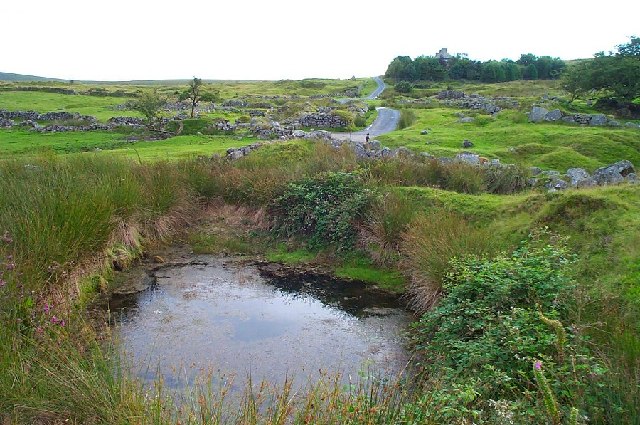
Heavily overgrown; little survives of the mine buildings beyond a row of former workers' cottages and the dressing floor below them, but building foundations, numerous shafts, test pits, spoil heaps and wheelpits remain visible across the site.
Workers' cottages, a dressing floor, building foundations, shafts, test pits, spoil heaps and wheelpits.
Nearby mines
- Eylesbarrow Mine — 2.9 miles (4.6 km) S
- Merrivale Quarry — 3.2 miles (5.2 km) NW
- Hooten Wheals — 3.8 miles (6.2 km) E
- Hexworthy Mine — 4.1 miles (6.6 km) E
- Brimpts Tin Mine — 6.0 miles (9.7 km) NE
Straight-line distance, within 9 miles (15 km). Show on the map.
Recorded claims
Individual factual claims, each attached to the source(s) that support it below. Where sources disagree, both are kept.
- At the start of the 1870s Whiteworks produced 8-9 tons of tin ore a year, one of Dartmoor's largest mines alongside Eylesbarrow and Gobbet. 1
- Little survives of the mine buildings beyond a row of workers' cottages and the dressing floor below them; the wider site is heavily overgrown, with numerous shafts, test pits, spoil heaps and wheelpits still visible. 2
- A brief early-1900s revival at Whiteworks operated under shared ownership with the Golden Dagger and Hexworthy mines before the site finally closed in 1914. 1
Photographs & further reading
The Historic Environment Record entry for the mine and its surviving remains.
View sourceSources
- (secondary) Whiteworks — Wikipedia
- (observational) WHITEWORKS TIN MINE — Dartmoor Explorations
Record created: 31 August 2026 · Last researched: 31 August 2026