 MineArchive
Dressing Floor
| Also known as | Dressing Floors (Plural form, used where a mine had more than one) |
|---|---|
| Category | Ore Processing |
The surface area at a mine where raw ore, once brought up from underground, was crushed, sorted, washed and concentrated into a saleable product before being sent for smelting — the industrial 'shop floor' of a working mine, as important to its output as anything happening underground.
Historical usage
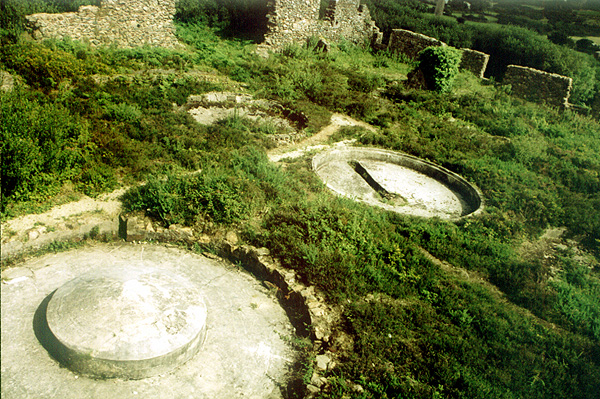
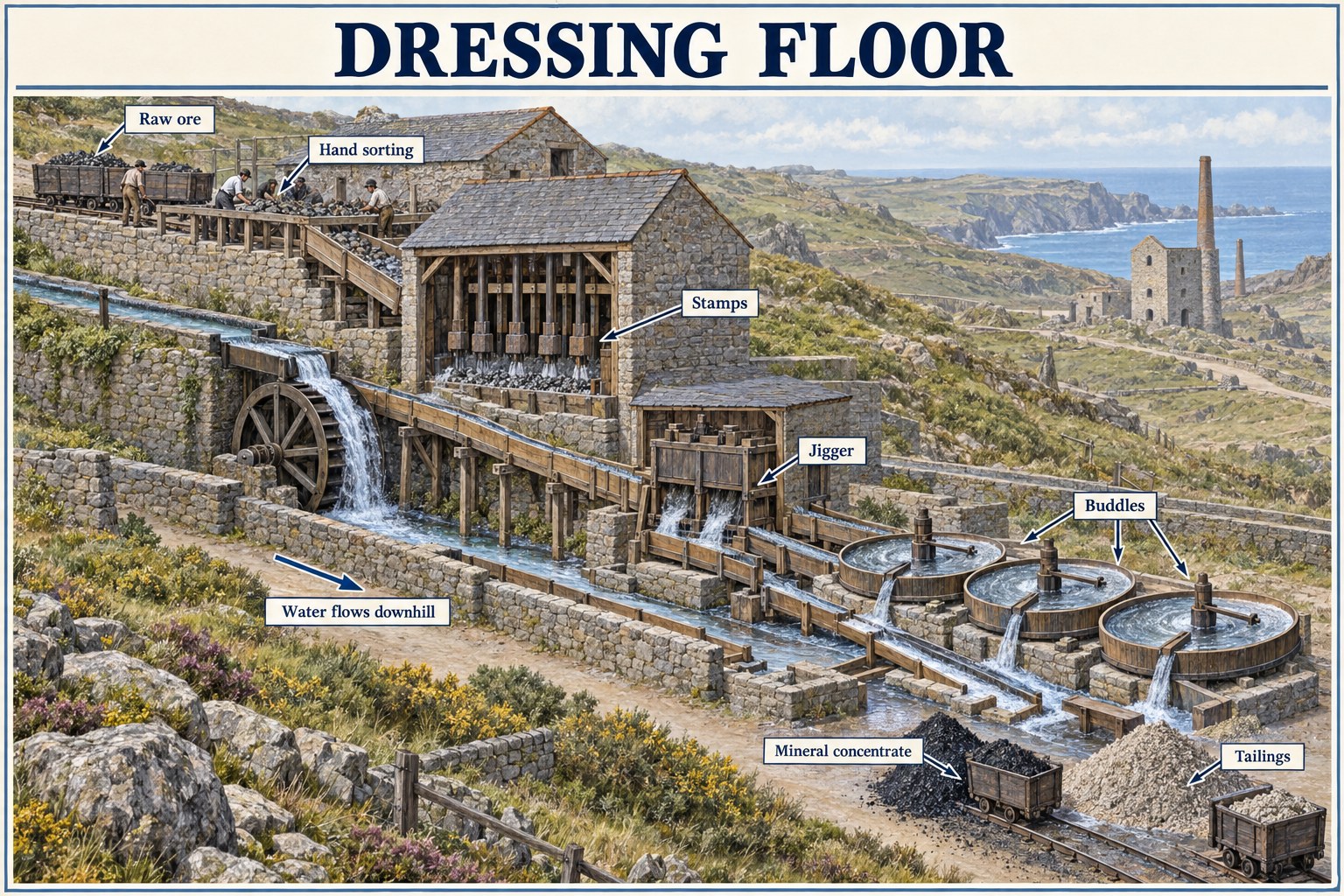
Dressing floors developed alongside the mining industry itself, growing from simple hand-sorting and washing in the earliest workings into extensive, purpose-built processing complexes by the 19th century, laid out with stamps, buddles, jiggers and other machinery in a deliberate sequence. Some of the best-preserved examples in Britain survive at Cornish mines such as Wheal Basset, where the West Basset Stamps of 1875 stand above a dressing floor still counted among the finest surviving examples of its kind anywhere; similarly extensive dressing-floor remains survive at Old Gang Mines in Swaledale and at Coniston and Roughten Gill in the Lake District.
How it worked
Ore arriving from underground was first broken down to a workable size, typically by stamps — heavy, water- or steam-powered hammers — then passed through a sequence of buddles, jiggers and other gravity- and water-based separating devices that exploited the difference in density between valuable ore and worthless waste rock. Because the process relied heavily on gravity and flowing water, dressing floors were usually laid out on a slope, so material could move from one stage to the next with the minimum of manual handling.
Why it was used
Ore straight from the ground was almost never pure or saleable as it stood — dressing floors existed to turn raw, waste-mixed rock into a concentrated product worth smelting, at a fraction of the cost and effort of shipping and processing the full volume of unsorted material. Getting this stage right could make the difference between a marginal mine and a genuinely profitable one, whatever the quality of the ore itself.
Risks & limitations
Dressing was labour-intensive, water-hungry and, particularly where women and children worked as ore-sorters ('bal maidens') on the floor itself, physically hard and repetitive; the waste material it produced, often laden with residual arsenic, lead or other toxic minerals, could leave dressing-floor sites contaminated for well over a century after mining itself had ceased.
Regional variation
Terminology and specific equipment varied by region and period, but the underlying sequence — crush, then separate by gravity and water — was near-universal wherever ore had to be concentrated before smelting, from Cornish tin and copper dressing floors to lead-ore washing floors in the Pennines and Peak District.
Related terminology
Belland Yard, Bouse Team, Cornish Rolls, Froth Flotation, Smelt Mill
Mines associated with this term
5 examples chosen from 52 linked records — the term page is not an index.
- Fee Donald Mine — Highland (well documented example)
Named 3 times in this record, first in the history: “…and a large ore-processing area with a water-wheel pit, crushing and dressing floors, spoil heaps and washing floors. Historic Environment Scotland…” - Nantymwyn Mine — Carmarthenshire (well documented example)
Linked on an exact-phrase match in this record's own text. - Arkendale Mine — North Yorkshire (well documented example)
Named in this record’s current condition: “…thick with the remains of its lead industry — levels, hushes, spoil, dressing floors and the ruins of smelt mills — much of it protected.” - Ashnott Lead Mine — Lancashire (well documented example)
Named 3 times in this record, first in the workings: “…infilled or roughly capped shafts, open-cuts, adits, spoil heaps and dressing floors. The main entrance is a level on the western side of the knoll about…” - Beever Mine — North Yorkshire (well documented example)
Named 4 times in this record, first in the summary: “…the late eighteenth and early nineteenth centuries. A stamp mill and dressing floors were built at Beevers by 1826, and Beever's Engine Shaft was sunk in…”
Sources
- (primary) Stamps Engine House to West Basset Stamps on North Wheal Basset Sett — Historic England (Listed Building record)
- (secondary) Dressing the Ore — Cornish Mining World Heritage Site
Record created: 23 August 2026 · Last researched: 23 August 2026