 MineArchive
Lode
| Category | Mine Workings & Access |
|---|
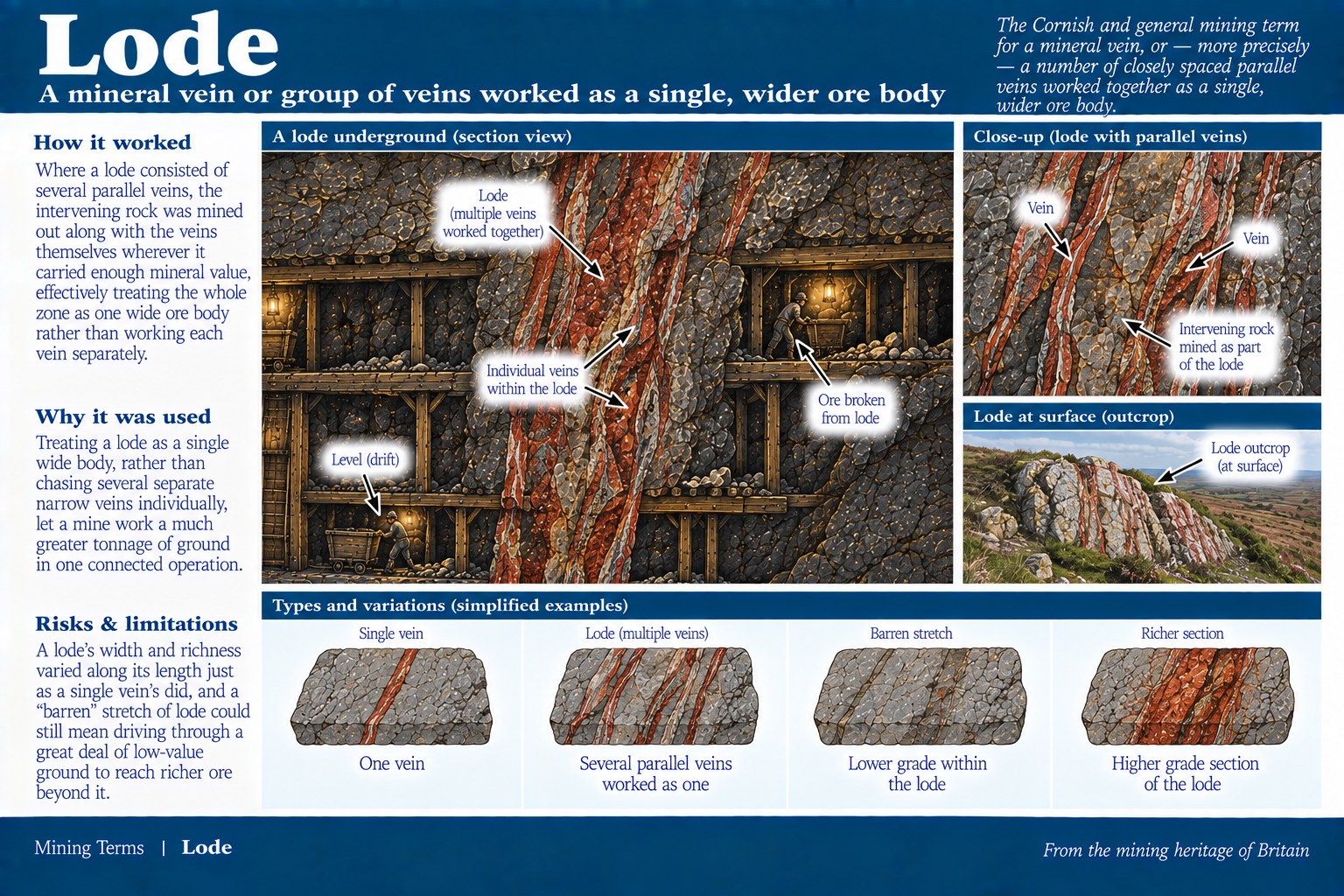
The Cornish and general mining term for a mineral vein, or — more precisely — a number of closely spaced parallel veins worked together as a single, wider ore body.
Historical usage
Lode is a Cornish-origin word (vein is Latin), reflecting Cornwall and west Devon's long mining tradition; a lode could be a single vein or several running close enough together that the ground between them also became worth working, producing a much broader ore body than any one vein alone.
How it worked
Where a lode consisted of several parallel veins, the intervening rock was mined out along with the veins themselves wherever it carried enough mineral value, effectively treating the whole zone as one wide ore body rather than working each vein separately.
Why it was used
Treating a lode as a single wide body, rather than chasing several separate narrow veins individually, let a mine work a much greater tonnage of ground in one connected operation.
Risks & limitations
A lode's width and richness varied along its length just as a single vein's did, and a "barren" stretch of lode could still mean driving through a great deal of low-value ground to reach richer ore beyond it.
Regional variation
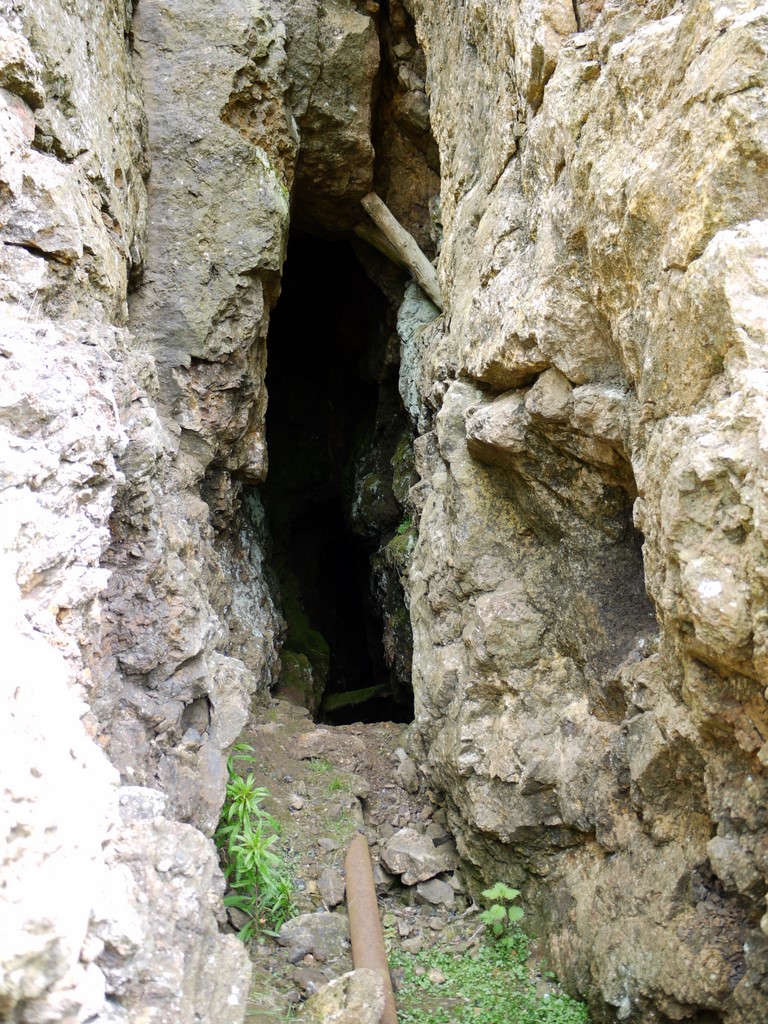
Lode is the standard term in Cornwall and west Devon specifically; elsewhere in Britain the near-synonymous 'Vein' (see above) is more commonly used. A lode can occasionally be seen whole rather than inferred from workings. At West Rigg Opencut in Weardale the Weardale Iron Company's ironstone working cut clean across the Slitt Vein and left its structure standing exposed in section, which is why the site is both a Site of Special Scientific Interest and part of a scheduled monument covering the Middlehope Shield and Low Slitt lead mines and their ore works.
Related terminology
Mines associated with this term
5 examples chosen from 107 linked records — the term page is not an index.
- Burrow Farm Mine — Somerset (well documented example)
Named 4 times in this record, first in the history: “…and a branch reached it from the mineral railway in 1863. The lode proved fickle, and the mine closed in 1868. It was reopened in 1879,…” - Faggergill Mine — North Yorkshire (well documented example)
Named in this record’s history: “…Company, established in 1656. The Old Vein, Faggergill's principal lode, had been found in the chert beds above the Main Limestone before…” - Milwr Tunnel — Flintshire (well documented example)
In 1917 the tunnel broke unexpectedly into a flooded cavern at the Pant Lode, releasing water at 10,000 gallons a minute. - Penlee Quarry — Cornwall (well documented example)
Named 3 times in this record, first in the geology: “…pegmatitic, and pyrometasomatic in the greenstones. A north–south lode dipping 65 degrees west carries an assemblage unusual for Cornwall —…” - Wheal Hermon — Cornwall (well documented example)
Named 5 times in this record, first in the history: “…in 1821 as Wheal St Just, with a single shaft sunk on the Hermon lode just above high-water mark, and worked as Wheal Hermon from 1822;…”
Sources
- (observational) Slitt Vein lead mine uncovered at West Rigg Opencut — Geograph Britain and Ireland
- (secondary) Lode — Wikipedia
- (secondary) Section 17. Lodes And Veins — Chest of Books
Record created: 22 August 2026 · Last researched: 9 September 2026