 MineArchive
Burrow Farm Mine
| Also known as | Burrow Farm Iron Mine, Barrow Farm |
|---|---|
| Location | Brompton Regis, Brendon Hills, Somerset — 51.1013, -3.4173 (approximate) |
| Commodity | Iron |
| Type | Ironstone |
| Worked | 1860 (shaft sunk)–1883 |
| Maximum depth | Around 150ft (46m) by 1867 |
| Operators | Brendon Hills Iron Ore Company (1860–1883), Ebbw Vale Steel, Iron and Coal Company (1860–1883) |
Overview
An iron mine on the Brendon Hills whose engine house — built in 1879 from stone carted three kilometres across the hills from a pit that had already failed, to hold a third-hand engine from South Wales — worked for barely four years before the field collapsed, and now stands as the only Cornish-type beam engine house left on Exmoor.
History
The Brendon Hills iron field existed because South Wales ran out of ore. By 1830 the local supplies feeding the ironworks were nearing exhaustion just as the railway boom sent demand for wrought-iron rails climbing, and it became worth mining ore in west Somerset and shipping it across the Bristol Channel to smelt. The Brendon Hills Iron Ore Company was formed in 1853 under the control of the Ebbw Vale proprietors, and about twenty named mines worked the hills between 1837 and 1909. Getting the ore out was the hard part: the West Somerset Mineral Railway, authorised in 1855 and complete by 1861, ran north to Watchet harbour, and to climb the escarpment it used a rope-worked incline at Comberow, 1,100 yards long at a gradient of 1 in 4, lifting the line 800 feet. Burrow Farm's own shaft was sunk in 1860 through much older surface workings, and a branch reached it from the mineral railway in 1863. The lode proved fickle, and the mine closed in 1868. It was reopened in 1879, and the engine house was raised using stone taken from the abandoned engine house at Langham Hill, three kilometres east. Whatever the ore was worth, the arithmetic never worked: ore that cost about £1.25 a ton to raise was selling at 75p, and by the time mining across the field stopped in June 1883 the venture had lost some £762,000. Between 1852 and 1883 a little over three-quarters of a million tons of usable ore reached Ebbw Vale. A revival under the Somerset Mineral Syndicate from 1907 reopened other pits in the field, not this one, and produced 4,800 tons before winding up in 1910.
Geology
The ore was worked from lodes in the Morte Slates, Devonian rocks folded into the Brendon anticline and syncline, and consisted of goethite, haematite and siderite. It suited the Bessemer process that Ebbw Vale took up in the 1860s, which is what made carting it to South Wales worthwhile at all. The orebodies were not dependable: Burrow Farm's lode was described as fickle, which is the immediate reason the mine shut in 1868 after only eight years.
Geological setting: Anticlines and Synclines (historical documentary reference), Veins and Lodes (well documented example)
Workings
One shaft, about 150 feet deep by 1867, with several others in the vicinity now blocked. The 1879 engine house held a 25-inch rotative beam engine doing double duty, pumping the workings and winding from the shaft — a third-hand machine by the time it arrived, brought from Langham Hill Pit and originally from South Wales. Extensive openworks across the site show ore being taken at surface long before the Victorian shaft, possibly in the medieval period or earlier, and the shaft of 1860 was sunk straight through them.
Closure
The lode proved fickle and the mine closed in 1868; it was reopened in 1879.
What remains
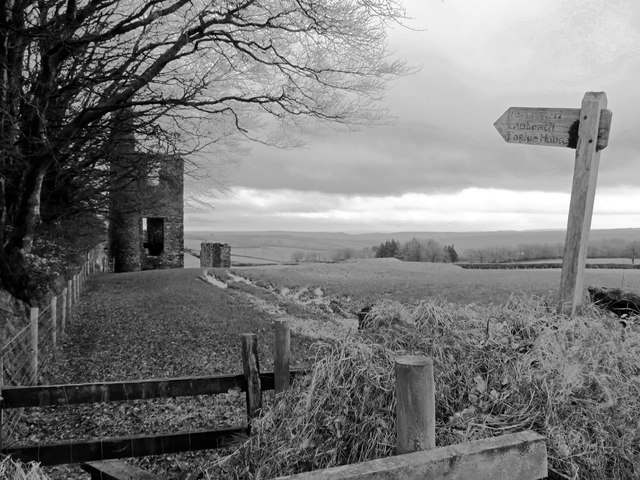
The engine house survives roofless but substantially complete, all four walls standing about 10 metres high in local stone and the re-used Langham material, with its circular chimney attached to the north wall at full height. It was conserved for public display in 1990, and a rapid condition survey of Exmoor's listed buildings in June 2013 scored it 5A. A photograph taken on 21 December 2023 shows the permissive path to it open and the structure sound, with the freestanding remnant of the miners' dry standing to one side.
The engine house and chimney; the free-standing wall of the miners' dry, included in the listing; the shaft site and its adjacent spoil heap; a section of the branch railway trackbed; and the infilled openworks of the earlier surface mining. Scheduled Monument 1021353; the engine house and drying shed are separately listed Grade II (1345418).
Related mines
- Carnarvon New Pit — Both were Brendon Hills Iron Ore Company pits served by sidings off the West Somerset Mineral Railway, which carried their ore to Watchet for shipment to South Wales.
Nearby mines
- Carnarvon New Pit — 0.8 miles (1.2 km) E
Straight-line distance, within 9 miles (15 km). Show on the map.
What's uncertain
Points where sources disagree or the record could not be settled; both accounts are kept. All open questions in the archive.
- The engine house is dated to 1879 by the Geograph record and by accounts of the mine's reopening; the Exmoor HER and some published summaries give 1880. Either way it stood for at most four working years before closure in 1883. (disputed) 1,2
Recorded claims
Individual factual claims, each attached to the source(s) that support it below. Where sources disagree, both are kept.
- The engine house is dated to 1879 by the Geograph record and by accounts of the mine's reopening; the Exmoor HER and some published summaries give 1880. Either way it stood for at most four working years before closure in 1883. (disputed) 1,2
- One shaft had reached about 150 feet by 1867. 1
- A 25-inch rotative beam engine, used for both pumping and winding, brought from Langham Hill Pit and originally from South Wales — third-hand by the time it reached Burrow Farm. 2
- A little over three-quarters of a million tons of usable ore went from the Brendon Hills to Ebbw Vale between 1852 and 1883. 3
- Net losses on the Brendon Hills venture amounted to some £762,000 by 1883, ore costing about £1.25 a ton to raise against a selling price of 75p. 3
- The BGS mine-plans catalogue holds 18 records for the Brendon Hills; item 21863618 lists Barrow Farm among the mines covered, alongside Carnarvon, Colton, Gupworthy, Kennisome Hill, Langham and Raleigh's Cross. 4
Photographs & further reading
The separate HER record for the engine house itself, including its 1990 conservation.
View sourceSources
- (primary) MSO8858 — Burrow Farm Mine — Exmoor National Park Historic Environment Record
- (observational) Permissive path to Burrow Farm engine house (21 December 2023) — Geograph Britain and Ireland
- (secondary) Mining on the Brendon Hills — Wikipedia
- (primary) Mine plans catalogue: Brendon Hills (incl. Barrow Farm), item 21863618 — British Geological Survey
Record created: 26 August 2026 · Last researched: 26 August 2026