 MineArchive
Faggergill Mine
| Location | Whaw, Arkengarthdale, North Yorkshire — 54.4500, -2.0340 (approximate) |
|---|---|
| Commodity | Lead |
| Type | Metal |
| Worked | By 1521–1914 |
| Operators | Bathurst family (1656–1860), Stang and Cleasby Mines (1908–1914) |
Overview
One of Arkengarthdale's principal lead mines, worked in some form since at least the 16th century and developed intensively from 1840 to 1881 into some fifteen miles of tunnelling. Its closure in 1914, precipitated by a bitter 1870 strike over fixed working hours and a collapsing lead price, brought to an end a lead-mining tradition in the dale stretching back around 800 years.
History
Lead has been taken from Arkengarthdale since at least 1285, the earliest documented record of mining in the dale, and by 1521 workings were already established at Moulds, Punchard Gill and Faggergill itself. For much of its early life Faggergill was worked under the dominant local mining interest in the dale, the CB (Charles Bathurst) Company, established in 1656. The Old Vein, Faggergill's principal lode, had been found in the chert beds above the Main Limestone before the 19th century, but the mine's main period of development ran from 1840 to 1881, during which at least five miles of tunnelling were driven — eventually reaching, across the mine's four levels and multiple shafts, a total of around fifteen miles of underground workings.
A new company took over Faggergill in 1870, and its very first act — imposing strict working hours across a five-day week, with punitive treatment for miners arriving late for a fixed 7am start — provoked a bitter strike. The dispute lasted eight weeks before the miners, their numbers badly depleted and their resources exhausted, were effectively starved back to work; the Darlington and Stockton Times reported that as many as fifty families left Arkengarthdale altogether in search of other work, some as far away as Patterdale in the Lake District. The mine recovered to produce handsome profits through the 1870s and into the mid-1880s, but profitability had begun a steady decline by 1887. New ore was found in 1908 at Slot Hole and Nut Hole, driven into two swallow holes in the upper part of the Main Limestone and worked from then on by the newly formed Stang and Cleasby Mines company, whose Nuthole workings connected directly into the existing Faggergill levels. With the price of lead falling and the cost of drilling and pumping rising, the company was finally wound up in 1914 — bringing to a close a lead-mining tradition in Arkengarthdale stretching back roughly 800 years.
Geology
Faggergill's Old Vein, like the other productive lodes of Swaledale and Arkengarthdale, occurs within chert beds associated with the Main and Underset Limestones of the Carboniferous Yoredale Series — a sequence of alternating limestones, sandstones, shales and thin coals in which the cherty limestone horizons proved consistently the richest ground for galena mineralisation across the wider North Pennine orefield.
Workings
An extensive underground mine developed across four main levels and numerous shafts, eventually totalling around fifteen miles of tunnelling; its later working, from 1908, extended into new ground at Slot Hole and Nut Hole via workings driven by the Stang and Cleasby Mines company that connected directly into the existing Faggergill levels.
Closure
Falling lead prices and rising costs led to the mine's operating company being wound up in 1914, ending Arkengarthdale's roughly 800-year lead-mining history.
What remains
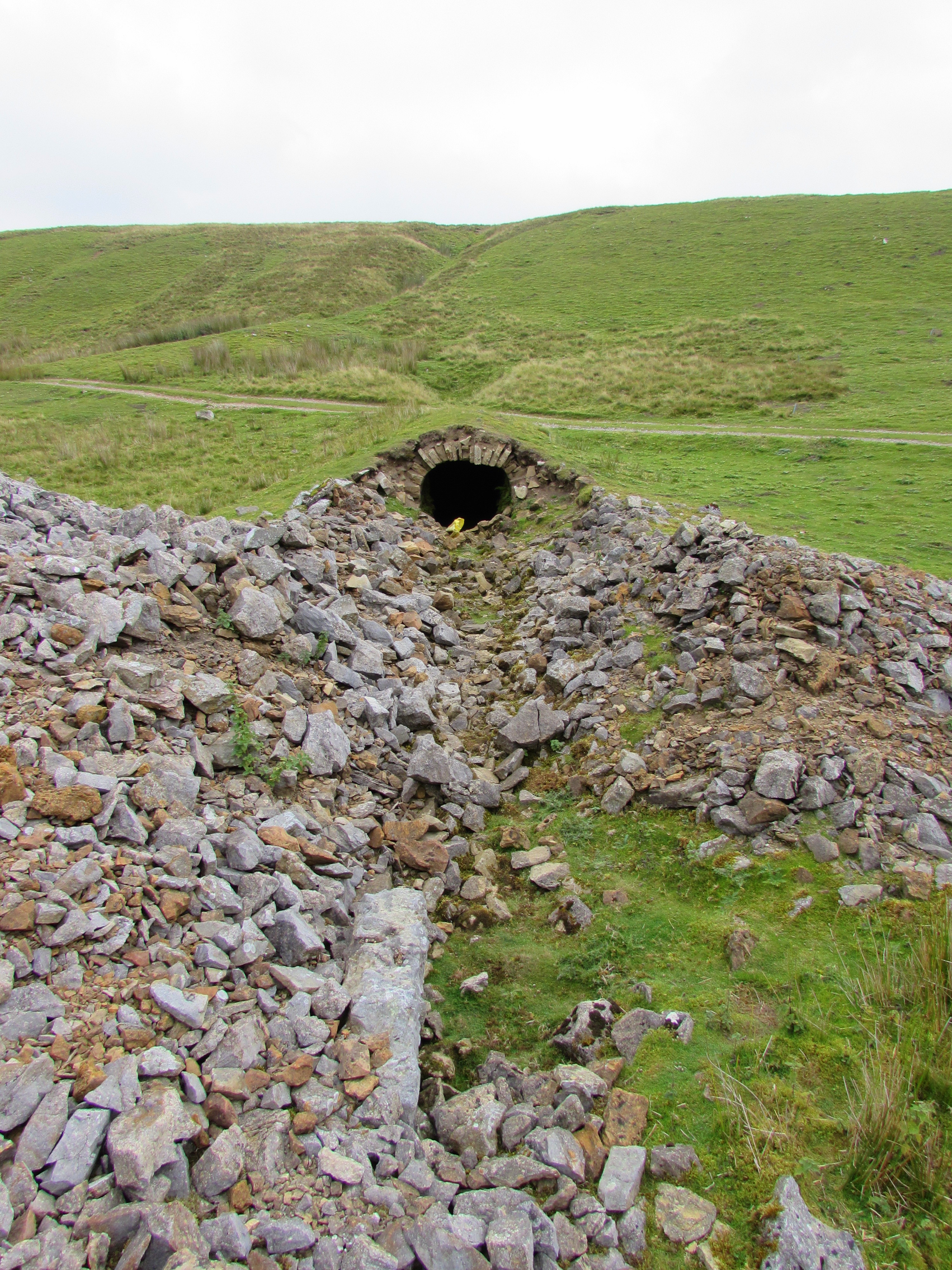
The old workings survive as a network of adit levels, shafts and spoil across the hillside above Whaw; several levels remain visible and are a recognisable feature of the dale.
Multiple adit level entrances, shaft mounds and spoil heaps survive across the site, visible from the roads and paths through upper Arkengarthdale.
Related mines
- Booze Mine — Both Arkengarthdale lead mines, and directly compared in the surviving output figures: Booze Wood Level averaged about 67 tons of ore a year across the 1870s and 1880s against 966 tons a year from Faggergill, which is the measure of how far it fell short of expectations.
- Cleasby Mines — Stang & Cleasby worked the Sloate Hole and Nuthole ground at Faggergill itself, the Nuthole level connecting through into the older Faggergill workings; Cleasby is named on the Faggergill record.
Nearby mines
- Shaw Beck Gill Mine — 1.6 miles (2.5 km) SE
- Cleasby Mines — 1.9 miles (3.0 km) NW
- Moulds Side Mine — 2.0 miles (3.2 km) S
- Cragg End Flag Stone Mine — 2.1 miles (3.4 km) SE
- Hungry Chert Quarries — 2.3 miles (3.8 km) S
Straight-line distance, within 9 miles (15 km). Show on the map.
The old levels and shafts are unmanaged and hazardous — this entry describes history and general location only, not an access guide.
Recorded claims
Individual factual claims, each attached to the source(s) that support it below. Where sources disagree, both are kept.
- Lead mining in Arkengarthdale is first recorded in 1285, with workings at Moulds, Punchard Gill and Faggergill established by 1521; Faggergill was for much of its early life worked under the CB (Charles Bathurst) Company, founded in 1656. 1
- The Old Vein was known before the 19th century, but Faggergill's main period of development ran 1840-1881, during which at least five miles of tunnelling were driven across four levels, eventually totalling around fifteen miles of workings. 2,1
- A new management's imposition of a fixed 7am start and strict five-day working week in 1870 provoked an eight-week strike; miners were eventually forced back to work, and as many as fifty families left Arkengarthdale for work elsewhere, some as far as Patterdale in the Lake District. 2,1
- New ore was found at Slot Hole and Nut Hole in 1908, worked by the newly formed Stang and Cleasby Mines company whose workings connected into the existing Faggergill levels; the operating company was wound up in 1914 amid falling lead prices. 2,1
- An 1867 'Report on the Scargill and Faggergill Mines' by Herbert Evans is recorded among historical sources for Arkengarthdale mining. 3
Sources
- (secondary) Arkengarthdale — Wikishire
- (observational) Faggergill Lead Mine — Geograph Britain and Ireland (Matthew Hatton)
- (secondary) Arkengarthdale — Northern Mine Research Society
Record created: 26 August 2026 · Last researched: 26 August 2026