 MineArchive
Galena
| Category | Commodities |
|---|
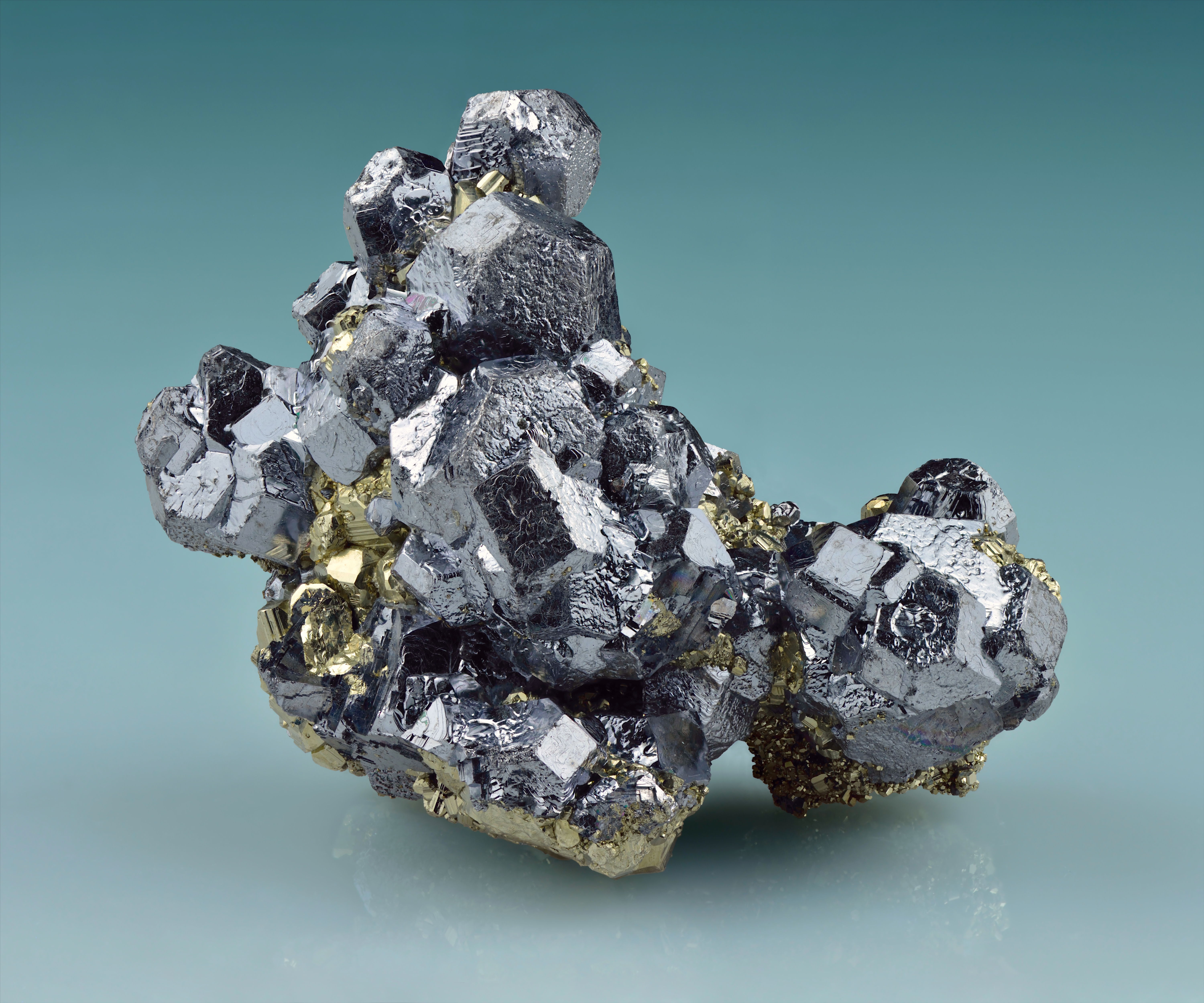
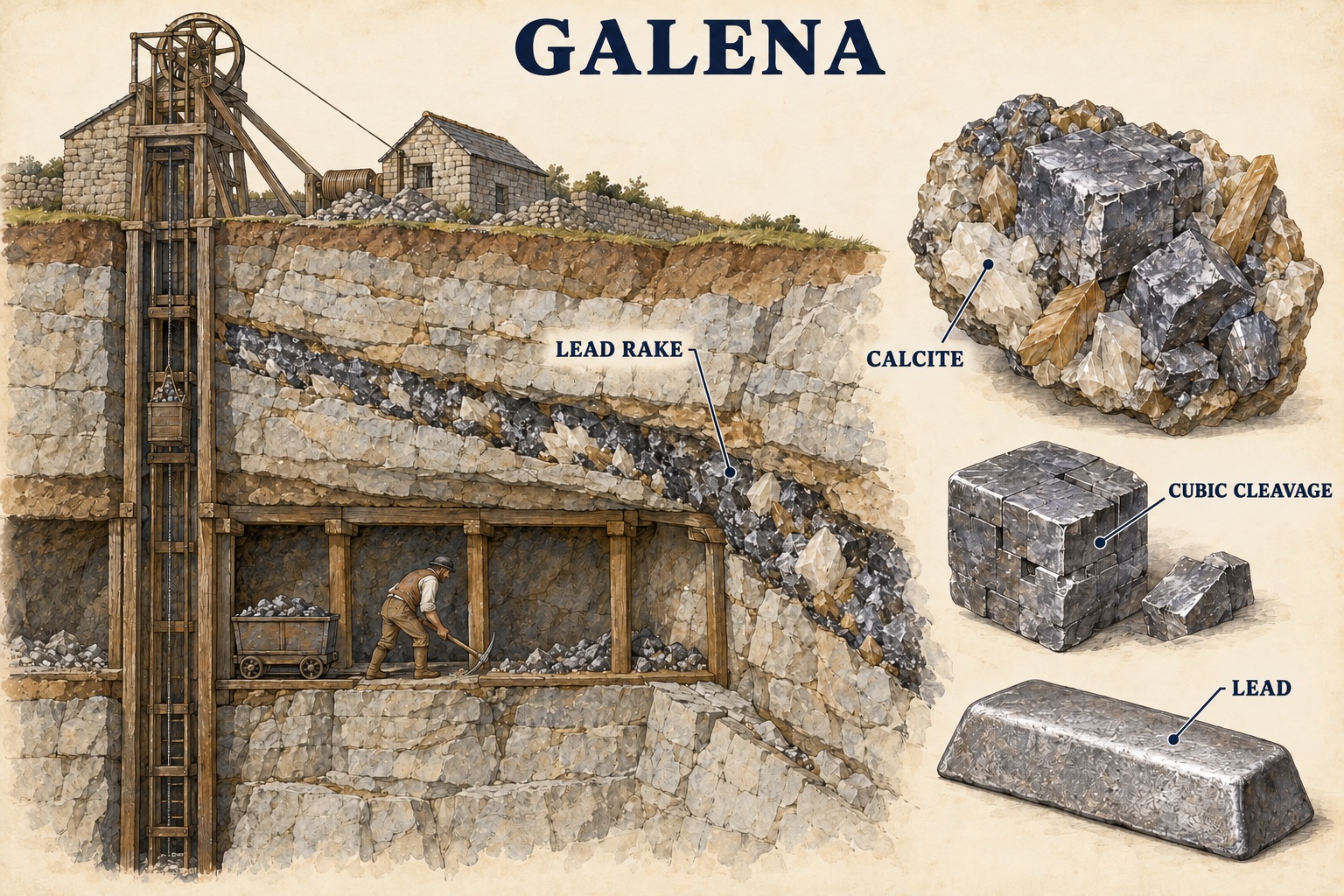
Lead sulphide (PbS), the principal ore mineral of lead — a heavy, brittle mineral that breaks along a distinctive cubic cleavage into bright, silvery-grey cubes.
Historical usage
Galena has been worked across Britain's lead orefields since Roman times — 'pigs' of lead stamped with the Emperor Trajan's name survive from the Yorkshire Dales, and mining in the Halkyn-Minera district of north-east Wales dates from the same period — with major activity through the 16th to 18th centuries building to a 19th-century peak across the Pennines, Mendips, Wales and Scotland's Southern Uplands.
How it worked
Its heavy weight, metallic lustre and perfect cubic cleavage make galena straightforward to recognise in hand specimen, which let prospectors trace mineral veins by eye. In districts like the Mendips it occurred as thin crusts, bands or crystals within narrow veins known as rakes, mixed with worthless gangue minerals such as calcite and barytes; early miners worked weathered, rounded secondary galena accumulated near the surface before deeper, harder primary veins had to be tackled with shafts.
Why it was used
Galena was, in practice, the only commercially important lead ore worked in Britain, and at some localities — notably Charterhouse in the Mendips — it carried enough silver to be valuable for cupellation as well as for its lead content.
Risks & limitations
Ore quality and silver content varied significantly by locality, directly affecting a mine's profitability; smelting galena releases poisonous sulphur dioxide gas and volatilised lead fumes, a hazard managed only crudely, if at all, in early smelting.
Regional variation
Worked across virtually every English, Welsh and Scottish lead orefield — the Pennines, Mendips, Peak District, North and Mid-Wales, and the Southern Uplands — though silver content and vein character varied considerably between districts.
Related terminology
Gangue, Lead, Silver, Sphalerite
Mines associated with this term
5 examples chosen from 60 linked records — the term page is not an index.
- Faggergill Mine — North Yorkshire (well documented example)
Named in this record’s geology: “…cherty limestone horizons proved consistently the richest ground for galena mineralisation across the wider North Pennine orefield.” - Fee Donald Mine — Highland (well documented example)
Named in this record’s history: “…1727, two years after Sir Alexander Murray's original discovery of galena in the hills around Strontian led him to open a mine there in 1725.…” - Grebe Swallet Mine — Somerset (well documented example)
Named 3 times in this record, first in the history: “…began there in 1981; diggers soon noted, from the abundance of galena and the many stemple holes cut into the rift walls, that the cave…” - Lead Mines Clough — Lancashire (well documented example)
Named twice in this record, first in the history: “…in 1788-89, and by the 1790s the mine was also yielding copper and galena. The last phase of working began in 1824, when landowner Frank Hall…” - Arkendale Mine — North Yorkshire (well documented example)
Named in this record’s geology: “…the Carboniferous limestones and shales of the dales, depositing galena with fluorspar, barytes and calcite. The veins of Arkengarthdale and…”
Sources
- (primary) Galena — Amgueddfa Cymru — National Museum Wales
- (primary) Lead ore and mines — British Geological Survey (Foundations of the Mendips)
Record created: 27 August 2026 · Last researched: 27 August 2026