 MineArchive
Harrybecca Mine
| Also known as | Bacon's Mine |
|---|---|
| Location | Hassop Common, north of Hassop, Derbyshire — 53.2547, -1.6634 (approximate) |
| Commodities | Lead, Fluorspar |
| Type | Metal |
| Worked | Early 18th century–1950s |
| Operators | George Edward Bacon — Reworked the mine for fluorspar in the 1940s and 1950s as Bacon's Mine |
An old lead mine on Hassop Common, part of the Brightside title in the eighteenth century and reworked for fluorspar in the 1940s and 1950s as Bacon's Mine.
Location
Approximate location. The large pin is this mine; the small round markers are the nearest mines on record. Click one for its page. View on full map
History
Harrybecca Mine lies on Hassop Common, the steep southern slope of the eastern end of Longstone Edge, north of Hassop. It is a complex of two very narrow, roughly parallel vein workings running east to west down the hill, with deep open-cuts where the south vein was worked to the surface. When it was first worked is not known: one account dates the vein workings to at least the seventeenth century, and the county record puts the shallow workings in the early eighteenth century at the latest. It holds a series of plumbs and hadings, ore lying in vertical joints and in steeply inclined beds, which show mining techniques and geology not repeated elsewhere in the country.
In the second half of the eighteenth century the mine was part of the Brightside Mine title. The county record places an engine shaft known as Middle Engine, a deep shaft at the eastern end, within it; a caving account treats Middle Engine as a separate title to the east. Brightside, as a consolidated holding that included Harrybecca, fell out of use soon after the end of the Napoleonic wars. Whether Harrybecca ever reopened for lead is unclear, and the 1879 Ordnance Survey map shows it as disused.
In the 1940s and 1950s the old stopes were partly reworked for fluorspar by George Edward Bacon of Youlgreave, after whom it was known locally as Bacon's Mine, and who also worked White Coe Mine under the name of the Hassop Mines. The site had been called Evans Gin, and Bacon's tidying-up of titles brought it and Lower Harrybecca under the one name. He linked the two old veins with a large central stope, blasted a new adit and tramway to a new dressing floor, and installed two compressors and a log-washer. Worked by pick and shovel, it supplied fluorspar and barytes, calcite spar for pebble-dashing and rockery, furnace stone, building stone and gritstone.
Geology
Narrow, roughly parallel east-west veins in the fore-reef limestone of Hassop Common, on the flank of Longstone Edge near the Deep Rake. The ore occurs in plumbs (mineralised vertical joints) and hadings (steeply inclined beds). The veins carried galena, later worked for fluorspar, barytes and calcite.
Workings
Two very narrow vein workings linked in the 1950s by a large central stope, with deep open-cuts, an adit and two underground tramway levels at the eastern end serving the fluorspar workings. A climbing shaft about 15 m deep, with the remains of an iron ladder probably fitted during fluorspar prospecting in the 1940s and 1950s, leads to small passages in several narrow interconnecting veins, including a small area of pillar-and-stall working not recorded in any other lead mine in Britain. The open-cuts and stopes show firesetting with coal.
Closure
The lead workings had fallen out of use by 1879. Fluorspar working under George Bacon in the 1940s and 1950s was on a limited scale; much of the 1950s tramway structure has since collapsed.
What remains
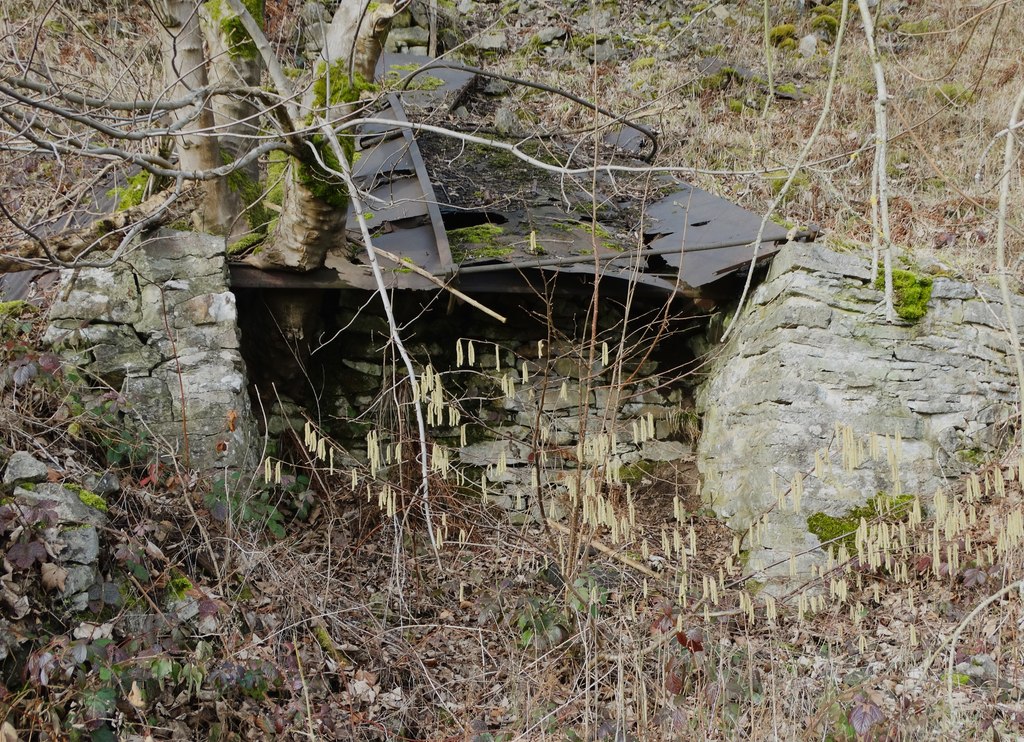
The open-cuts, shafts and parts of the underground workings survive; underground inspection in 1993 confirmed features of geological and archaeological importance. Much of the 1950s timber and corrugated-iron structure has collapsed.
Shafts, an overgrown gin circle, ruined buildings including a coe (a miners' tool and changing house), concrete platforms, the remains of a large walled enclosure, and the 20th-century fluorspar plant with levels, platforms, drystone supports for ore chutes (one made from an old lorry back) and collapsed corrugated-iron sheds.
Related mines
- Brightside Lead Mine — Harrybecca was part of the Brightside Mine title in the second half of the eighteenth century, and fell out of use with that consolidated holding after the Napoleonic wars.
- Middle Engine Mine — Shared title and same complex: Middle Engine is the deep engine shaft at Harrybecca's eastern end, both within the Brightside Mine title in the late 18th century.
Nearby mines
- Middle Engine Mine — 0.0 miles (0.0 km) N
- Brightside Lead Mine — 0.3 miles (0.5 km) E
- Silver Hillocks Mine — 0.8 miles (1.2 km) W
- Longstone Edge — 0.9 miles (1.5 km) W
- Red Rake Mine — 1.0 miles (1.6 km) NE
Straight-line distance, within 9 miles (15 km). Show on the map.
Further reading
The county record of the mine's workings, surface remains and history, from the Peak District lead-mining surveys.
View sourceA visit report with a history of the lead and fluorspar workings and photographs of the stopes, chutes and tramways.
View sourceA caving club trip report on Harrybecca's vein workings, its earlier name and the 1950s fluorspar consolidation.
View sourceSources
- (secondary) MDR4102 - Harrybecca Leadmine, Hassop — Derbyshire Historic Environment Record
- (observational) Harrybecca Lead/Fluorspar mine, Hassop, Derbyshire, April-June 2021 — 28DaysLater
- (observational) Harrybecca/Middle Engine Mines (Phil Wolstenholme) — Technical Speleological Group
Record created: 14 November 2026 · Last researched: 14 November 2026