 MineArchive
Fire-setting
| Also known as | Firesetting (Unhyphenated spelling), Fire setting (Spaced spelling) |
|---|---|
| Category | Mine Workings & Access |
Breaking hard rock by burning a fire against the face and then quenching it, so that thermal shock cracks the stone. It was the principal means of working rock too hard for hand tools from the Neolithic until gunpowder replaced it, and in some European mines it survived into the nineteenth century.
Historical usage
The earliest evidence comes from a Neolithic flint mine in western Germany, where the charcoal shows a deliberate preference for deciduous oak. Archaeological traces become common in Bronze Age copper mines across Europe: the Bronze Age workings on the Great Orme in north Wales used fire-setting against the harder rock alongside stone hammers, and it was used at Llanymynech Hill on the Powys border to get at the copper there. Diodorus Siculus described it in Egyptian gold mines about 60 BC and Pliny the Elder in more detail in the first century AD; Roman miners in Britain used it as a matter of course. It persisted in northern European mines until the nineteenth century.
How it worked
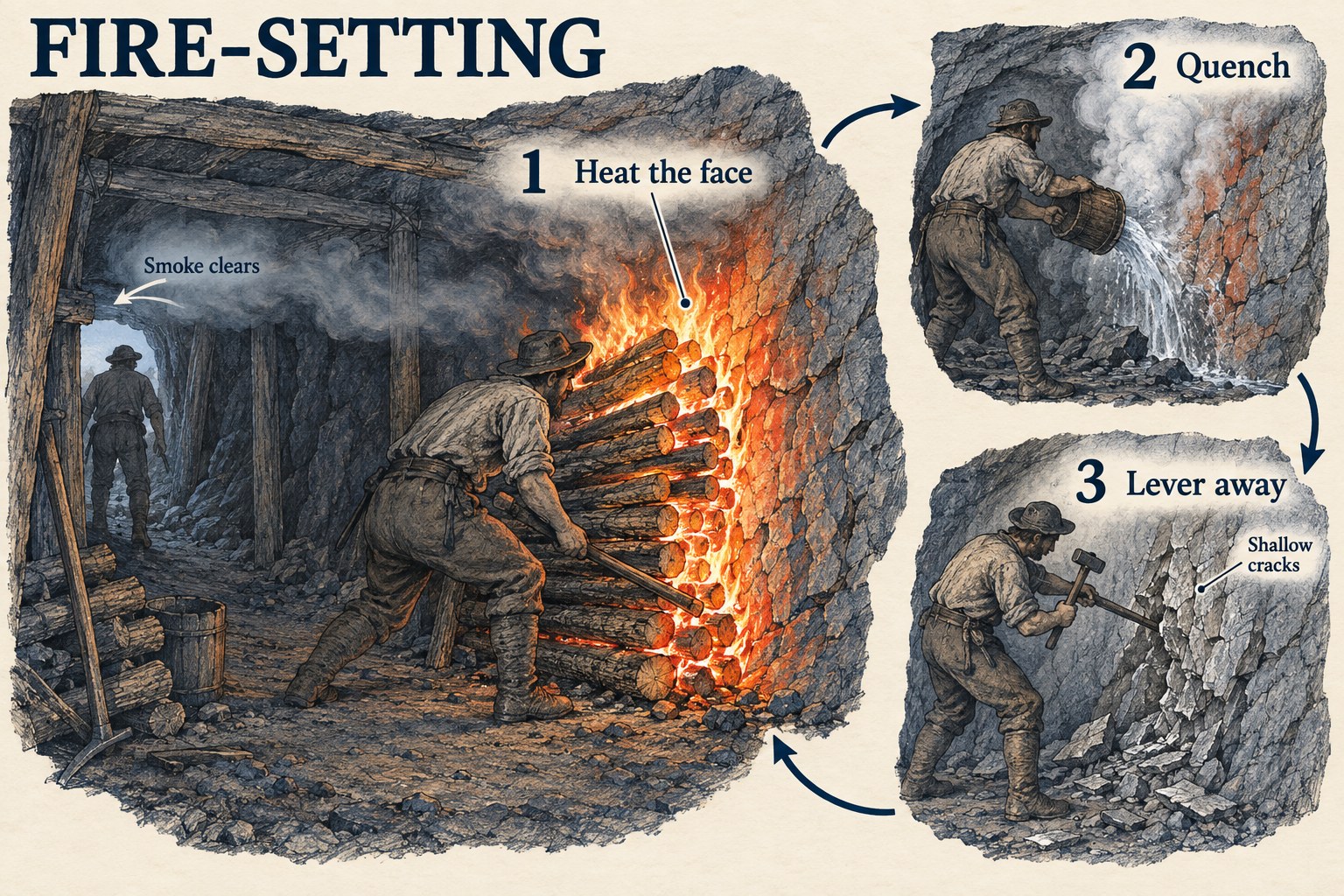
A fire of stacked timber is built against the rock face and burned hard, heating the surface layer. The face is then cooled suddenly — with water, and according to Roman accounts sometimes with vinegar — and the abrupt contraction cracks and spalls the heated rock, which can then be levered and hammered away. The cycle is repeated. The effect is shallow, working the outer few inches at a time, so progress is slow and measured in cycles rather than in feet a day.
Why it was used
Before explosives, there was nothing else that would touch hard rock. Stone hammers, antler picks and later iron gads work well enough in soft or already-fractured ground, but against a solid quartz or limestone face they are almost useless. Fire-setting made ore bodies accessible that no amount of hammering would have opened, which is why it appears wherever prehistoric and ancient miners met hard rock.
Risks & limitations
It consumes enormous quantities of timber — the limiting factor in most places was not rock but firewood, and mining districts were deforested by it. It fills the workings with smoke and fumes, so it had to be done at the end of a shift and the workings left to clear, and it can only be used where there is enough ventilation to burn a fire at all, which constrains how far from an opening it can be practised. Gunpowder, once available, was faster, cheaper and did not need to be waited out.
Regional variation
Written 'fire-setting' or 'firesetting'. British archaeological reports usually identify it from reddened and spalled rock faces, charcoal deposits and the characteristically rounded, blistered profile of the workings rather than from any documentary record.
Related terminology
Adit, Bronze Age, Copper, Gads, Gunnies, Powder House, Rock Drill, Roman
Mines associated with this term
5 examples chosen from 11 linked records — the term page is not an index.
- Gorseydale Lead Mines — Derbyshire (well documented example)
Named in this record’s history: “…techniques used to work ore across the centuries, including fire-setting, plug-and-feather splitting and both lime and gunpowder blasting --…” - Great Orme Copper Mines — Conwy (well documented example)
Bronze Age working on the Orme used fire-setting against the harder rock alongside stone hammers to reach the malachite veins. - Hillocks Mine — Derbyshire (well documented example)
Named 3 times in this record, first in the summary: “…into solid ground, with coffin levels, pick-marks and the scars of firesetting in its upper reaches. A horse gin stood at the head of its engine…” - Llanymynech Hill Mines and Quarries — Powys (well documented example)
Bronze Age miners broke the copper ore out of Llanymynech Hill by fire-setting, with metalworking evidence found in the hillfort defences. - West Mine — Cheshire (well documented example)
Named in this record’s history: “…and 1877 by the Alderley Edge Mining Company; possible evidence of fire-setting found while excavating the opencast in 1858 suggests the ground had…”
Sources
- (primary) The use of fire in prehistoric and ancient mining: firesetting — G. Weisgerber and L. Willies, Paléorient 26(2), 2000
- (secondary) Ancient Roman mining and quarrying techniques — Brewminate
Record created: 25 August 2026 · Last researched: 25 August 2026