 MineArchive
Bronze Age
| Category | Periods |
|---|
The period from about 2300 BC, when metal came into use in Britain, to about 800 BC, in which copper was first mined in Britain and Ireland to make bronze. Mining began in Ireland by about 2400 BC and in Wales and north-west England around 2200 BC, and the Great Orme in North Wales became one of the largest prehistoric copper mines in Europe.
Historical usage
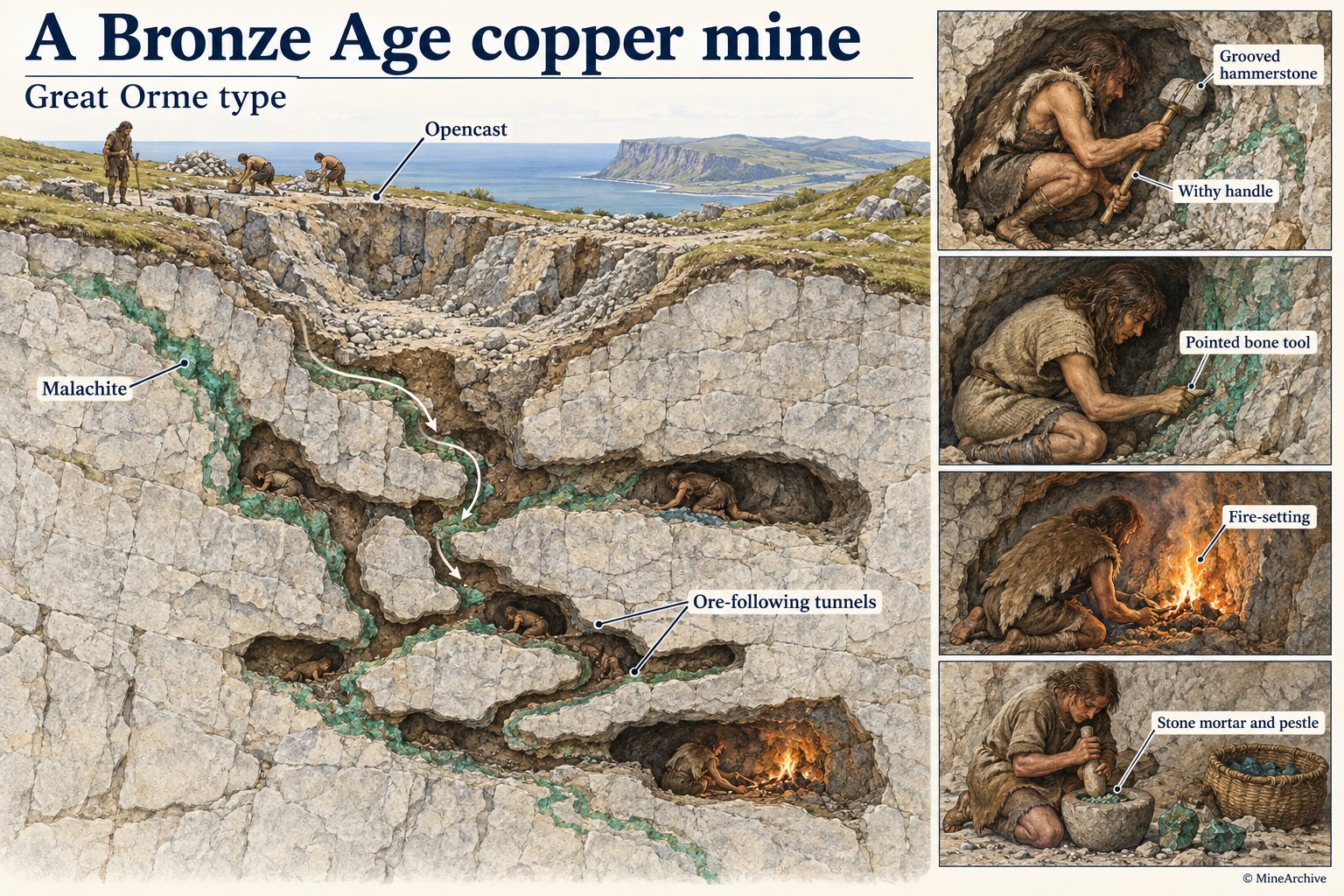
Copper mining began at Ross Island in County Kerry by about 2400 BC and in Britain a couple of centuries later, around 2200-2000 BC, at Parys Mountain on Anglesey and in mid Wales, in what looks like a wave of prospecting that may have come from Ireland. The Early Mines Research Group, formed in 1988, has since found twelve Early Bronze Age copper mines, nine of them in the Cambrian Mountains of mid Wales, among them Copa Hill at Cwmystwyth, worked from about 2100 to 1600 BC. England has few: Alderley Edge in Cheshire, where the main activity at Engine Vein falls around 1900-1700 BC, and Ecton in Staffordshire, with Bradda Head on the Isle of Man undated. All of these were small and had closed by about 1600 BC. The Great Orme was different. Worked for nearly a millennium, it had its boom between about 1600 and 1400 BC, when its metal accounts for virtually all the copper in British metalwork of that phase and reached from Brittany to Sweden; its miners left over 2,400 hammerstones and more than 30,000 pieces of bone, many of them tools, and moved at least 16,000 and perhaps 40,000 tonnes of rock. Tin, the other half of bronze, came from Cornwall, where the Early Mines Research Group has published the dating of an antler pick from the Carnon valley as new evidence of Bronze Age tin working. Flint was still mined in simple pits at Grime's Graves into the Bronze Age, until bronze metalwork eclipsed flint tools.
How it worked
The miners worked ore that weathering had already softened where they could: at the Great Orme, veins in dolomite whose chalcopyrite had largely turned to green malachite and brown goethite, soft enough to dig with bone tools. Harder rock was broken by fire-setting and pounded with hammerstones, rounded cobbles often with a groove pecked round them to take a withy handle, some of them very large; stone mortars and pestles crushed the ore. Workings began as opencasts and followed the ore underground through small tunnels and shafts, whose many openings also ventilated them. Wooden tools survive in places: an oak shovel from Alderley Edge dated to around 1780 BC, and a wooden pipe at Copa Hill. Charcoal, hammerstones and waste in the spoil tips are how most of these mines have been found and dated.
Why it was used
Copper alloyed with tin made bronze, which gradually replaced flint and stone for tools and weapons. At its peak the Great Orme may have produced one to four tonnes of copper a year, enough for some 2,200 to 8,900 palstave axes, and its metal was traded across north-west Europe.
Risks & limitations
The evidence is scarce and easily lost: many of these sites were reworked in the 19th century, which destroyed much of the earlier working, as at Alderley Edge, while Mount Gabriel in County Cork survives largely undisturbed only because its ore was too poor to tempt later miners. Dates rest on radiocarbon from charcoal, bone and wood, and estimates of output vary widely, from 232 to 830 tonnes of copper for the whole of the Great Orme's Bronze Age working. How the mines were run is debated: the Great Orme's size was once put down to a small seasonal workforce, but its peak output suggests a full-time mining community.
Regional variation
Ireland's mines, Ross Island and Mount Gabriel, are among the earliest; the Welsh mines, mostly small, cluster in the Cambrian Mountains and on Anglesey and the North Wales coast; England has Alderley Edge and Ecton, and the Isle of Man Bradda Head. Cornwall's part was tin rather than copper.
Related terminology
Copper, Fire-setting, Iron Age, Neolithic, Tin
Mines associated with this term
5 examples chosen from 14 linked records — the term page is not an index.
- Brynlow Mine — Cheshire (surviving physical example)
A Bronze Age surface pit lies directly above an 18th-century coffin level. - Engine Vein — Cheshire (surviving physical example)
The open scar at Engine Vein holds Bronze Age stone-hammer workings. - Great Orme Copper Mines — Conwy (surviving physical example)
Copper mined for around eight centuries with stone and bone tools; the largest prehistoric copper mine known. - Ecton Copper Mines — Staffordshire (well documented example)
One of only two known Bronze Age copper mines in England. - Cwmystwyth Mines — Ceredigion (well documented example)
Bronze Age copper working on Copa Hill, excavated by the Early Mines Research Group.
Sources
- (primary) Boom and bust in Bronze Age Britain: major copper production from the Great Orme mine and European trade, c. 1600-1400 BC — Antiquity (Cambridge University Press)
- (secondary) Early Mines Research Group — Early Mines Research Group
- (secondary) History of Grime's Graves — English Heritage
- (secondary) How Did Copper Mining Evolve in Bronze Age Britain? — AncientCraft
- (secondary) Mining archaeology in the British Isles — Wikipedia
Record created: 18 September 2026 · Last researched: 18 September 2026