 MineArchive
Neolithic
| Category | Periods |
|---|
The New Stone Age, in Britain from about 4000 to about 2300 BC, when farming and pottery arrived from the Continent, and the first period in which people in Britain dug mines. Flint was mined from shafts sunk into the chalk, and hard stone was quarried from mountainsides for polished axes that travelled the length of the British Isles.
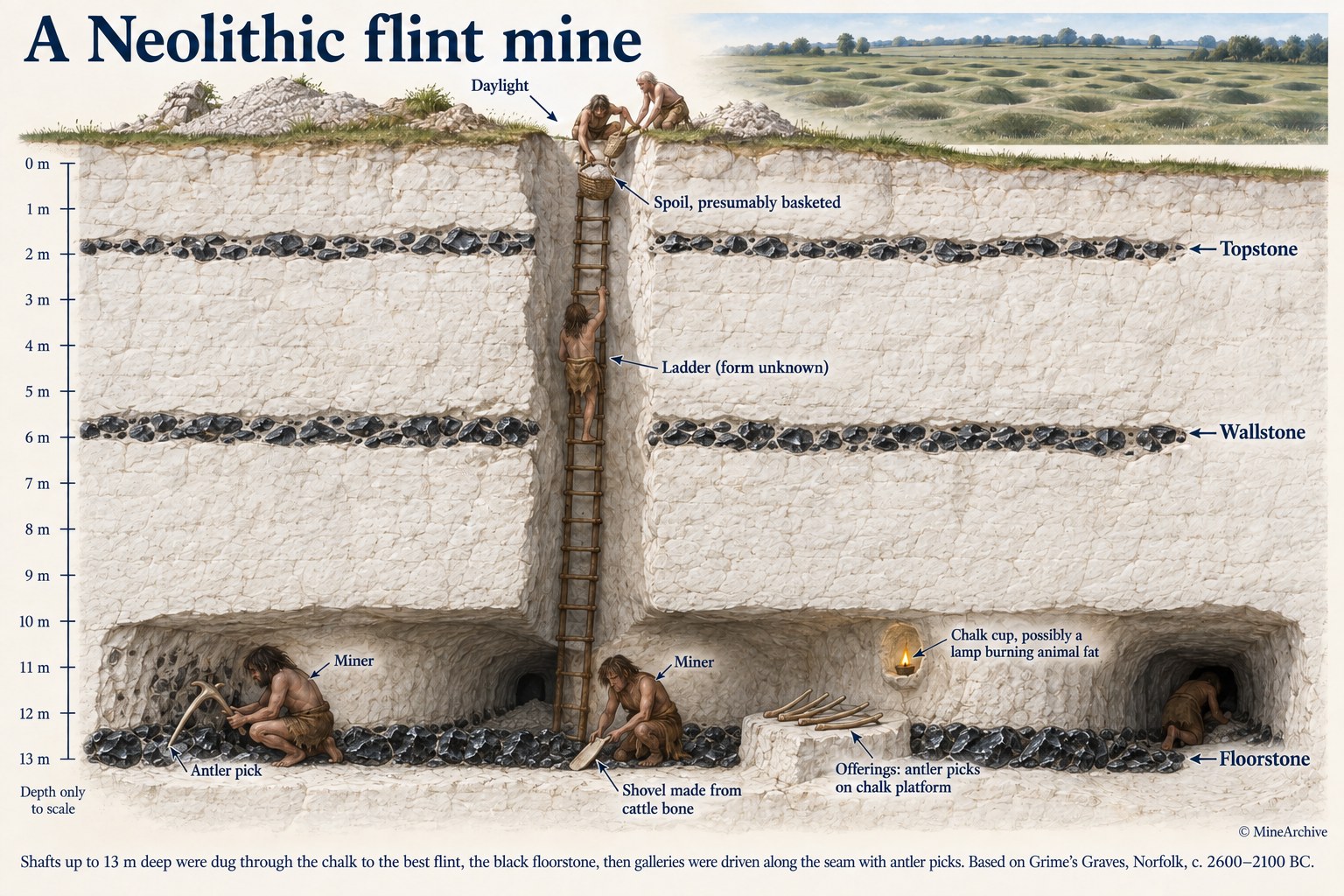
Historical usage
Flint had been the basic raw material for tools in these islands for hundreds of thousands of years, but it was gathered from surface deposits such as till, brickearth, clay-with-flints and beach cobbles; only in the Neolithic is there evidence for its systematic exploitation by mining. Stone was chosen with care before then: the volcanic tuff of Great Langdale was already being selected for tools at Maryport in the Final Palaeolithic and Mesolithic, long before its axe quarries opened. Mining began soon after the Neolithic reached Britain. The South Downs mines of Sussex, among them Cissbury and Harrow Hill, were worked from as early as 4000 BC until about 3600 BC, and a recent dating programme has shown that they predate the earthwork monuments of the chalk, so mining was not simply prompted by flint met while digging ditches. Grime's Graves in Norfolk, the largest known, was worked a thousand years later, from about 2600 BC, and mining carried on there until about 2100 BC, into the Bronze Age. A few flint mines have been investigated in Scotland, at the Den of Boddam, and in County Antrim, but only the Breckland and the South Downs saw working on an industrial scale. Alongside the flint mines, hard rock was quarried for axes: the Langdale tuff of Cumbria, worked from about 4000 to 3500 BC, accounts for around 27 per cent of all the Neolithic polished stone axes examined in the UK, and axe-working sites like Langdale's have been found at Penmaenmawr in North Wales, with Tievebulliagh in County Antrim among the other sources. The first flint mines were recognised for what they were only in 1868-70, when Canon William Greenwell dug a deep shaft at Grime's Graves and found galleries radiating from its base.
How it worked
At a flint mine the miners dug a roughly circular pit or shaft down through the chalk to a seam of flint. Where the flint lay shallow they widened or undercut the pit; in the deepest mines, up to 13 metres at Grime's Graves, they drove galleries out from the foot of the shaft along the best seam, the black 'floorstone', having dug through poorer seams, the topstone and wallstone, on the way down. They broke the chalk with picks made from red-deer antler and shifted it with shovels made from cattle bones, presumably hauling the spoil up in baskets. The deepest shafts would have needed ladders, and small chalk cups found in some mines may have been lamps burning animal fat. At the axe quarries the hard rock was broken from outcrops and scree, with hammerstones found among the debris, and roughed out into axe blanks on the spot: the Langdale screes are full of rough-outs and rejects.
Why it was used
Flint picked up at the surface is often flawed by weathering and rolling, while the floorstone dug from the chalk at Grime's Graves is glossy black and of excellent quality. Yet mining was in some ways unnecessary, since surface flint was widely used and could make large tools, and the act of mining may itself have given the flint special meaning. Carved chalk cups, balls and phalli, two antler picks and a greenstone axe laid around a wading bird's skull, Grooved Ware pots placed on chalk platforms and fires lit at shaft bottoms that were not used for cooking all suggest ritual bound up with the work.
Risks & limitations
Mining deep into chalk with bone and antler tools was dark, dangerous and labour-intensive, and shows a high level of organisation and technical skill. For the historian the limits are the evidence: the miners left no records, dating depends on modern radiocarbon programmes, and many early investigators took the hollows for dwellings until Greenwell's excavation proved them mines.
Regional variation
The deep, galleried flint mines belong to the English chalk, on the South Downs of Sussex and in the Breckland of Norfolk, and the two groups were worked a thousand years apart. Elsewhere Neolithic extraction was of hard stone for axes, in Cumbria, North Wales and County Antrim, where Rathlin Island's porcellanite was also worked, and of stone for monuments, as the Preseli bluestone quarries show.
Related terminology
Mines associated with this term
5 examples chosen from 6 linked records — the term page is not an index.
- Brockley Porcellanite Quarry — County Antrim (surviving physical example)
A Neolithic porcellanite quarry on Rathlin Island, from about 3800 BC. - Grime's Graves — Norfolk (surviving physical example)
Flint mined from shafts and galleries from about 2600 BC; the largest known Neolithic flint mine. - Tievebulliagh Axe Factory — County Antrim (surviving physical example)
A Neolithic porcellanite quarry and axe-making site, axes dated 3800-2500 BC. - Preseli Bluestone Quarries — Pembrokeshire (historical documentary reference)
Proposed as quarries where Neolithic people extracted stone pillars, radiocarbon dated to around 3000 BC. - Brandon Flint Mines — Suffolk (historical documentary reference)
Its own history begins with Neolithic axe-flint, some 6,000 years before the gunflint trade.
Sources
- (secondary) History of Grime's Graves — English Heritage
- (secondary) Langdale axe industry — Wikipedia
- (secondary) Neolithic Flint Mines (Introduction to Prehistory factsheet 7, Philippa Bradley, 2019) — The Prehistoric Society
Record created: 18 September 2026 · Last researched: 18 September 2026