 MineArchive
Grime's Graves
| Location | Weeting, near Thetford, Norfolk — 52.4739, 0.6772 (exact) |
|---|---|
| Commodity | Flint |
| Type | Mineral |
| Worked | c. 2600 BC–c. 2400 BC or c. 2100 BC |
| Maximum depth | Up to 13 m (English Heritage); more than 14 m in the largest shafts (Wikipedia) |
Overview
A Neolithic flint mining complex over 4,000 years old, the largest known prehistoric flint mine and the only one open to the public — its miners left antler picks, and even their fingerprints, still in place underground.
History
Grime's Graves was worked from about 2600 BC as a source of high-quality flint for making polished stone axes and other tools; English Heritage dates the end of Neolithic mining to about 2100 BC, Wikipedia to about 2300 BC and the Prehistoric Society to about 2400 BC. The flint was roughly shaped on site, and the blanks were possibly traded elsewhere for polishing: a medium-depth shaft could have yielded some 60 tons of flint, enough for as many as 10,000 axes, and the whole site perhaps 16,000 to 18,000 tonnes. The site takes its name from Anglo-Saxon settlers, who named the pitted landscape after the god Grim (a byname of Woden): English Heritage says they took it for his burial place, while Wikipedia reads the name as 'the masked one's quarries', suggesting they had some idea what the pits were. Antiquarian Canon William Greenwell excavated here in 1868-70, proving for the first time that deep-shaft mining had taken place anywhere in prehistoric Britain. Later excavation recovered antler picks used by the original miners, one of which preserved an intact human fingerprint, some 4,000 years after it was left: the miners coated their hands in wet clay to protect them, and on some picks the clay survives with their last user's fingerprints in it. Between 100 and 150 broken picks have been found in each excavated mine, and at least 28 mines and pits have been excavated since the 1850s, the most recent campaign in the 1970s. After a gap of about half a millennium, flint was briefly mined again in simple pits in the Bronze Age; from around 1400 BC the old shafts served a farming settlement as rubbish dumps, and between about 390 and 150 BC the site was a small burial ground.
Geology
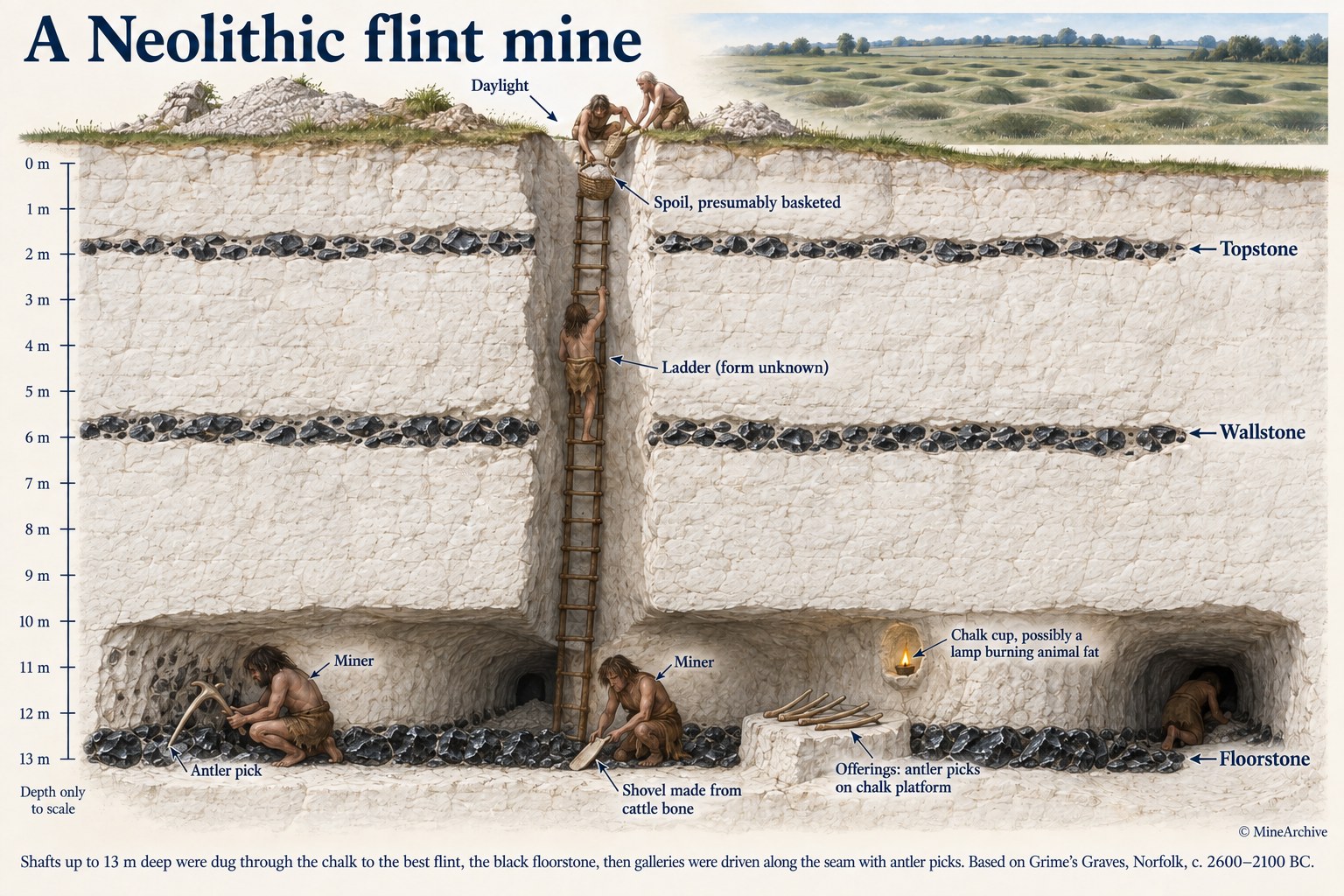
The mine exploits a distinctive band of high-quality flint nodules within the Cretaceous chalk of the Norfolk Breckland. The flint here formed some 90 million years ago, when the area lay under a warm sea. Three seams run through the chalk: an upper topstone and a middle wallstone, which the miners dug through, and the deep, glossy black floorstone they were after. The chalk shelves deepest in the south of the site, where the shafts had to go deepest.
Workings
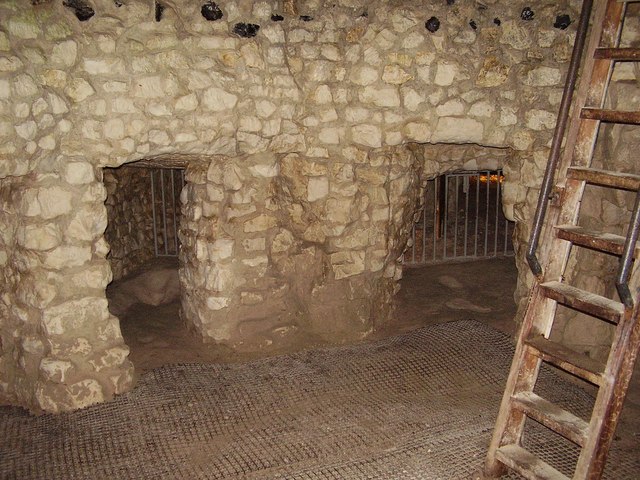
Miners sank at least 433 mines and pits down through sand, clay and chalk to reach the flint seam, then worked galleries outward from the shaft bottom to follow the seam — using red deer antlers as picks, and shovels of cattle bone by the Prehistoric Society's account, or of wood as Wikipedia infers from other mines. English Heritage puts the deepest shafts, in the south of the site, at up to 13 metres, and Wikipedia gives the largest as more than 14 metres deep and 12 metres across at the surface; in the north and west, pits of 3 to 6 metres were enough and have no galleries. The galleries are only two or three feet high. The mines were open to the sky and worked in daylight, the white chalk walls reflecting the light.
Closure
Neolithic mining ended by about 2100 BC in English Heritage's account, about 2300 BC in Wikipedia's and about 2400 BC in the Prehistoric Society's; the reasons are not recorded and can only be inferred archaeologically, though English Heritage links the end of flint mining to bronze metalwork displacing flint tools. Flint was briefly mined again in simple pits some five centuries later.
What remains
Grime's Graves is the only Neolithic flint mine in Britain open to the public, managed by English Heritage, with a shaft open for visitors to descend. Pit 1, excavated in 1914, is the long-standing public pit, and Greenwell's Pit, capped with concrete for many years, was opened on guided tours in April 2017. Since 2020 ground movement has opened a window from Greenwell's Pit into an unexcavated mine, where two antler picks lie where they were left. A chalk plaque cut with close-set lines was found in 2023, during work for a new building at the pit, before the site reopened in 2024. The heathland is a Site of Special Scientific Interest and part of the Breckland Special Area of Conservation.
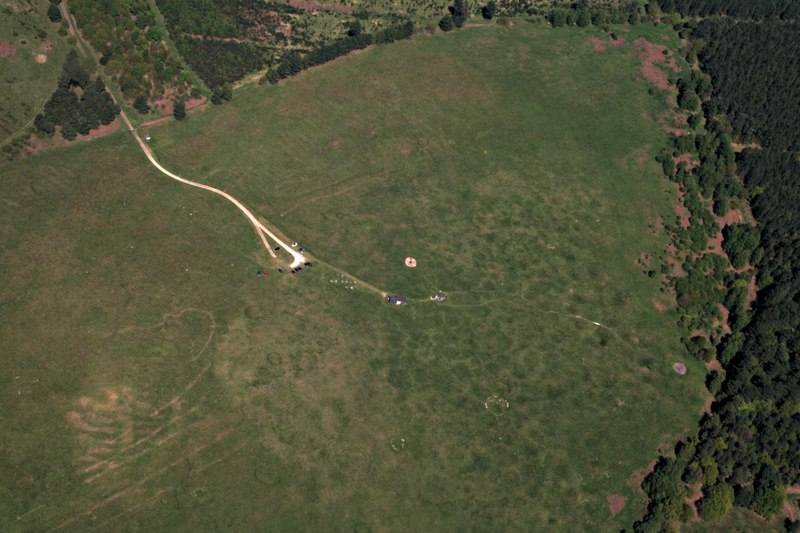
The dips and humps of 433 mines and pits cover nearly 8 hectares within a scheduled area of some 37 hectares, along with one excavated and preserved shaft open for public descent.
Related mines
- Brandon Flint Mines — Brandon's earliest flint-mining phase followed the same technique documented at Grime's Graves, and worked a continuation of the same Cretaceous chalk flint band.
- Cissbury Flint Mines — Both Neolithic flint mines worked with antler picks from shafts and radiating galleries.
Nearby mines
- Brandon Flint Mines — 3.1 miles (5.0 km) SW, Suffolk
Straight-line distance, within 9 miles (15 km). Show on the map.
People
- William Greenwell · excavator, 1868–1870 — Dug the deep shaft now called Greenwell's Pit, revealing the galleries and the miners' tools.
What's uncertain
Points where sources disagree or the record could not be settled; both accounts are kept. All open questions in the archive.
- Grime's Graves was mined from about 2600 BC until about 2100 BC. (disputed) 3
- Grime's Graves was worked between c. 2600 and c. 2300 BC. (disputed) 1
- The Grime's Graves mines operated during the later Neolithic, 2650-2400 BC. (disputed) 5
- The deepest shafts, in the south of the site, are up to 13 metres deep; in the north and west, pits of 3-6 metres were enough. (disputed) 5,3,6
- The largest shafts are more than 14 m deep and 12 m in diameter at the surface. (disputed) 1,2
- The miners used shovels made from cattle bones. (disputed) 5
- The miners probably used wooden shovels, inferred by analogy with other flint mines. (disputed) 1,2
- A medium-depth shaft could have yielded about 60 tons of flint, enough for up to 10,000 polished axes; the site may have produced 16,000-18,000 tonnes. (uncertain) 1,2
Recorded claims
Individual factual claims, each attached to the source(s) that support it below. Where sources disagree, both are kept.
- Canon William Greenwell's 1868-70 excavations first proved the existence of prehistoric deep-shaft mining anywhere in Britain. 1,2,3
- An antler pick recovered from the mine preserved an intact human fingerprint, left by a Neolithic miner some 4,000 years ago. 2,4
- Grime's Graves was mined from about 2600 BC until about 2100 BC. (disputed) 3
- Grime's Graves was worked between c. 2600 and c. 2300 BC. (disputed) 1
- The Grime's Graves mines operated during the later Neolithic, 2650-2400 BC. (disputed) 5
- At least 433 mines and pits have been recorded at Grime's Graves. 1,2,6
- The deepest shafts, in the south of the site, are up to 13 metres deep; in the north and west, pits of 3-6 metres were enough. (disputed) 5,3,6
- The largest shafts are more than 14 m deep and 12 m in diameter at the surface. (disputed) 1,2
- The miners used red deer antler picks, 100-150 broken picks being found in each excavated mine. 1,4
- The miners used shovels made from cattle bones. (disputed) 5
- The miners probably used wooden shovels, inferred by analogy with other flint mines. (disputed) 1,2
- A medium-depth shaft could have yielded about 60 tons of flint, enough for up to 10,000 polished axes; the site may have produced 16,000-18,000 tonnes. (uncertain) 1,2
- The Anglo-Saxons named the site after the god Grim, a byname of Woden. 1,7
- Flint mining briefly resumed in simple pits in the Bronze Age; from about 1400 BC the shafts were used as middens, and c. 390-150 BC the site was a burial ground. 3
- Since 2020 a window opened by ground movement in Greenwell's Pit shows two antler picks in an unexcavated mine; a chalk plaque cut with lines was found in 2023. 4,8
Photographs & further reading
English Heritage's account of the mine from the Neolithic to its excavation, with reconstructions of the miners at work.
View sourceThe official scheduling record for the flint mines and a nearby round barrow.
View sourceSources
- (secondary) Grime's Graves — Wikipedia
- (secondary) Grime's Graves: A Neolithic Flint Mine — Amusing Planet
- (secondary) History of Grime's Graves — English Heritage
- (secondary) Discoveries at Grime's Graves — English Heritage
- (secondary) Neolithic Flint Mines (Introduction to Prehistory factsheet 7, Philippa Bradley, 2019) — The Prehistoric Society
- (secondary) Description of Grime's Graves — English Heritage
- (secondary) Going Underground: Grime's Graves Neolithic Flint Mine Opens to the Public — English Heritage
- (observational) Grime's Graves Flint Mines (visitor logs and photographs, 2017-2025) — The Megalithic Portal
- (primary) Research on Grime's Graves — English Heritage
Record created: 21 August 2026 · Last researched: 18 September 2026