 MineArchive
Chalk
| Category | Commodities |
|---|---|
| Commodity page | Chalk → |
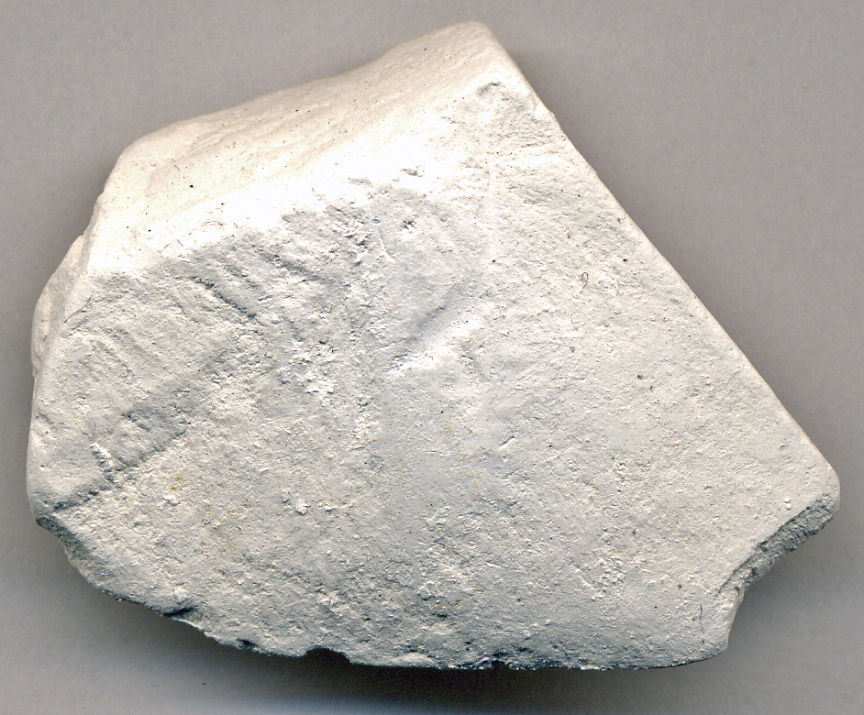
A soft, fine-grained, almost pure white limestone formed from the compacted skeletal remains of microscopic marine algae, worked across southern and eastern England both as a locally hard building stone and, far more commonly, dug and spread on fields as marl.
Historical usage
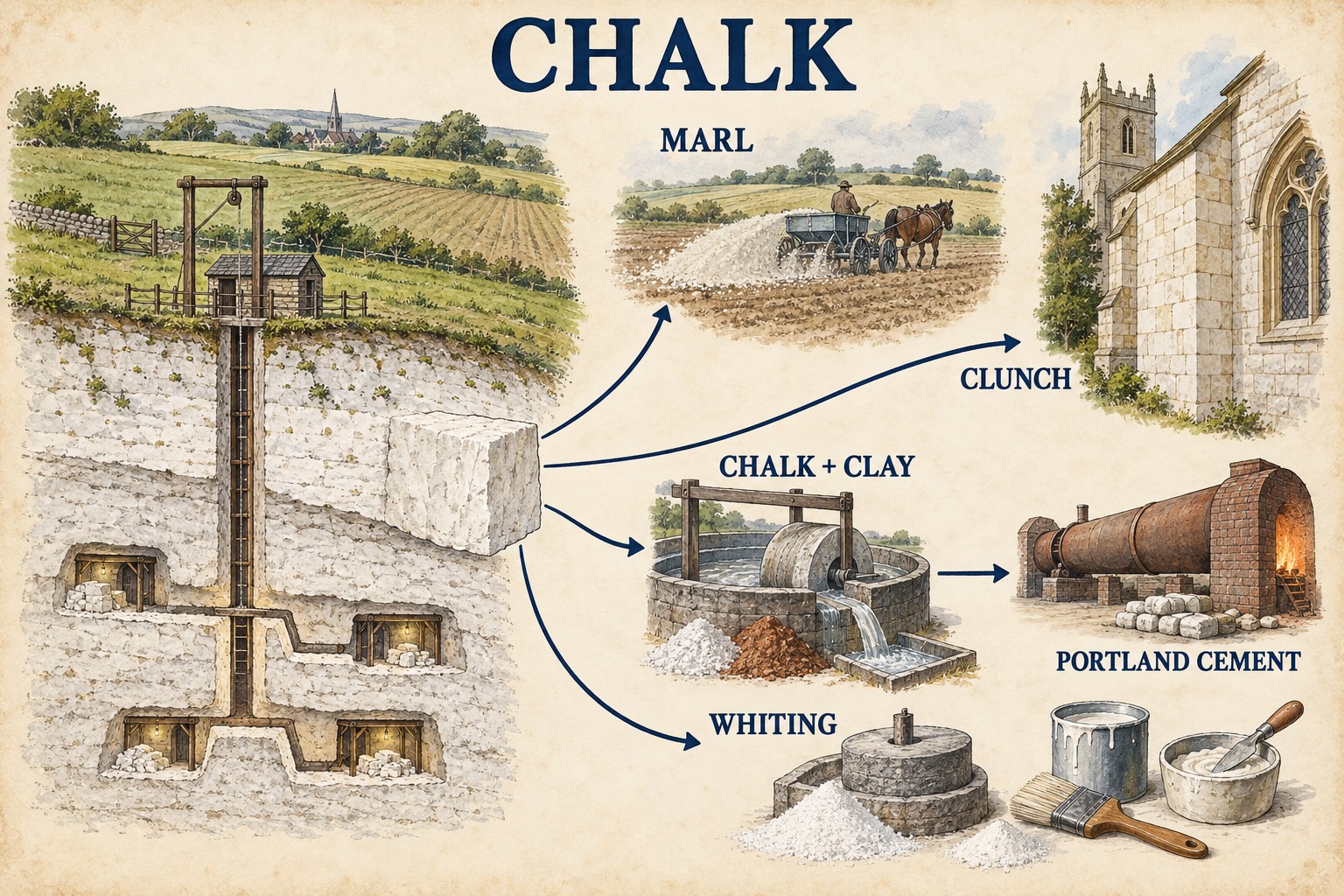
Chalk underlies much of southern and eastern England, from the White Cliffs of Dover to the Chiltern and Wessex downs, and has been dug for at least two purposes since ancient times: as marl, chalk rich in lime and trace minerals spread on fields to improve heavy clay soil, worked from narrow shafts and chambers such as the deneholes of Hangman's Wood; and as a hard, workable local variety known as clunch, quarried and mined — most notably at Totternhoe in Bedfordshire — for buildings ranging from parish churches to Westminster Abbey and Windsor Castle. Chalk found an entirely new industrial role in the 19th century: William Aspdin's 1842 refinement of his father Joseph's 1824 cement patent used a wet-process mix of soft Thames-side chalk and Medway clay to produce what became the standardised recipe for Portland cement, giving rise to a dense cluster of cement works along the Thames and Medway estuaries that dominated British cement production for the rest of the century. Powdered chalk, sold as whiting, became a related industrial product in its own right, used in paint, putty, polish and paper.
How it worked
Where chalk was quarried as clunch for building stone, blocks were cut and dressed much like any other freestone; where it was dug as marl or raw material for cement, it was extracted more roughly from open pits or, in districts like the Thames Estuary and Essex, from narrow shafts sunk down to the chalk with chambers excavated at the base — a method that deliberately minimised the loss of productive farmland at the surface. For cement manufacture, soft chalk was mixed wet with clay in a washmill, a technique borrowed directly from ceramics, before firing.
Why it was used
Chalk's chemical purity as calcium carbonate, combined with how easily it broke down when mixed with water, made it valuable for two very different reasons across its history: spread on land, its lime content corrected acidic clay soils that would otherwise have been poor for arable farming, while mixed wet with clay it became the essential raw material of Portland cement, the artificial stone that rebuilt industrial Britain.
Value over time
For most of its history chalk was a low-value bulk material, worth digging only because marl was cheap to spread and clunch was cheap to quarry close to where it was needed — nothing like the high-value metal ores elsewhere on this site. That changed dramatically after 1842, when chalk became the key raw material of Portland cement: demand grew so fast that the Thames and Medway estuaries filled with competing cement works through the second half of the 19th century, giving ordinary chalk an entirely new industrial value it had never had as marl or building stone. Chalk's older use as agricultural marl declined steeply over the same period, as manufactured fertilisers offered a cheaper, more consistent alternative, while whiting — powdered chalk sold for paint, polish and paper — remained a smaller but genuine related trade into the 20th century.
Hazards & challenges
Chalk contains only around 2% silica, far less than sandstone or granite, so the classic dust disease of hard-rock mining, silicosis, was never a major hazard of chalk working in the way it was for tin, granite or coal. The real danger was structural: chalk is a soft rock, easily dissolved and weakened by groundwater over time, and unmarked or poorly supported denehole shafts and chambers historically posed a genuine risk of sudden collapse to unwary miners, passers-by, livestock and children alike, a hazard well understood by medieval diggers themselves, who kept individual chambers deliberately small to reduce the risk.
Risks & limitations
Because chalk shafts and chambers were dug into a soft, naturally weak rock prone to being eaten away by percolating groundwater, structural collapse was — and remains — a genuine hazard: many deneholes and chalk mines were only ever safe because medieval and later diggers deliberately kept individual chambers small, and unexpected chalk-mine collapses still occasionally open up beneath modern streets and gardens, as at Gillingham, Kent, in 2014 and St Albans in 2018.
Regional variation
The chalk downlands of southern and eastern England — Kent, the Chilterns, Wessex, Lincolnshire and East Anglia — are the only significant British source; Totternhoe in Bedfordshire and Hangman's Wood in Essex represent its two very different traditional uses, clunch building stone and marl, while the Thames and Medway estuaries became the heartland of the 19th-century chalk-based cement industry.
Related terminology
Mines associated with this term
5 examples chosen from 25 linked records — the term page is not an index.
- Barrington Chalk Pit — Cambridgeshire (well documented example)
Named 5 times in this record, first in the summary: “A vast Cambridgeshire chalk quarry that fed a cement works born out of one of the 20th century's…” - Chislehurst Caves — Kent (well documented example)
Twenty-two miles of chalk and flint workings under a Kent suburb, misnamed caves and credited to Druids on the strength of one Edwardian theory. - Eastern Quarry — Kent (well documented example)
Named 11 times in this record, first in the summary: “A vast chalk quarry between Swanscombe and Greenhithe, opened by the Swanscombe…” - Kensworth Chalk Pit — Bedfordshire (well documented example)
Named 12 times in this record, first in the summary: “The largest working chalk quarry in the United Kingdom, opened in 1964 on the Bedfordshire…” - Magheramorne Quarry — County Antrim (well documented example)
Named 10 times in this record, first in the summary: “A vast chalk quarry on the western shore of Larne Lough, worked for lime from the…”
See every mine that worked chalk →
Sources
- (secondary) Cement Plants: Chalk Raw Materials — Cement Plants and Kilns in Britain and Ireland
- (secondary) Chalk Mining and Associated Industries of Frindsbury — Kent Archaeological Society
- (secondary) Medieval chalk mine possible cause of ground collapse in Bexleyheath — Ground Engineering
- (secondary) William Aspdin — Wikipedia
Record created: 22 August 2026 · Last researched: 22 August 2026