 MineArchive
Barrington Chalk Pit
| Location | Barrington, Cambridgeshire — 52.1420, 0.0330 (exact) |
|---|---|
| Commodity | Chalk |
| Type | Quarry |
| Worked | 1914–10 November 2008 |
| Operators | Eastwoods Cement Ltd (1924–1962) |
Overview
A vast Cambridgeshire chalk quarry that fed a cement works born out of one of the 20th century's most notorious banking frauds, and which went on to produce nearly 20 million tonnes of cement before closing in 2008.
History
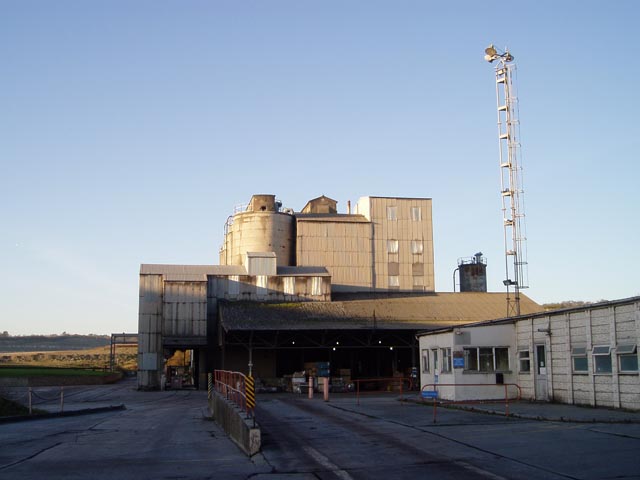
The site's cement-making history began badly: the Dreadnought Portland Cement Company, floated in 1914 by the corrupt Farrow's Bank, acquired Hill Farm at Barrington and began building works that stalled almost immediately — by the war's end almost nothing had been completed. Farrow's Bank had disguised years of losses by wildly inflating the value of its assets, and Dreadnought, in which barely £40,000 had actually been invested, was carried on the bank's books at £780,000 by 1920. When the bank collapsed, Dreadnought was compulsorily wound up in March 1921, and its unfinished 150 acres of mineral land, power house and partial rail spur to Foxton station went unsold at auction in November 1922.
Eastwoods Ltd bought the site for just £6,000 in 1924 and floated Eastwoods Cement Ltd the following year; construction finally got moving with Vickers-supplied plant, and the works' first kiln began production in July 1927 — thirteen years after Dreadnought's original launch. A second kiln followed in 1931, working chalk and clay from Chapel Hill by the wet process, with the Barrington Light Railway (opened 1927) carrying coal in and cement out to the main line at Foxton. The works expanded steadily: a third kiln around 1956, and in 1962 Eastwoods was absorbed into the Rugby Portland Cement Company, which built a fourth, much larger Danish-supplied kiln in 1964. Ownership passed on to the Rugby Group, then RMC, then Cemex in 2005. Kiln A4, the last still running, finally shut down on 10 November 2008, having produced around 19.7 million tonnes of clinker since 1927.
The exhausted quarry — the only remaining complete exposure of the Cambridge Greensand and Lower Chalk in the area — is now a Site of Special Scientific Interest, and since 2021 has also received spoil transported by rail from HS2 construction sites.
Geology
Worked the Cambridge Greensand and the overlying Lower Chalk of the Cretaceous, exposed at Chapel Hill; the pit is now the only remaining complete exposure of this sequence in the area, valued for its diverse fossil vertebrate and invertebrate fauna.
Workings
A large open quarry supplying chalk and clay to an adjoining cement works via a wet-process production line, connected to the national rail network from 1927 by the Barrington Light Railway.
Closure
The last kiln closed on 10 November 2008, after producing around 19.7 million tonnes of clinker since 1927; the works were later demolished and the quarry began receiving landfill and, from 2021, HS2 spoil.
What remains
The former quarry is registered as a Site of Special Scientific Interest and Geological Conservation Review site; parts remain a closed working quarry, other areas have been infilled and returned to fields with footpaths, and since 2021 the site has also received spoil transported by rail from HS2 construction.
Little of the cement works itself survives following demolition; the exhausted quarry, now an SSSI, is the site's principal surviving feature.
Nearby mines
- Cherry Hinton Pit — 6.3 miles (10.1 km) NE
Straight-line distance, within 9 miles (15 km). Show on the map.
Recorded claims
Individual factual claims, each attached to the source(s) that support it below. Where sources disagree, both are kept.
- The Dreadnought Portland Cement Company was floated in 1914 by Farrow's Bank, which fraudulently inflated its unfinished, barely-funded works to a book value of £780,000 before the bank's 1920 collapse forced Dreadnought's winding-up in 1921. 1
- Eastwoods Ltd bought the site for £6,000 in 1924, brought the first kiln into production in July 1927, and the works passed through Rugby Portland Cement (1962), the Rugby Group, RMC and finally Cemex (2005). 1
- The last kiln closed on 10 November 2008 after producing around 19.7 million tonnes of clinker since 1927; the exhausted quarry is now an SSSI and, since 2021, has received HS2 construction spoil. 1,2
- Located at about 52.142 N, 0.033 E. 2
Sources
- (secondary) Barrington — Cement Kilns (Peter O'Reilly)
- (secondary) Barrington Chalk Pit — Wikipedia
Record created: 27 August 2026 · Last researched: 27 August 2026