 MineArchive
Kensworth Chalk Pit
| Also known as | Kensworth Quarry |
|---|---|
| Location | Kensworth, near Dunstable, on the Bedfordshire Chilterns, Bedfordshire — 51.8660, -0.5170 (exact) |
| Commodity | Chalk |
| Type | Quarry |
| Worked | 1964–Still active |
| Maximum depth | Surface quarrying; no depth figure applies. |
| Operators | Cemex UK Operations Ltd |
Overview
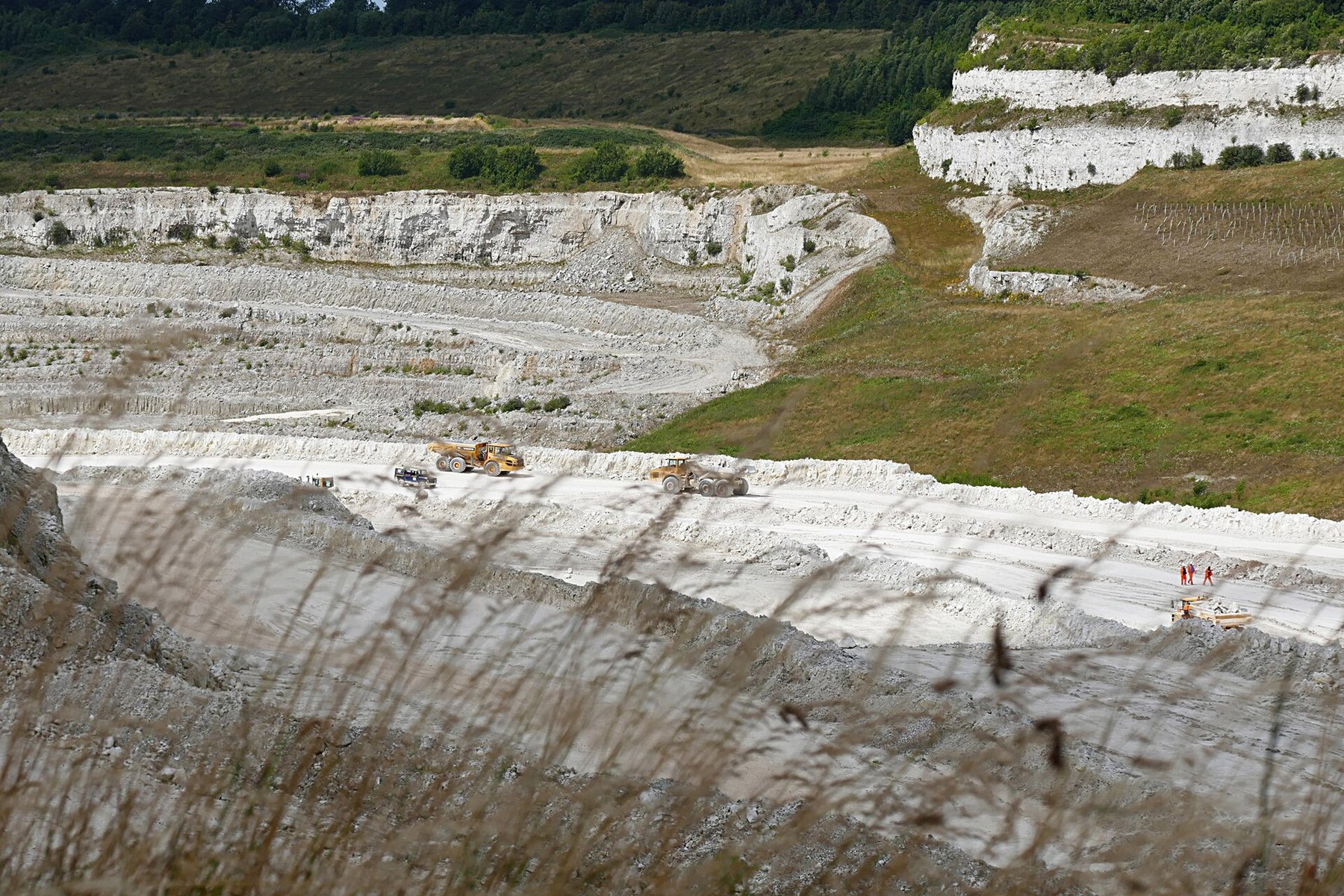
The largest working chalk quarry in the United Kingdom, opened in 1964 on the Bedfordshire Chilterns, whose output never travels by road: the chalk is mixed with water to a slurry and pumped 92 kilometres underground to a cement works at Rugby, passing beneath the M1 four times on the way. It is also a Site of Special Scientific Interest, and the stratotype for the Kensworth Nodular Chalk Member.
History
The quarry opened in 1964 to feed the cement works at Rugby, which had been making blue lias lime since as early as 1855. Before 1965 the works had taken grey chalk by rail from Totternhoe, a few miles away in the same county. In 1965 a 92-kilometre pipeline was opened instead, carrying chalk from Kensworth as a slurry — 62 per cent chalk to 38 per cent water — to be combined at Rugby with Warwickshire blue lias stone in the raw mix for cement. It was installed in 1965 and is still running.
The quarry passed with the Rugby business into the CEMEX group. Around 8,000 tonnes of chalk a day leave the site as slurry, roughly 4,000 cubic metres pumped along the 57-mile line, which is reckoned to save up to 400 lorry movements a day. The site was notified as a Site of Special Scientific Interest in 1988.
Geology
The quarry exposes fossiliferous chalk of the late Cretaceous over 131.3 hectares, with many rare fossils including ammonites. Natural England calls it 'an unrivalled locality for stratigraphic studies in the Upper Cretaceous'; it is a Geological Conservation Review site, and one succession of layers within it is the stratotype — the defining reference section — for the Kensworth Nodular Chalk Member.
Geological setting: Sedimentary Beds and Seams (well documented example)
Workings
A large open chalk quarry with no rail or road despatch of its product at all. The chalk is worked, crushed and mixed with water into a slurry, then pumped through a 92.2-kilometre underground pipeline to the cement plant at Rugby in Warwickshire — the whole point of the arrangement being to move eight thousand tonnes a day without lorries. The pipeline passes under the M1 four times.
Closure
Still working, and the largest active chalk quarry in the United Kingdom. The slurry pipeline installed in 1965 remains in use.
What remains
A large working quarry of 131.3 hectares, notified as a geological SSSI in 1988 and a Geological Conservation Review site. There is no public access. Field trips have been arranged for geological societies by permission.
Not applicable — the quarry is in production.
Nearby mines
- Totternhoe Stone Mines — 4.5 miles (7.3 km) NW
- Pitstone Chalk Quarry and Cement Works — 5.5 miles (8.9 km) SW, Buckinghamshire
- Leighton Buzzard Sand Quarries — 7.4 miles (11.8 km) NW
- Double Arches Pit — 8.0 miles (12.9 km) NW
Straight-line distance, within 9 miles (15 km). Show on the map.
Recorded claims
Individual factual claims, each attached to the source(s) that support it below. Where sources disagree, both are kept.
- The quarry opened in 1964 and is the largest active chalk quarry in the United Kingdom. 1
- A 92-kilometre pipeline opened in 1965 carries the chalk as a slurry of about 62 per cent chalk to 38 per cent water from Kensworth to the cement works at Rugby, and is still in use. 1,2
- Before 1965 the Rugby works took grey chalk by rail from Totternhoe in Bedfordshire. 2
- About 8,000 tonnes of chalk a day are transferred as slurry along the pipeline, some 4,000 cubic metres, passing under the M1 four times and saving up to 400 lorry movements a day. 1
- The 131.3-hectare site was notified as a geological Site of Special Scientific Interest in 1988 and is a Geological Conservation Review site; Natural England describes it as 'an unrivalled locality for stratigraphic studies in the Upper Cretaceous'. 3
- One succession of layers in the quarry is the stratotype for the Kensworth Nodular Chalk Member. 3
- The quarry exposes fossiliferous late Cretaceous chalk with many rare fossils, ammonites among them. 3
Photographs & further reading
A local geological society's account of chalk working in the county, with a description of Kensworth's unusual pipeline method and a photograph taken inside the working quarry.
View sourceThe history of the works this quarry feeds, including the 1965 opening of the slurry pipeline that replaced rail-borne chalk from Totternhoe.
View sourceSources
- (secondary) Livelihoods from Chalk in the Bedfordshire Chilterns — Bedfordshire Geology Group
- (secondary) Rugby (Cement Plants and Kilns in Britain and Ireland) — Cement Plants and Kilns in Britain and Ireland
- (secondary) Kensworth Chalk Pit — Wikipedia
Record created: 3 September 2026 · Last researched: 3 September 2026