 MineArchive
Pitstone Chalk Quarry and Cement Works
| Location | Pitstone, near Tring, Buckinghamshire — 51.8330, -0.6350 (approximate) |
|---|---|
| Commodities | Chalk, Limestone |
| Type | Mineral |
| Worked | 1937–1991 |
| Operators | Tunnel Portland Cement Company Ltd (1937–1968), Castle Cement Ltd (1986–1991) |
Overview
Three vast chalk quarries under the Chiltern escarpment and the cement works they fed — the last cement plant built in the Chilterns and, for a time, the largest in Britain. It closed in 1991, and the biggest of its worked-out pits is now a nature reserve.
History
The land was first earmarked for cement in 1927 by a speculative company that failed to raise the money; the works were built a decade later, in 1937, on ground from the broken-up Bridgewater and Pendley Manor estates, as Tunnel Portland Cement's first purpose-built plant. The first cement went out in November 1937 to Marley Tiles at Leighton Buzzard, a few miles away. The works grew about five times over, passing to Tunnel Cement in 1968 and to Castle Cement in 1986, and produced ordinary clinker alongside two specialities — sulfate-resisting cement from 1954 and white cement from 1957 to 1972. Across five kilns it made something like 22.7 million tonnes of clinker, eighteenth of any British plant. It closed in December 1991.
Geology
The Chiltern escarpment supplied both halves of the recipe from almost the same ground: soft Chalk Marl, which carries the clay a cement kiln needs, and higher-grade Grey and Middle Chalk for the lime. That combination is why the plant was put here rather than nearer its market.
Geological setting: Sedimentary Beds and Seams (well documented example)
Workings
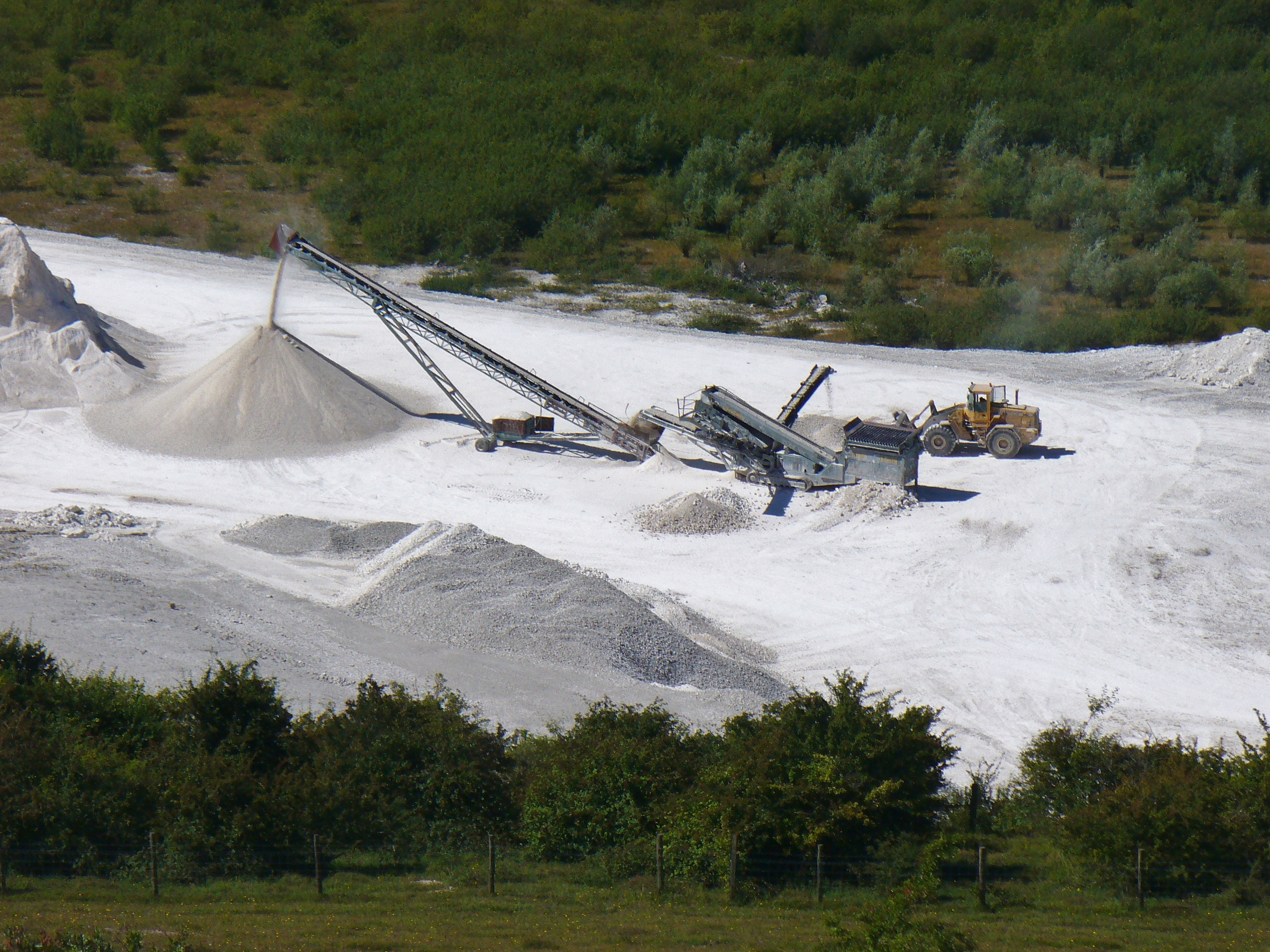
Three quarries in succession. From 1937 to 1969 Grey Chalk and Chalk Marl came from a quarry near Marsworth, carried to the works by rail and mixed in a washmill; from 1969 a closer Marsworth pit replaced it, worked by bucket-wheel excavator and delivered by conveyor. From 1953 a third quarry at Aldbury, over the county boundary in Hertfordshire, supplied Middle and Grey Chalk, washed on site and pumped to the plant as slurry.
Closure
Production stopped in 1991 in an industry-wide downturn, and the plant was cleared rather than mothballed.
What remains
The works site is an industrial estate, with part of the surviving structure converted to offices and listed. The earliest marl quarries have gone back to farmland and housing; the later pits stand partly flooded. The largest of them, once Pitstone Quarry 3, is now College Lake, a 67-hectare nature reserve with a chalk-cutting machine left in place as an exhibit.
Flooded quarry faces, a listed converted works building on an industrial estate, and the College Lake reserve in the largest pit.
Nearby mines
- Totternhoe Stone Mines — 4.6 miles (7.4 km) N, Bedfordshire
- Kensworth Chalk Pit — 5.5 miles (8.9 km) NE, Bedfordshire
- Leighton Buzzard Sand Quarries — 6.8 miles (10.9 km) N, Bedfordshire
- Double Arches Pit — 8.3 miles (13.3 km) N, Bedfordshire
Straight-line distance, within 9 miles (15 km). Show on the map.
What's uncertain
Points where sources disagree or the record could not be settled; both accounts are kept. All open questions in the archive.
- The works site is now an industrial estate, with the surviving building converted to offices and listed. (uncertain) 1,2
Recorded claims
Individual factual claims, each attached to the source(s) that support it below. Where sources disagree, both are kept.
- The site was first earmarked for cement production in 1927 by a speculative company that failed to raise the funding; construction began in 1937 on land from the dissolved Bridgewater and Pendley Manor estates. 1
- Grey Chalk and Chalk Marl came from a Marsworth quarry by rail from 1937, from a closer Marsworth pit by bucket-wheel excavator and conveyor from 1969, and Middle and Grey Chalk from an Aldbury quarry in Hertfordshire from 1953. 1
- Five kilns produced around 22.7 million tonnes of clinker over the works’ life, eighteenth among British plants, including sulfate-resisting cement from 1954 and white cement from 1957 to 1972. 1
- The works site is now an industrial estate, with the surviving building converted to offices and listed. (uncertain) 1,2
Photographs & further reading
Plant-by-plant technical history of the works, its kilns and its quarries.
View sourceSources
- (secondary) Pitstone — Cement Plants and Kilns in Britain and Ireland — Cement Kilns
- (secondary) Pitstone — Buckinghamshire Heritage Portal — Buckinghamshire Council
Record created: 25 August 2026 · Last researched: 25 August 2026